Child Health Nursing
High-Risk Newborn and Neonatal Care
Preterm and low-birth-weight babies, post-term babies, neonatal resuscitation, neonatal jaundice, birth asphyxia, respiratory distress syndrome, neonatal sepsis and neonatal intensive care.
Open quizzes and study tools Download PDF
CHAPTER 04 / CHILD HEALTH NURSING 04. High-Risk Newborn and Neonatal Care
1. Definitions and risk assessment
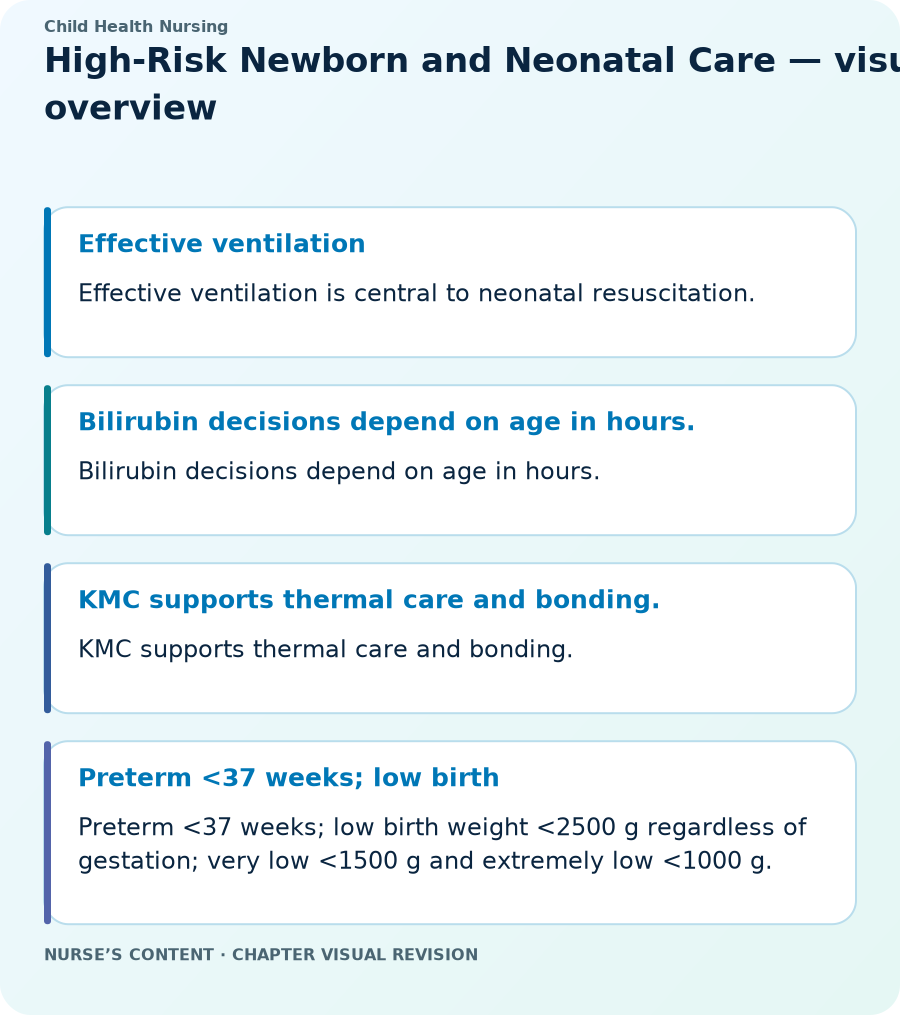
Preterm <37 weeks; low birth weight <2500 g regardless of gestation; very low <1500 g and extremely low <1000 g. Post-term ≥42 weeks. Small for gestational age is below expected weight for gestation, usually <10th percentile. Risk factors include maternal illness, prematurity, infection, difficult birth and congenital anomalies.
Prematurity and LBW
Definition and pathophysiology: Immature lungs, thermoregulation, glucose control, feeding and immunity increase risk.
Clinical features and investigations: Apnoea, temperature instability, poor suck, hypoglycaemia, infection; monitor weight, glucose and oxygenation.
Management and nursing care: Kangaroo mother care as soon as appropriate with support, breast milk/alternative feeding per plan, thermal care, respiratory support and infection prevention; specialist follow-up including retinopathy and hearing screening.
Post-term newborn
Definition and pathophysiology: Placental insufficiency or meconium exposure may occur.
Clinical features and investigations: Dry peeling skin, possible hypoglycaemia, respiratory distress or birth trauma.
Management and nursing care: Assess breathing, glucose, feeding and complications; neonatal review for abnormalities.
Birth asphyxia and resuscitation
Definition and pathophysiology: Failure to establish adequate gas exchange at birth may cause hypoxic-ischaemic injury.
Clinical features and investigations: Apnoea/gasping, low HR, poor tone; assess breathing and heart rate.
Management and nursing care: Warm, position airway, dry/stimulate as appropriate; start effective positive-pressure ventilation promptly for apnoea/gasping or HR <100/min after initial steps. Correct ventilation; if HR remains <60 after 30 seconds of effective ventilation, trained team starts coordinated 3:1 compressions and ventilation per neonatal algorithm. Monitor temperature and neurological status; therapeutic hypothermia only under specialist eligibility/protocol.
Neonatal jaundice
Definition and pathophysiology: Bilirubin accumulation; physiological jaundice typically begins after first 24 h; haemolysis, prematurity, infection and cholestasis can be pathological.
Clinical features and investigations: Yellow skin/sclera; use transcutaneous/serum bilirubin and age in hours, gestation and risk-specific threshold. Pale stool/dark urine or early jaundice is concerning.
Management and nursing care: Support feeding, phototherapy as prescribed using adequate irradiance, eye protection per device, temperature and hydration monitoring; exchange transfusion in selected severe cases. Sunlight is not a substitute.
Respiratory distress syndrome
Definition and pathophysiology: Surfactant deficiency in preterm lungs causes alveolar collapse.
Clinical features and investigations: Tachypnoea, grunting, retractions, hypoxaemia; CXR/clinical evaluation.
Management and nursing care: CPAP or other respiratory support, oxygen titration to neonatal targets, surfactant when indicated and thermal/feeding support. Avoid uncontrolled oxygen.
Neonatal sepsis
Definition and pathophysiology: Systemic infection early or late after birth.
Clinical features and investigations: Poor feeding, lethargy, temperature instability, apnoea, respiratory distress or poor perfusion; blood culture and other tests.
Management and nursing care: Urgent neonatal assessment, prescribed empiric antibiotics and support, infection prevention and monitor organ function. Do not dismiss nonspecific symptoms.
2. NICU nursing care
Use appropriate incubator/warmer, cardiorespiratory and saturation monitoring, accurate small-volume fluids and medicines, hand hygiene and safe vascular access. Minimize painful procedures, use neonatal pain tools, support parents and milk expression, developmental positioning and sleep. Monitor for NEC (distension, bloody stool, feeding intolerance) and urgent referral.
3. Important Examination Questions
Long Answer Questions
- 1. Describe care of preterm/LBW newborn and neonatal resuscitation.
Short Answer Questions
- 1. Explain jaundice and phototherapy
- 2. describe RDS
- 3. list neonatal sepsis signs.
Very Short Answer Questions (with answers)
- 1. What is LBW? — Birth weight <2500 g.
- 2. What is neonatal CPR ratio? — 3:1 in indicated newborn resuscitation.
4. Quick Revision
- • Effective ventilation is central to neonatal resuscitation.
- • Bilirubin decisions depend on age in hours.
- • KMC supports thermal care and bonding.
5. Conclusion
Effective ventilation is central to neonatal resuscitation. Bilirubin decisions depend on age in hours. KMC supports thermal care and bonding.
Chapter reference images