Child Health Nursing
Newborn Care and Assessment
Characteristics of a normal newborn, immediate newborn care, APGAR scoring, newborn reflexes, physical assessment, thermoregulation, cord care, eye care and essential newborn care.
Open quizzes and study tools Download PDF
CHAPTER 03 / CHILD HEALTH NURSING 03. Newborn Care and Assessment
1. Normal newborn characteristics
Neonatal period is birth through first 28 completed days; term birth is 37+0 to 41+6 weeks. Typical term birth weight approximately 2.5–4 kg; variations reflect gestation and growth. Normal quiet newborn respiratory rate about 30–60/min, heart rate often 100–160/min, axillary temperature 36.5–37.5°C. Assess in context, using neonatal ranges and trends.
2. Essential immediate care
Prepare warm area and resuscitation equipment; dry thoroughly, assess breathing, support skin-to-skin and thermal care, delay cord clamping when appropriate (often at least 60 seconds if stable), and initiate breastfeeding within one hour if possible. No routine suction of a vigorous newborn. Identify with approved bands, give vitamin K and birth vaccines per protocol, examine and document. A newborn who is apnoeic/gasping needs immediate neonatal resuscitation, not waiting for Apgar.
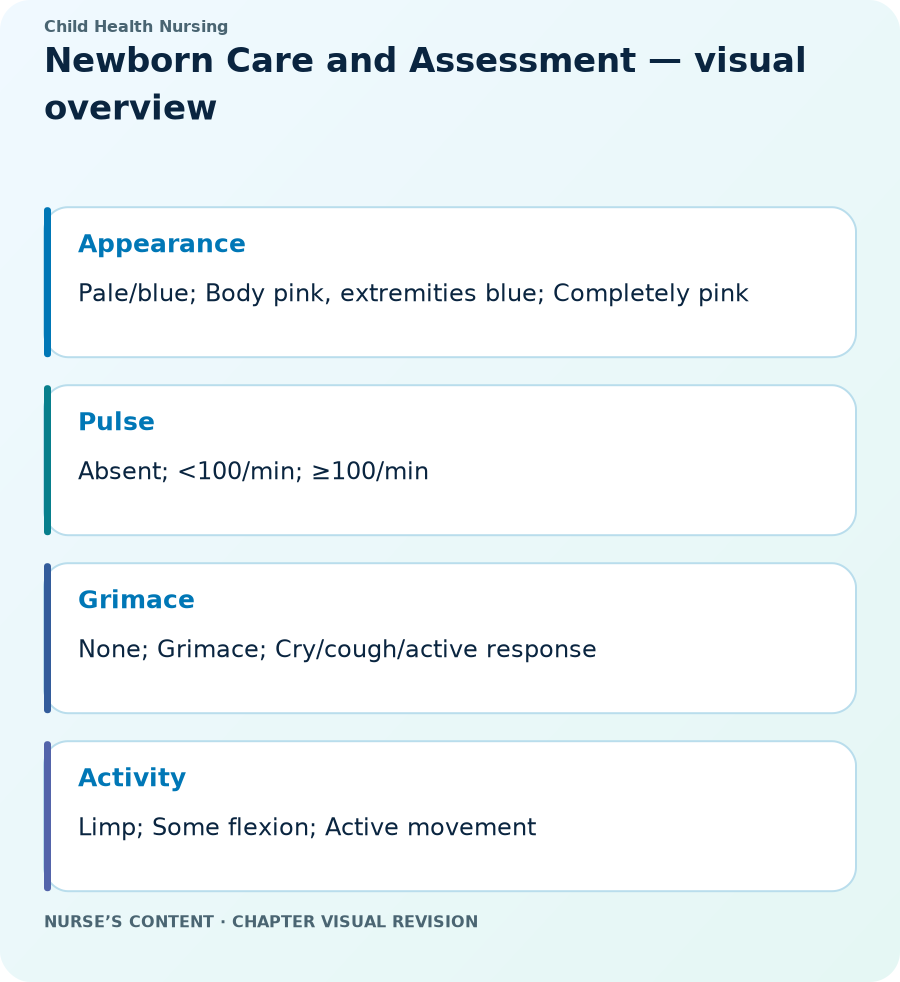
3. Apgar scoring at 1 and 5 minutes
| Sign | 0 | 1 | 2 |
|---|---|---|---|
| Appearance | Pale/blue | Body pink, extremities blue | Completely pink |
| Pulse | Absent | <100/min | ≥100/min |
| Grimace | None | Grimace | Cry/cough/active response |
| Activity | Limp | Some flexion | Active movement |
| Respiration | Absent | Slow/irregular | Good breathing/cry |
Score 0–10; repeat at 5-min intervals up to 20 min when 5-min score <7 according to protocol. Colour assessment has limitations across skin tones. Apgar describes status and response, not a standalone diagnosis of asphyxia or guide to delay resuscitation.
4. Newborn reflexes and examination
Rooting (turn toward cheek stimulation), sucking, Moro (symmetrical startle), palmar/plantar grasp, stepping and asymmetric tonic neck are primitive reflexes. Assess fontanelles, red reflex per trained examiner, palate, chest, heart, abdomen, genitalia, anus, hips, spine and limbs. Note respiratory distress, central cyanosis, absent movement, abnormal tone, jaundice in first 24 h, poor feeding or temperature instability.
5. Thermal, cord and eye care
Prevent heat loss by evaporation, conduction, convection and radiation; dry, use warm linens/skin-to-skin, delay bath at least 24 h when feasible, avoid overheating. Keep cord clean/dry according to local policy; do not apply unapproved substances. Eye prophylaxis follows national/local policy. Teach safe sleep supine on firm flat separate surface without loose bedding.
6. Important Examination Questions
Long Answer Questions
- 1. Describe immediate and essential newborn care with Apgar scoring.
Short Answer Questions
- 1. Explain newborn reflexes, thermoregulation and physical assessment.
Very Short Answer Questions (with answers)
- 1. Maximum Apgar? — 10.
- 2. What is neonatal period? — First 28 days of life.
7. Quick Revision
- • Resuscitation is based on breathing and heart rate.
- • Warmth and early feeding are essential.
- • Early jaundice or poor feeding requires clinical assessment.
8. Conclusion
Resuscitation is based on breathing and heart rate. Warmth and early feeding are essential. Early jaundice or poor feeding requires clinical assessment.
Chapter reference images