Child Health Nursing
Growth and Development
Principles of growth and development, factors affecting development, developmental milestones, theories of development, growth charts and assessment of developmental progress.
Open quizzes and study tools Download PDF
CHAPTER 02 / CHILD HEALTH NURSING 02. Growth and Development
1. Concepts and principles
Growth is quantitative change in size; development is acquisition and change of abilities. Maturation reflects biological progression. Development proceeds generally cephalocaudally, proximodistally and from simpler to complex skills, but rates and patterns vary. Genetics, prenatal exposures, nutrition, disease, responsive caregiving, play, education and socioeconomic conditions interact.
2. Developmental milestones (approximate educational examples)
| Age | Gross/fine motor | Language/social |
|---|---|---|
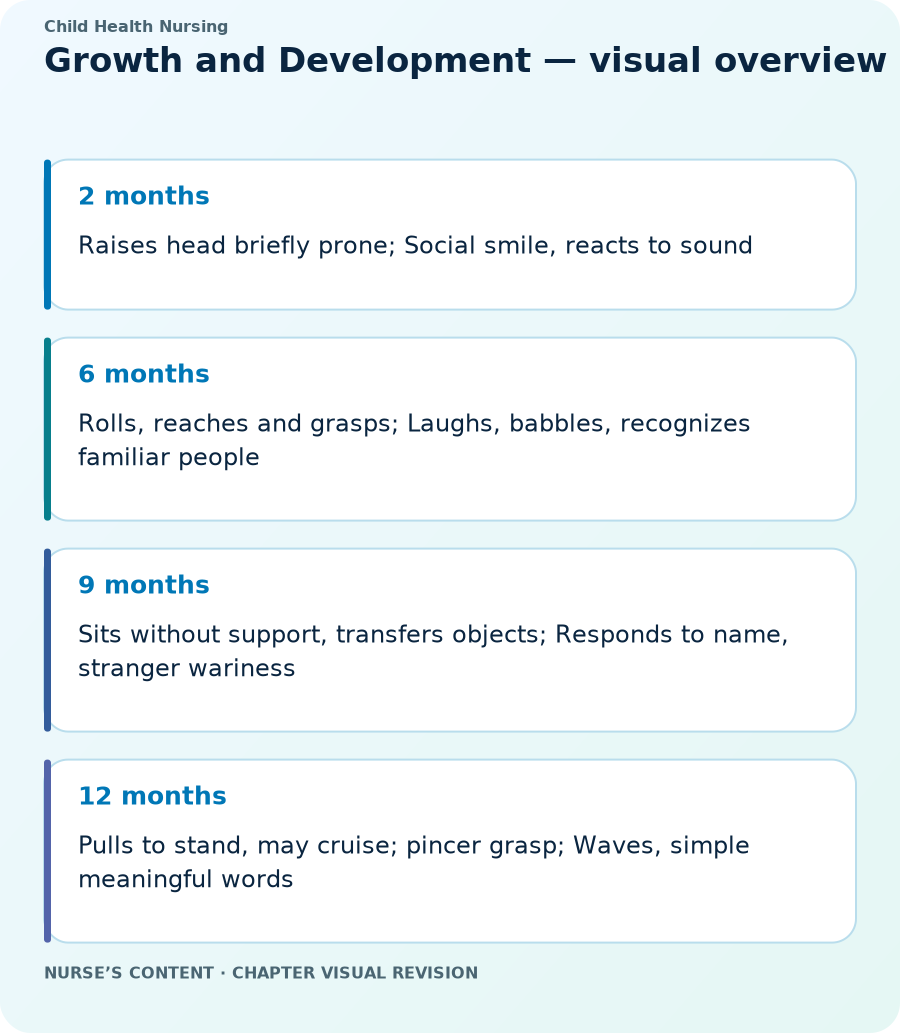
| 2 months | Raises head briefly prone | Social smile, reacts to sound |
| 6 months | Rolls, reaches and grasps | Laughs, babbles, recognizes familiar people |
| 9 months | Sits without support, transfers objects | Responds to name, stranger wariness |
| 12 months | Pulls to stand, may cruise; pincer grasp | Waves, simple meaningful words |
| 18 months | Walks independently, scribbles | Several words, simple pretend play |
| 2 years | Runs, kicks ball, uses spoon | Two-word combinations, parallel play |
| 3 years | Climbs, draws simple marks | Short conversation, joins play |
| 4–5 years | Hops, improves drawing/dressing | Sentences, cooperative play, stories |
Milestones are surveillance clues, not rigid deadlines. Use validated screening and corrected age for preterm children as appropriate; loss of previously acquired skills warrants assessment.
3. Developmental theories
| Theorist | Stages/concepts |
|---|---|
| Erikson | Trust vs mistrust (infancy), autonomy vs shame (toddler), initiative vs guilt (preschool), industry vs inferiority (school), identity vs role confusion (adolescent). |
| Piaget | Sensorimotor 0–2; preoperational 2–7; concrete operational 7–11; formal operational about 12 onward. |
| Freud | Historical oral, anal, phallic, latency, genital stages; not established universal biological stages. |
| Attachment | Responsive, consistent care supports security; separation and illness may increase distress. |
4. Growth assessment
Measure weight on calibrated scale, recumbent length under 2 years, standing height thereafter, head circumference in infancy and young children as indicated. Plot age- and sex-specific WHO growth standards (0–5 years), appropriate references thereafter. Weight-for-age identifies underweight, height-for-age stunting, weight-for-height/BMI-for-age wasting or overweight. Interpret serial trend, not one point. Z-score is standard deviations from reference median using appropriate chart method. For children 6–59 months MUAC <115 mm, weight-for-height z <−3 or bilateral pitting nutritional oedema indicates severe acute malnutrition evaluation.
5. Nursing application
Assess feeding and development during visits, encourage responsive play and language, screen hearing/vision, address risk factors, refer for early intervention. Demonstrate positioning and measurement to caregivers; record date, age, measurements and interpretation.
6. Important Examination Questions
Long Answer Questions
- 1. Describe principles, milestones and theories of growth and development.
Short Answer Questions
- 1. Explain growth charts
- 2. compare growth and development
- 3. describe developmental screening.
Very Short Answer Questions (with answers)
- 1. What is stunting? — Low height-for-age.
- 2. Which theory includes sensorimotor stage? — Piaget.
7. Quick Revision
- • Plot serial measurements.
- • Assess developmental domains together.
- • Regression is a warning sign.
8. Conclusion
Plot serial measurements. Assess developmental domains together. Regression is a warning sign.
Chapter reference images