Biochemistry
Water and Electrolyte Balance
Body water distribution, sodium, potassium, calcium, chloride and phosphate balance, osmosis, diffusion, fluid regulation and biochemical importance.
Open quizzes and study tools Download PDF
CHAPTER 15
Water and Electrolyte Balance
Body fluids, osmosis, diffusion, electrolyte homeostasis and clinical importance
1. Body water distribution
Total body water (TBW) commonly represents around 50–60% of adult body mass. Infants have a higher proportion; older age and higher adiposity reduce it. Approximately two-thirds of TBW is intracellular (ICF) and one-third extracellular (ECF). ECF includes plasma and interstitial fluid, plus small specialized compartments. An illustrative 70-kg adult with 60% TBW has 42 L water: 28 L ICF and 14 L ECF, including roughly 3–3.5 L plasma. Actual values vary.
2. Movement of water and solutes
Diffusion moves solute down its concentration gradient; facilitated diffusion uses transport proteins. Osmosis is movement of water across a semipermeable membrane in response to effective solute concentration. Filtration is pressure-driven fluid movement; active transport requires energy. Osmolality measures particles per kg of solvent; tonicity depends on effective osmoles that drive water shifts across cell membranes. Hypertonic fluid tends to shrink cells; hypotonic fluid tends to swell them. Na⁺/K⁺-ATPase maintains gradients by transporting 3 Na⁺ out and 2 K⁺ in per ATP.
3. Fluid regulation
- • ADH increases collecting-duct water permeability through aquaporin-2; thirst promotes intake.
- • RAAS: renin → angiotensin II → aldosterone, supporting perfusion and sodium retention.
- • Natriuretic peptides promote sodium excretion and oppose volume-retaining mechanisms.
- • Kidneys match water and electrolyte losses to intake; skin, lungs and GI tract contribute to losses.
Estimated serum osmolality (mOsm/kg) ≈ 2 × Na (mmol/L) + glucose (mg/dL)/18 + BUN (mg/dL)/2.8. Typical measured osmolality is ~275–295 mOsm/kg; effective osmolality excludes urea.
4. Major electrolytes and typical adult serum ranges
| Electrolyte | Typical range | Function |
|---|---|---|
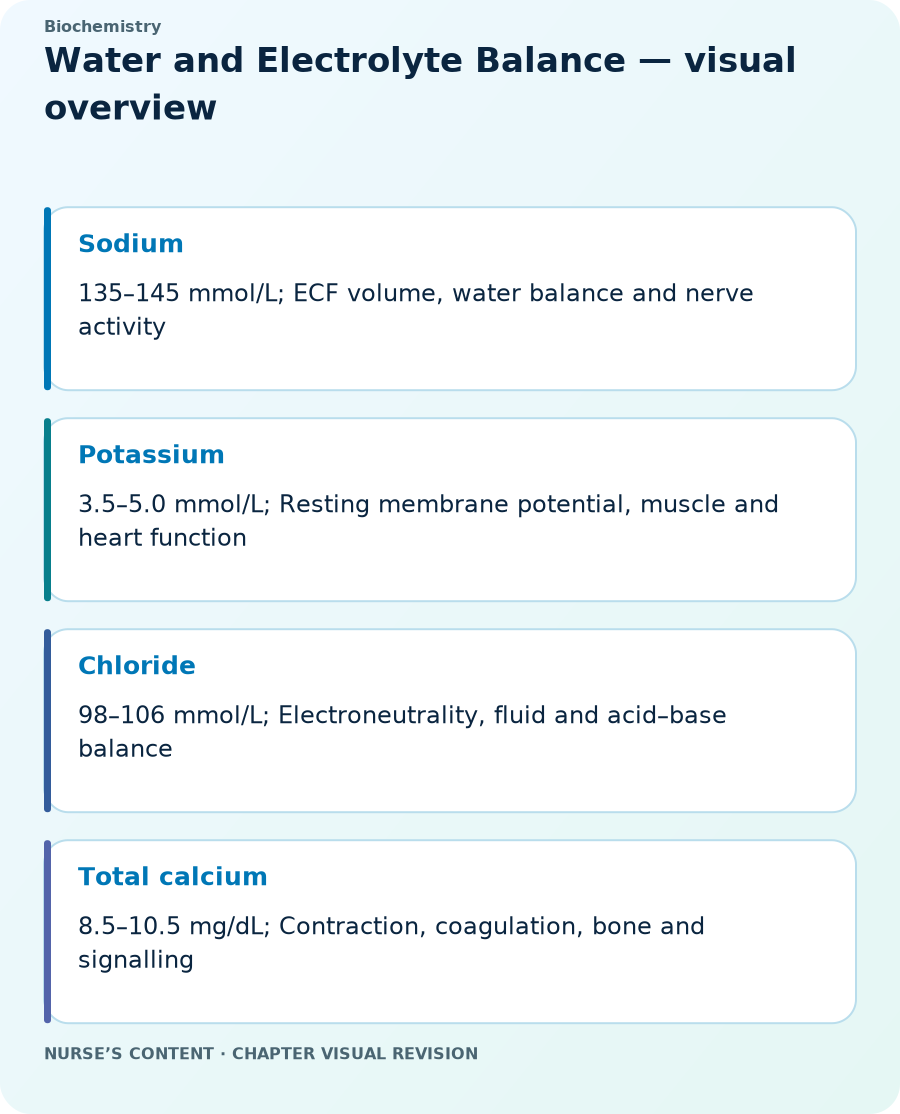
| Sodium | 135–145 mmol/L | ECF volume, water balance and nerve activity |
| Potassium | 3.5–5.0 mmol/L | Resting membrane potential, muscle and heart function |
| Chloride | 98–106 mmol/L | Electroneutrality, fluid and acid–base balance |
| Total calcium | 8.5–10.5 mg/dL | Contraction, coagulation, bone and signalling |
| Magnesium | 1.7–2.2 mg/dL | Enzyme, cardiac and neuromuscular function |
| Phosphate | 2.5–4.5 mg/dL | ATP, bone, nucleic acids and buffering |
5. Electrolyte disturbances
| Disturbance | Common causes and manifestations |
|---|---|
| Hyponatraemia | Water excess, diuretics, sodium loss; headache, confusion, seizures when severe |
| Hypernatraemia | Water deficit or sodium gain; thirst, altered consciousness |
| Hypokalaemia | GI losses, diuretics, shifts into cells; weakness, ECG changes |
| Hyperkalaemia | Renal impairment, medications, cell breakdown; dangerous arrhythmias |
| Hypocalcaemia | Vitamin D deficiency, hypoparathyroidism, critical illness; tingling, tetany |
| Hypercalcaemia | Hyperparathyroidism, malignancy; constipation, weakness, confusion |
| Hypophosphataemia | Refeeding, renal losses; muscle and respiratory weakness |
| Hypomagnesaemia | GI or renal losses; tremor, arrhythmias and refractory hypokalaemia |
6. Fluid imbalance and replacement
Dehydration is water deficit; extracellular volume depletion may result from salt and water loss. Fluid overload may occur with heart or renal dysfunction. Assess weight, intake/output, perfusion, oedema, lungs and laboratory trends. Isotonic crystalloids support extracellular expansion when clinically appropriate; hypotonic fluids and hypertonic saline have specific indications. Dextrose 5% in water behaves mainly as free water after metabolism. Treatment and correction rates must be prescribed and monitored; overly rapid sodium correction can cause serious neurological harm.
7. Biochemical functions of key ions
| Ion | Important function |
|---|---|
| Sodium | Extracellular osmolality, membrane transport and nerve impulses |
| Potassium | Resting membrane potential, muscle and cardiac excitability |
| Chloride | Electrical neutrality, gastric acid production and acid–base balance |
| Calcium | Contraction, coagulation, signalling and mineralization |
| Magnesium | ATP-associated reactions and neuromuscular regulation |
| Phosphate | Energy transfer, membranes, nucleic acids and buffers |
8. Fluid balance monitoring
Intake includes oral, enteral and intravenous fluids; measurable output includes urine, drainage, vomit and stool when quantified. Insensible loss through skin and breathing is less directly measured. Compare trends in weight, intake-output records, perfusion, oedema and laboratory results. An abrupt weight increase may reflect fluid retention, but the clinical context matters.
9. Nursing applications
Use accurate intake/output charts and daily weights when indicated; monitor infusion rates, IV site and ECG in high-risk cases. A haemolysed specimen may cause pseudohyperkalaemia, but a possible critical result requires prompt assessment and confirmation. Never give concentrated potassium by direct IV push; follow local infusion safety protocols.
10. Important Examination Questions
Long Answer Questions
- 1. Explain body fluid distribution and electrolyte regulation.
- 2. Describe body water compartments and mechanisms of fluid movement.
- 3. Discuss the biochemical functions and clinical disturbances of major electrolytes.
Short Answer Questions
- 1. Write a short note on Osmosis vs diffusion.
- 2. Write a short note on ADH.
- 3. Write a short note on RAAS.
- 4. Write a short note on sodium and potassium disturbances.
Very Short Answer Questions
- 1. Which is the major extracellular cation? – Sodium.
- 2. Which is the major intracellular cation? – Potassium.
- 3. What is osmosis? – Net water movement across a selectively permeable membrane due to osmotic differences.
- 4. What hormone increases water permeability in collecting ducts? – ADH.
Additional objective question
Principal extracellular cation? – Sodium.
11. Quick Revision
- • Roughly two-thirds of total body water is intracellular.
- • ADH promotes water reabsorption; aldosterone affects sodium and potassium handling.
- • Ionized calcium is biologically active; total calcium depends partly on albumin.
- • Sodium and potassium disturbances can cause neurological and cardiac complications.
Conclusion
Water and electrolyte regulation maintains volume, membrane function and circulation; safe management requires individualized monitoring and prescribed correction.
Chapter reference images