Biochemistry
Vitamins
Classification of vitamins, sources, functions, daily requirements, deficiency disorders and toxicity of fat-soluble and water-soluble vitamins.
Open quizzes and study tools Download PDF
CHAPTER 06
Vitamins
Fat- and water-soluble vitamins, dietary requirements, deficiencies and toxicity
1. Definition and classification
Vitamins are organic micronutrients needed in small amounts for normal metabolism, growth and physiological function. They do not directly supply energy. Most must be obtained from food; some can be synthesized in limited amounts. Fat-soluble vitamins are A, D, E and K; water-soluble vitamins include the B-complex and C. Vitamin B12 is stored substantially in the liver, despite being water-soluble.
2. Fat-soluble vitamins
| Vitamin | Sources and functions | Deficiency | Excess / toxicity |
|---|---|---|---|
| A (retinoids) | Liver, dairy, eggs; carotenoids in carrots and leafy vegetables. Vision, epithelial integrity and immunity. | Night blindness, xerophthalmia, keratomalacia | Preformed vitamin A excess: liver injury, headache, fetal harm |
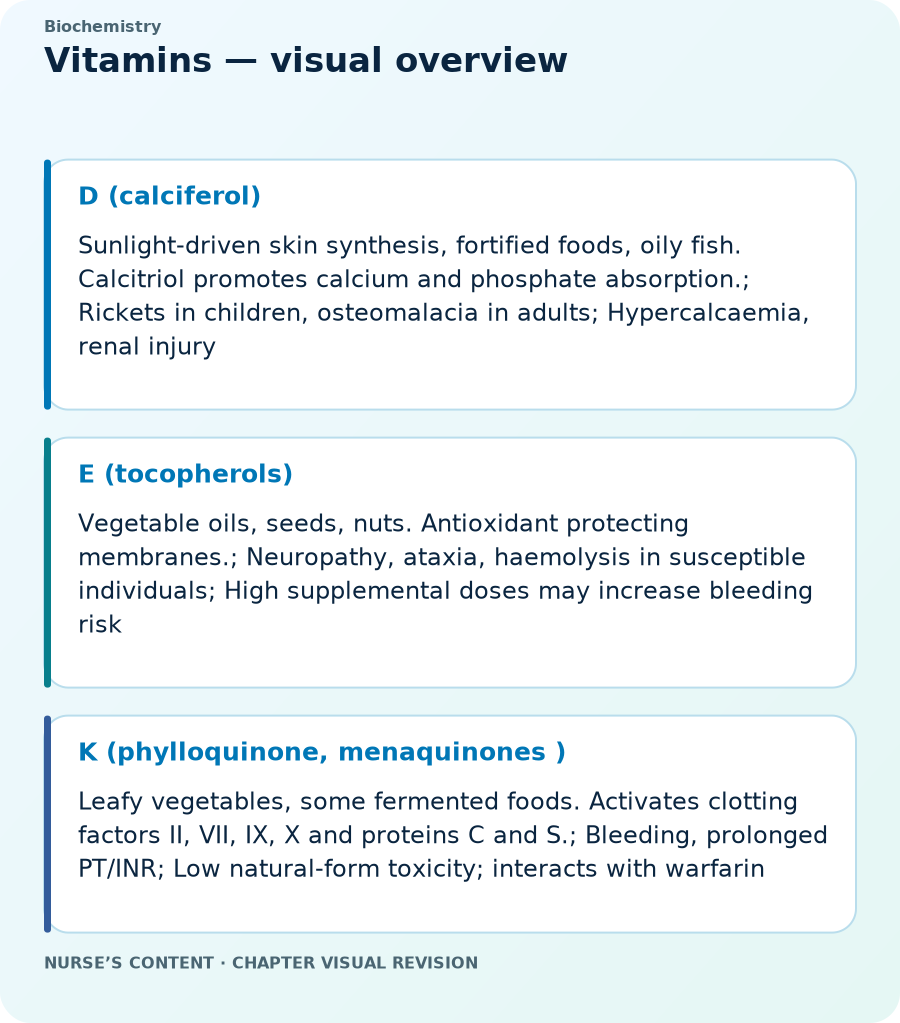
| D (calciferol) | Sunlight-driven skin synthesis, fortified foods, oily fish. Calcitriol promotes calcium and phosphate absorption. | Rickets in children, osteomalacia in adults | Hypercalcaemia, renal injury |
| E (tocopherols) | Vegetable oils, seeds, nuts. Antioxidant protecting membranes. | Neuropathy, ataxia, haemolysis in susceptible individuals | High supplemental doses may increase bleeding risk |
| K (phylloquinone, menaquinones ) | Leafy vegetables, some fermented foods. Activates clotting factors II, VII, IX, X and proteins C and S. | Bleeding, prolonged PT/INR | Low natural-form toxicity; interacts with warfarin |
3. Water-soluble vitamins
| Vitamin | Sources and key biochemical role | Deficiency and excess |
|---|---|---|
| B1 Thiamine | Whole grains, legumes, pork; TPP in oxidative decarboxylation | Beriberi; Wernicke encephalopathy. Oral toxicity uncommon. |
| B2 Riboflavin | Milk, eggs, grains; FAD and FMN for redox reactions | Cheilosis, angular stomatitis, glossitis. Toxicity uncommon. |
| B3 Niacin | Meat, fish, nuts; NAD/NADP redox reactions | Pellagra: dermatitis, diarrhoea, dementia (and death untreated). High doses: flushing, liver injury. |
| B5 Pantothenate | Widely distributed foods; coenzyme A | Rare deficiency, fatigue and paraesthesia. High doses may cause diarrhoea. |
| B6 Pyridoxine | Fish, meat, legumes, potatoes; PLP in amino acid metabolism and haem synthesis | Neuropathy, dermatitis, microcytic anaemia; excess supplements can cause sensory neuropathy. |
| B7 Biotin | Eggs, nuts, legumes; carboxylase cofactor | Dermatitis, alopecia. High supplements can interfere with laboratory assays. |
| Vitamin | Sources and key biochemical role | Deficiency and excess |
|---|---|---|
| B9 Folate | Leafy vegetables, legumes; one-carbon transfer and DNA synthesis | Megaloblastic anaemia, fetal neural tube defects; excess folic acid may mask B12-related anaemia. |
| B12 Cobalamin | Animal foods, fortified foods; methionine synthase and methylmalonyl-CoA mutase | Megaloblastic anaemia, neuropathy, raised methylmalonic acid. Toxicity uncommon. |
| C Ascorbic acid | Amla, guava, citrus, vegetables; collagen synthesis, antioxidant, iron absorption | Scurvy, bleeding gums, poor wound healing. High doses may cause GI upset and increase stone risk in susceptible people. |
4. Daily intake recommendations for healthy adults
Indian ICMR-NIN 2020 values reproduced in the FSSAI summary [1]. Figures are for non-pregnant reference adults with sedentary activity unless stated; dietary requirements differ in pregnancy, lactation, age and illness. AI = adequate intake; IU = international units. Values are not therapeutic replacement doses.
| Vitamin | Men / women per day |
|---|---|
| A | 1000 / 840 µg |
| D | 600 IU (15 µg) each |
| E | 7.5–10 mg tocopherol (adult reference) |
| K | 55 µg (adult reference) |
| B1 | 1.4 / 1.4 mg |
| B2 | 2.0 / 1.9 mg |
| B3 | 14 / 11 mg |
| B5 | 5 mg each (AI) |
| B6 | 1.9 mg each |
| B7 | 40 µg each (AI) |
| B9 | 300 / 220 µg |
| B12 | 2.2 µg each |
| C | 80 / 65 mg |
5. Vitamin absorption and storage
Fat-soluble vitamins are absorbed with dietary lipids and depend on adequate bile and pancreatic function. They may accumulate in the body, particularly vitamins A and D; high-dose supplements can cause toxicity. Most water-soluble vitamins have limited storage, although B12 is an important exception. Dietary deficiency, impaired absorption, increased demand and drug interactions can produce deficiency even when some intake is present.
6. Coenzyme forms and biochemical pathways
| Vitamin | Active form or derivative | Key reaction |
|---|---|---|
| B1 | Thiamine pyrophosphate (TPP) | Pyruvate and α-ketoglutarate dehydrogenases; transketolase |
| B2 | FAD, FMN | Oxidation-reduction reactions |
| Vitamin | Active form or derivative | Key reaction |
|---|---|---|
| B3 | NAD⁺, NADP⁺ | Electron transfer and reductive synthesis |
| B5 | Coenzyme A | Acyl-group transfer |
| B6 | Pyridoxal phosphate (PLP) | Transamination and decarboxylation |
| B7 | Biotin | ATP-dependent carboxylation |
| B9 | Tetrahydrofolate derivatives | One-carbon transfer and nucleotide synthesis |
| B12 | Methylcobalamin, adenosylcobalamin | Methionine synthesis and methylmalonyl-CoA rearrangement |
7. Distinguishing major deficiency syndromes
Vitamin A and D
Vitamin A-derived retinal participates in the visual cycle; deficiency initially affects dark adaptation and may progress to ocular injury. Vitamin D promotes mineral homeostasis. Rickets affects growing bones, while osteomalacia describes defective mineralization of adult bone.
Folate and vitamin B12
Both deficiencies can impair DNA synthesis and cause megaloblastic anaemia. B12 deficiency can cause neurological injury even without obvious anaemia. Folate alone may improve blood findings without treating B12-related neurological damage; suspected deficiency requires appropriate testing and treatment.
8. Biochemical and nursing importance
Vitamin D activation occurs via liver 25-hydroxylation and kidney 1α-hydroxylation. Vitamin B12 absorption requires intrinsic factor and a functioning terminal ileum. Fat malabsorption increases risk of A, D, E and K deficiency. In at-risk patients with suspected thiamine deficiency, prompt thiamine treatment is time-critical; emergency glucose for hypoglycaemia must not be delayed. Teach food-based nutrition, identify supplement use, monitor prescribed replacement and report suspected deficiency or toxicity. High-dose supplements should not be used without appropriate assessment [2].
9. Important Examination Questions
Long Answer Questions
- 1. Classify vitamins and describe sources, functions and deficiency disorders.
- 2. Describe the fat-soluble vitamins with sources, functions and deficiency manifestations.
- 3. Explain the biochemical roles of water-soluble vitamins and their coenzyme forms.
Short Answer Questions
- 1. Write a short note on B12 absorption.
- 2. Write a short note on vitamin D activation.
- 3. Write a short note on pellagra.
- 4. Write a short note on scurvy.
Very Short Answer Questions
- 1. Which deficiency causes pellagra? – Niacin (B3).
- 2. Which vitamin deficiency causes scurvy? – Vitamin C.
- 3. What vitamin is needed for intrinsic-factor-dependent absorption? – Vitamin B12.
- 4. Where is 25-hydroxylation of vitamin D performed? – Primarily the liver.
Additional objective question
Which vitamin is required for gamma-carboxylation of clotting factors? – Vitamin K.
10. Quick Revision
- • Fat-soluble vitamins: A, D, E, K; water-soluble: B group and C.
- • Vitamin K is required for normal activation of several coagulation proteins.
- • Vitamin C supports collagen hydroxylation and non-haem iron absorption.
- • Many B vitamins serve as precursors of coenzymes.
Conclusion
Understanding vitamin function, absorption, deficiency and toxicity supports nutritional evaluation and safe patient education.
Chapter reference images