Biochemistry
Hormones and Biochemical Regulation
Chemical nature and functions of hormones, mechanism of hormone action, second messengers, endocrine regulation and biochemical importance of hormones.
Open quizzes and study tools Download PDF
CHAPTER 12
Hormones and Biochemical Regulation
Chemical classes, receptors, second messengers and endocrine regulation
1. Definition
Hormones are chemical signalling molecules produced by endocrine or other cells that act on target cells possessing appropriate receptors. Endocrine signals travel through blood; paracrine signals act locally and autocrine signals act on the producing cell. Hormone action depends on receptor expression, concentration and downstream signalling.
2. Chemical nature of hormones
| Class | Examples | Typical mechanism |
|---|---|---|
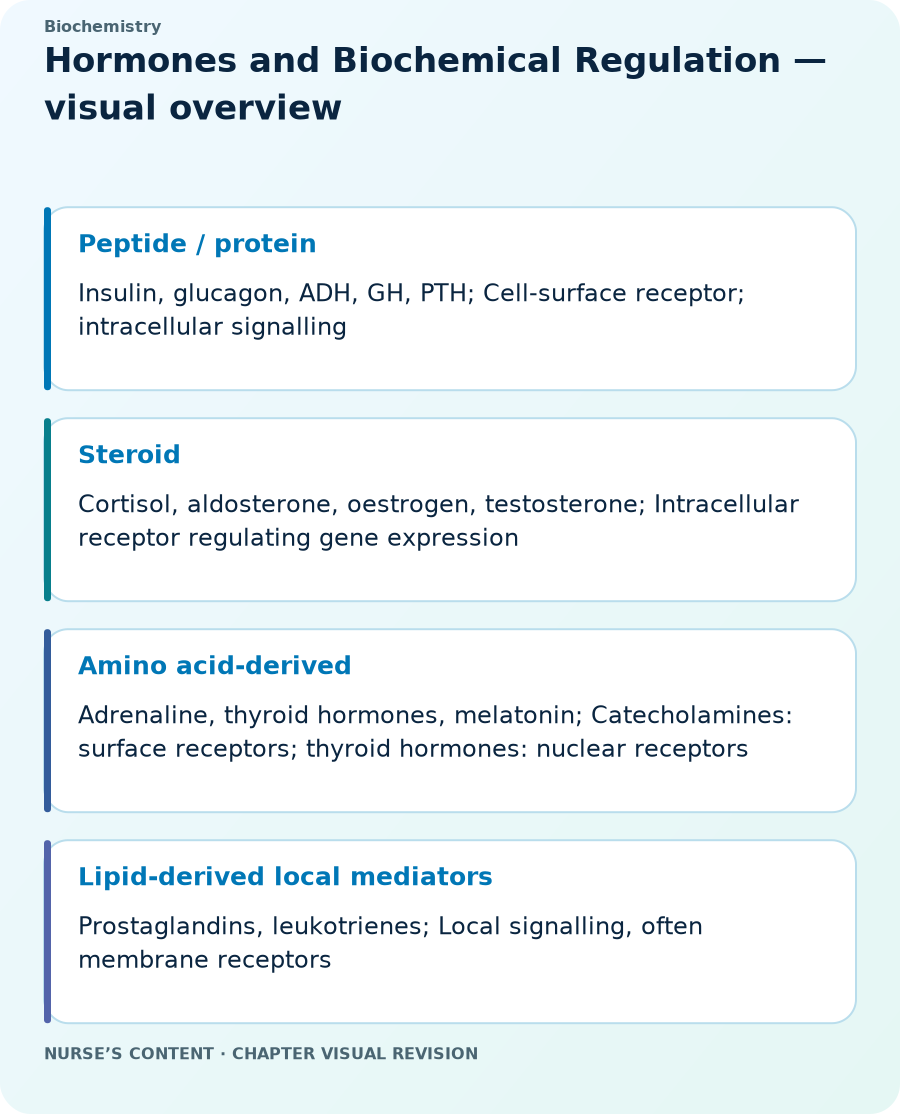
| Peptide / protein | Insulin, glucagon, ADH, GH, PTH | Cell-surface receptor; intracellular signalling |
| Steroid | Cortisol, aldosterone, oestrogen, testosterone | Intracellular receptor regulating gene expression |
| Amino acid-derived | Adrenaline, thyroid hormones, melatonin | Catecholamines: surface receptors; thyroid hormones: nuclear receptors |
| Lipid-derived local mediators | Prostaglandins, leukotrienes | Local signalling, often membrane receptors |
Peptide hormones are generally water-soluble and stored in vesicles. Steroid hormones are cholesterol-derived and usually synthesized as needed; steroid and thyroid hormones circulate substantially protein-bound. Free hormone is often most directly available to receptors.
3. Mechanism of action and second messengers
| Pathway | Examples / action |
|---|---|
| Gs → adenylyl cyclase → cAMP → PKA | Glucagon, ACTH and β-adrenergic signalling |
| Gi → reduced adenylyl cyclase | Selected inhibitory receptor pathways |
| Gq → PLC → IP₃ + DAG | IP₃ releases intracellular Ca²⁺; DAG activates PKC (e.g., α₁ receptors) |
| Receptor tyrosine kinase | Insulin receptor → phosphorylation cascades including PI3K/Akt |
| JAK–STAT | Growth hormone and prolactin pathways |
| cGMP | Natriuretic peptide signalling; nitric oxide activates soluble guanylyl cyclase |
Steroid/thyroid receptors alter transcription via DNA regulatory elements; responses often develop more slowly than rapid membrane pathways. Signalling amplification permits a small hormone signal to produce substantial cellular effects.
4. Major endocrine hormones
| Gland / hormone | Biochemical function |
|---|---|
| Anterior pituitary: TSH, ACTH, GH, FSH, LH, prolactin | Regulates thyroid, adrenal, growth, reproduction and lactation |
| Gland / hormone | Biochemical function |
|---|---|
| Posterior pituitary: ADH, oxytocin | Water reabsorption; uterine contraction and milk ejection (synthesized in hypothalamus) |
| Thyroid: T3/T4 | Metabolic regulation, growth and development |
| Parathyroid: PTH | Calcium and phosphate regulation |
| Adrenal cortex: cortisol, aldosterone | Stress and glucose regulation; sodium retention and potassium excretion |
| Adrenal medulla: adrenaline, noradrenaline | Acute stress response |
| Pancreatic islets: insulin, glucagon | Glucose and fuel homeostasis |
| Gonads: sex steroids | Reproductive development and function |
5. Regulation and feedback
Negative feedback stabilizes endocrine systems: hypothalamic TRH → pituitary TSH → thyroid T4/T3; rising thyroid hormone suppresses TRH/TSH. In the HPA axis, CRH → ACTH → cortisol; cortisol normally feeds back. Positive feedback occurs in selected processes, such as oxytocin-associated labour contractions and the LH surge. Circadian rhythms affect cortisol and melatonin. Hormone resistance can occur despite normal or high hormone concentrations.
6. Hormone synthesis, transport and receptor action
Peptide hormones are synthesized as precursors on ribosomes and processed through the secretory pathway. Many are stored in vesicles and released by regulated exocytosis. Steroid hormones are synthesized from cholesterol; thyroid hormones are formed by iodination and coupling of tyrosine residues in thyroglobulin. Binding proteins affect circulation and measured total hormone concentration.
Comparison of membrane and intracellular receptors
| Feature | Membrane receptor | Intracellular receptor |
|---|---|---|
| Common ligands | Peptides and catecholamines | Steroids and thyroid hormones |
| Location | Plasma membrane | Cytoplasm or nucleus |
| Mechanism | Signal transduction and enzyme activation | Regulation of gene transcription |
| Response | Often rapid | Often slower, with sustained effects |
There are exceptions. Receptor pathways can interact and timing varies with the particular hormone and tissue.
7. Biochemical effects of insulin and glucagon
Insulin stimulates glucose uptake in skeletal muscle and adipose tissue through GLUT4 translocation. It promotes glycogen synthesis and suppresses hepatic glucose production, adipose lipolysis and ketogenesis. Glucagon primarily acts on the liver, promoting glycogenolysis and gluconeogenesis during fasting. Cortisol, growth hormone and catecholamines also influence glucose availability and fuel metabolism.
8. Endocrine investigations and feedback
A low free T4 with raised TSH commonly suggests primary hypothyroidism, whereas low free T4 with a low or inappropriately normal TSH may suggest central disease. Discordant results require clinical review, including medication effects, acute illness and assay interference. A single hormone result may be misleading when secretion is pulsatile or follows a daily rhythm.
9. Clinical relevance and nursing applications
Diabetes reflects impaired insulin availability/action. Hypothyroidism may cause fatigue and slow metabolism; hyperthyroidism may cause heat intolerance and tachycardia. Adrenal insufficiency can lead to hypotension and electrolyte abnormalities. Monitoring requires correct specimen timing, clinical context, knowledge of drugs and recognition of acute endocrine emergencies. Educate patients about prescribed therapy and follow-up without changing hormone doses independently.
10. Important Examination Questions
Long Answer Questions
- 1. Classify hormones and explain their mechanisms of action.
- 2. Explain second messenger systems and intracellular receptor mechanisms.
- 3. Describe hormonal feedback and the biochemical effects of insulin and glucagon.
Short Answer Questions
- 1. Write a short note on cAMP.
- 2. Write a short note on negative feedback.
- 3. Write a short note on insulin receptor.
- 4. Write a short note on thyroid axis.
Very Short Answer Questions
- 1. What is a second messenger? – An intracellular signal transmitting receptor activation.
- 2. Which gland produces glucagon? – Pancreatic alpha cells.
- 3. Which hormones are synthesized in the hypothalamus and released by posterior pituitary? – ADH and oxytocin.
- 4. Which hormone increases renal water reabsorption through aquaporin-2? – ADH (vasopressin).
Additional objective question
The insulin receptor is which type? – Receptor tyrosine kinase.
11. Quick Revision
- • Hormones act on target cells with appropriate receptors.
- • cAMP, IP₃, DAG and calcium are important intracellular messengers.
- • Insulin uses a receptor tyrosine kinase; many steroids act through intracellular receptors.
- • Negative feedback maintains endocrine homeostasis.
Conclusion
Hormones coordinate biochemical pathways and maintain homeostasis through receptor-mediated signalling and feedback regulation.
Chapter reference images