Biochemistry
Proteins and Amino Acids
Definition, classification, structure and functions of proteins, essential and non-essential amino acids, protein digestion, absorption, metabolism and clinical significance.
Open quizzes and study tools Download PDF
CHAPTER 03
Proteins and Amino Acids
Amino acid classification, protein structure, digestion and clinical significance
1. Definition and chemical structure
Proteins are polymers of amino acids joined by peptide bonds. An amino acid has a central α-carbon attached to an amino group, carboxyl group, hydrogen and a variable side chain (except that glycine has two hydrogens). At physiological pH many amino acids are zwitterions. A peptide bond forms between the carboxyl group of one amino acid and the amino group of another.
2. Classification of amino acids
| Nutritional class | Examples |
|---|---|
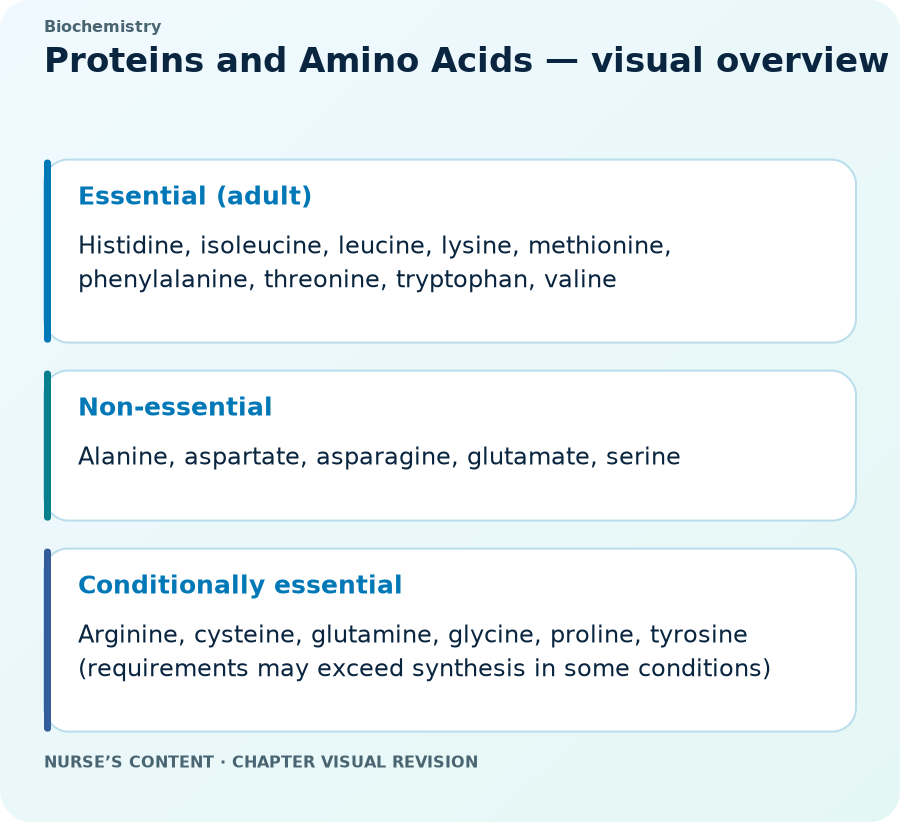
| Essential (adult) | Histidine, isoleucine, leucine, lysine, methionine, phenylalanine, threonine, tryptophan, valine |
| Non-essential | Alanine, aspartate, asparagine, glutamate, serine |
| Conditionally essential | Arginine, cysteine, glutamine, glycine, proline, tyrosine (requirements may exceed synthesis in some conditions) |
Classification by side chain: nonpolar (valine, leucine), polar uncharged (serine, threonine), acidic (aspartate, glutamate), basic (lysine, arginine, histidine). Leucine and lysine are exclusively ketogenic; other amino acids may be glucogenic or both.
3. Classification of proteins
| Basis | Types and examples |
|---|---|
| Shape | Fibrous (collagen, keratin); globular (albumin, enzymes); membrane proteins |
| Composition | Simple (albumin); conjugated (haemoglobin, glycoproteins); derived (protein breakdown products, traditional grouping) |
| Function | Structural, catalytic, transport, immune, contractile, receptor and regulatory |
4. Levels of protein structure
- • Primary: amino acid sequence.
- • Secondary: local α-helices and β-sheets stabilized mainly by backbone hydrogen bonds.
- • Tertiary: overall three-dimensional folding of a single polypeptide, stabilized by hydrophobic interactions, hydrogen bonds, ionic interactions and disulfide bonds.
- • Quaternary: arrangement of multiple polypeptide subunits, e.g., haemoglobin.
Denaturation disrupts native folding and often function without ordinarily breaking the primary peptide sequence. Heat, pH extremes and some chemicals may cause denaturation.
5. Functions of proteins
Enzymes catalyse reactions; collagen supports tissues; haemoglobin transports oxygen; albumin contributes to plasma oncotic pressure; antibodies provide immune defence; actin and myosin support contraction. Protein provides approximately 4 kcal/g when metabolized, but its primary functions are structural and functional.
6. Digestion and absorption
| Site | Process |
|---|---|
| Stomach | HCl denatures proteins and activates pepsinogen to pepsin; peptides form |
| Small intestine | Enteropeptidase activates trypsinogen; trypsin activates other pancreatic proteases |
| Intestinal lumen | Trypsin, chymotrypsin, elastase and carboxypeptidases cleave proteins |
| Brush border and enterocytes | Peptidases produce amino acids; amino acids and small peptides are absorbed |
Amino acids use several transporters, many sodium-dependent; di- and tripeptides enter by H⁺-coupled PEPT1 and are mostly hydrolysed in enterocytes. Amino acids enter portal blood and reach the liver.
7. Metabolism and clinical significance
The body has no dedicated protein storage depot. Amino acids are used for synthesis or catabolized; nitrogen is removed and converted mainly into urea in the liver. Carbon skeletons enter energy pathways or form glucose, ketones or lipids. Protein-energy malnutrition may cause muscle loss, impaired immunity and poor healing. Low albumin can reflect inflammation, liver disease, renal loss or dilution, not simply dietary deficiency. Some inherited amino acid disorders require specialist dietary management.
8. Chemical properties of amino acids
Amino acids are amphoteric: they can donate or accept protons. The isoelectric point is the pH at which an amino acid or protein has no net electrical charge. This principle supports electrophoretic separation. Side-chain properties influence folding, solubility and biological activity. Cysteine can form disulfide bonds, which stabilize many extracellular proteins.
9. Functional classification of proteins
| Function | Examples and importance |
|---|---|
| Structural | Collagen supports connective tissue; keratin contributes to skin and hair |
| Transport | Haemoglobin carries oxygen; transferrin carries iron |
| Storage | Ferritin stores iron; myoglobin binds oxygen in muscle |
| Catalytic | Amylase, lipase and other enzymes accelerate reactions |
| Defence | Immunoglobulins recognize antigens; complement participates in immunity |
| Contractile | Actin and myosin enable muscle contraction |
| Regulatory | Insulin and other peptide hormones regulate metabolism |
10. Protein quality and nutritional significance
A protein source provides amino acids in varying proportions. Protein quality depends on digestibility and the availability of indispensable amino acids relative to human requirements. Cereals and legumes can complement one another because their limiting amino acids often differ. Total dietary intake, energy availability and disease state also influence protein utilization.
Clinical protein abnormalities
- • Hypoalbuminaemia may accompany inflammation, liver dysfunction, renal protein loss or dilution. Reduced oncotic pressure can contribute to oedema, but oedema has multiple causes.
- • Proteinuria indicates urinary protein loss; persistent findings require evaluation.
- • Abnormal protein folding or aggregation occurs in selected diseases; it is not inferred from serum protein values alone.
11. Nursing applications
Assess intake, weight trends, swallowing and wound healing. Monitor renal and hepatic function where relevant. Support prescribed nutrition; do not interpret albumin alone as nutritional status.
12. Important Examination Questions
Long Answer Questions
- 1. Explain protein classification, structure, digestion and absorption.
- 2. Describe the four levels of protein structure and explain denaturation.
- 3. Classify amino acids and discuss the functions of proteins in the body.
Short Answer Questions
- 1. Write a short note on Essential amino acids.
- 2. Write a short note on denaturation.
- 3. Write a short note on peptide bond.
Very Short Answer Questions
- 1. Name two exclusively ketogenic amino acids. – Leucine and lysine.
- 2. What is a peptide bond? – An amide bond between amino acid residues.
- 3. Which stomach enzyme begins major protein digestion? – Pepsin.
- 4. What is quaternary structure? – Arrangement of multiple polypeptide subunits.
Additional objective question
Which level involves multiple polypeptide chains? – Quaternary.
13. Quick Revision
- • Nine amino acids are nutritionally essential for healthy adults.
- • Peptide bonds connect amino acids; hydrogen bonds stabilize secondary structures.
- • Proteases digest proteins into smaller peptides and amino acids.
- • The liver disposes of much amino nitrogen through urea synthesis.
Conclusion
Protein chemistry is essential to understanding enzymes, tissue repair, immunity, nutritional assessment and the biochemical basis of disease.
Chapter reference images