Biochemistry
Nucleic Acids and Molecular Biology
DNA, RNA, structure and functions of nucleotides, DNA replication, transcription, translation, genetic code and basic molecular biology.
Open quizzes and study tools Download PDF
CHAPTER 11
Nucleic Acids and Molecular Biology
Nucleotide structure, DNA, RNA, replication, transcription and translation
1. Nucleotides and nucleosides
Nucleic acids are polymers of nucleotides that store and express genetic information. A nucleotide contains a nitrogenous base, pentose sugar and phosphate group; a nucleoside contains base and sugar only. Purines are adenine (A) and guanine (G); pyrimidines are cytosine (C), thymine (T) and uracil (U). Nucleotides form 3′–5′ phosphodiester bonds. ATP is an energy-transfer molecule; cAMP is a second messenger; NAD and FAD contain nucleotide components.
2. DNA versus RNA
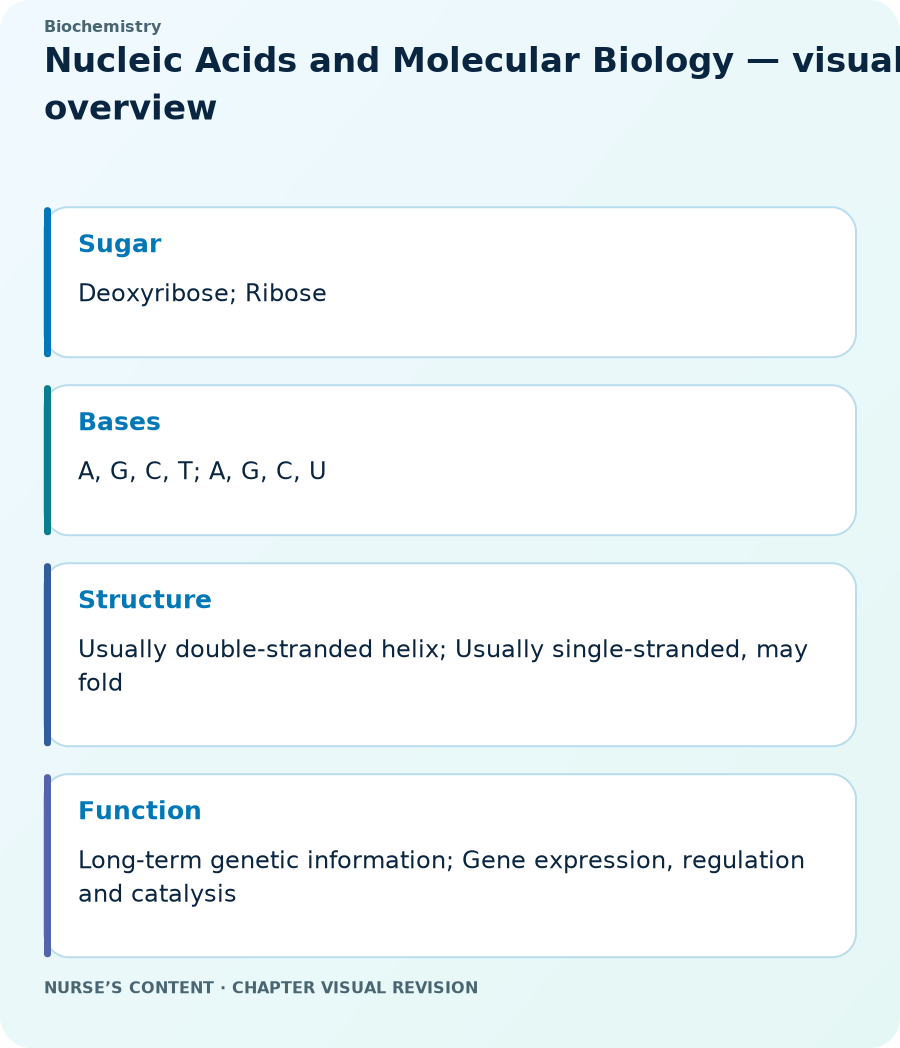
| Feature | DNA | RNA |
|---|---|---|
| Sugar | Deoxyribose | Ribose |
| Bases | A, G, C, T | A, G, C, U |
| Structure | Usually double-stranded helix | Usually single-stranded, may fold |
| Function | Long-term genetic information | Gene expression, regulation and catalysis |
DNA strands are antiparallel (5′→3′ and 3′→5′). A pairs with T via two hydrogen bonds and G with C via three. DNA associates with histone proteins in chromatin; chromosomes are organized DNA-protein structures. Mitochondria also contain DNA.
3. Types of RNA
- • mRNA: carries coding information to ribosomes.
- • tRNA: delivers amino acids and recognizes codons by its anticodon.
- • rRNA: structural and catalytic component of ribosomes.
- • snRNA: participates in RNA splicing; miRNA and other noncoding RNAs regulate gene expression.
4. DNA replication
Semiconservative replication yields two DNA molecules, each containing one parental and one newly synthesized strand. Helicase unwinds DNA; topoisomerase reduces torsional stress; primase forms primers. DNA polymerase extends DNA in the 5′→3′ direction, continuously on the leading strand and discontinuously on the lagging strand (Okazaki fragments). Primers are removed and replaced, and DNA ligase joins fragments. Proofreading and repair help maintain fidelity. Telomerase helps maintain chromosome ends in selected cells.
5. Transcription
RNA polymerase copies a DNA template into RNA in the 5′→3′ direction. In eukaryotes, most protein-coding transcripts undergo 5′ capping, splicing (introns removed, exons joined) and 3′ polyadenylation before export. Transcription factors and regulatory sequences control expression.
6. Translation and genetic code
At ribosomes, mRNA codons specify amino acids or stop signals. Aminoacyl-tRNA synthetases attach appropriate amino acids to tRNA. Initiation assembles the ribosome; elongation adds amino acids via peptide bonds; termination releases the polypeptide. Folding and post-translational modifications generate functional proteins.
| Genetic code feature | Explanation |
|---|---|
| Triplet | Three bases form one codon |
| Degenerate | Several codons may encode the same amino acid |
| Unambiguous | Each standard codon specifies one amino acid or stop signal |
| Nearly universal | Broadly conserved, with some exceptions |
| Start / stop | AUG usually starts translation; UAA, UAG and UGA are standard stop codons |
7. Mutations and molecular techniques
Substitution may be silent, missense or nonsense; insertion/deletion may cause a frameshift if not in multiples of three. DNA damage does not always become a permanent mutation. PCR amplifies selected DNA using primers, polymerase and temperature cycles; reverse-transcription PCR begins with RNA converted to cDNA. Sequencing reads nucleotide order. Genetic tests require appropriate consent, interpretation and confidentiality.
8. Structure of a nucleotide and the double helix
A base attaches to the pentose sugar through an N-glycosidic bond. A phosphate group attaches to the sugar and allows polymer formation through phosphodiester bonds. The negatively charged sugar-phosphate backbone lies outside the DNA helix; paired nitrogenous bases face inward. Complementary pairing allows each strand to serve as a template for copying and repair.
Comparison of major molecular processes
| Feature | Replication | Transcription | Translation |
|---|---|---|---|
| Template | DNA | DNA | mRNA |
| Product | DNA | RNA | Polypeptide |
| Main machinery | DNA polymerase and accessory proteins | RNA polymerase and regulatory proteins | Ribosome, tRNA and factors |
| Building blocks | Deoxyribonucleotides | Ribonucleotides | Amino acids |
| Eukaryotic site | Primarily nucleus | Primarily nucleus | Cytoplasmic ribosomes |
9. Gene expression and regulation
A gene contains information for a functional RNA or protein product. Promoters and other regulatory sequences influence transcription. Epigenetic processes, including DNA methylation and histone modification, can alter gene expression without changing the underlying nucleotide sequence. Post-transcriptional control includes RNA stability, splicing and translation efficiency. Protein modifications and degradation further alter activity.
10. Clinical example: molecular diagnosis
PCR uses repeated cycles of strand separation, primer annealing and primer extension. A positive nucleic-acid result indicates detection of a target sequence under the assay conditions; it does not necessarily prove viable infectious organisms. Correct specimen type, collection timing, contamination control and interpretation in clinical context are critical.
11. Clinical and nursing applications
Sickle cell disease illustrates a missense variant in β-globin. Molecular tests can detect pathogens or inherited variants; results depend on sampling, timing and test design. Explain specimen collection, respect genetic privacy and refer genetic counselling needs. Molecular biology supports drug development, cancer classification and infectious disease diagnosis.
12. Important Examination Questions
Long Answer Questions
- 1. Describe DNA structure, replication, transcription and translation.
- 2. Compare DNA and RNA and describe the major types of RNA.
- 3. Explain genetic code, translation and the clinical role of molecular testing.
Short Answer Questions
- 1. Write a short note on DNA versus RNA.
- 2. Write a short note on genetic code.
- 3. Write a short note on PCR.
Very Short Answer Questions
- 1. Which bases are purines? – Adenine and guanine.
- 2. What enzyme joins Okazaki fragments? – DNA ligase.
- 3. What is a codon? – Three adjacent nucleotide bases specifying an amino acid or stop signal in translation.
- 4. Which RNA is a core catalytic component of the ribosome? – rRNA.
Additional objective question
Which RNA carries amino acids? – tRNA.
13. Quick Revision
- • DNA stores genetic information; RNA has multiple roles in its expression.
- • A nucleotide contains base, sugar and phosphate; a nucleoside lacks phosphate.
- • DNA replication is semiconservative; polymerases extend nucleic acids 5′ to 3′.
- • AUG is a common start codon; UAA, UAG and UGA are standard stop codons.
Conclusion
Molecular biology explains inheritance, protein synthesis and the principles behind genetic and molecular laboratory investigations.
Chapter reference images