Biochemistry
Metabolism of Lipids
Beta-oxidation, fatty acid synthesis, ketone body formation, cholesterol metabolism, lipoproteins and clinical importance of lipid metabolism.
Open quizzes and study tools Download PDF
CHAPTER 10
Metabolism of Lipids
Lipolysis, β-oxidation, synthesis, ketones, cholesterol and lipoproteins
1. Lipolysis and fatty acid transport
During fasting, adipose triglycerides are hydrolysed by lipases (ATGL, hormone-sensitive lipase and monoacylglycerol lipase), yielding free fatty acids and glycerol. Fatty acids travel bound to albumin; glycerol reaches liver for glucose or triglyceride synthesis. Insulin suppresses adipose lipolysis; catecholamines stimulate it.
2. Beta-oxidation
Long-chain fatty acids are activated to acyl-CoA at a cost of two ATP equivalents. The carnitine shuttle (CPT I, translocase, CPT II) transports long-chain acyl groups into mitochondria. Malonyl-CoA inhibits CPT I, preventing simultaneous high rates of synthesis and oxidation.
| Cycle step | Reaction |
|---|---|
| 1 | Acyl-CoA dehydrogenase: oxidation; FADH₂ produced |
| 2 | Enoyl-CoA hydratase: hydration |
| 3 | Hydroxyacyl-CoA dehydrogenase: oxidation; NADH produced |
| 4 | Thiolase: cleavage; acetyl-CoA released and chain shortened by two carbons |
Palmitate (C16) undergoes seven cycles, yielding eight acetyl-CoA, seven NADH and seven FADH₂; complete oxidation yields approximately 106 net ATP using modern P/O estimates. Very-long-chain fatty acids begin oxidation in peroxisomes. Odd-chain fatty acids yield propionyl-CoA, which enters metabolism as succinyl-CoA via biotin and B12-dependent steps.
3. Fatty acid synthesis
Occurs mainly in cytosol of liver, adipose and lactating mammary tissue. Acetyl-CoA is exported indirectly as citrate. Acetyl-CoA carboxylase (biotin-dependent) uses ATP to form malonyl-CoA; fatty acid synthase uses NADPH to build palmitate. Insulin and citrate favour synthesis; energy deficit and AMPK inhibit it. Elongation and desaturation modify products.
4. Ketone bodies
Acetoacetate, β-hydroxybutyrate and acetone are produced primarily in liver mitochondria during low insulin availability or prolonged fasting. Peripheral tissues convert acetoacetate/β-hydroxybutyrate to acetyl-CoA for energy; liver lacks the key SCOT enzyme for ketone utilization. Nutritional ketosis differs from diabetic ketoacidosis (DKA), in which excess ketoacids cause metabolic acidosis.
5. Cholesterol metabolism
Cholesterol is synthesized from acetyl-CoA; HMG-CoA reductase is a major regulatory enzyme and the target of statins. Cholesterol forms membranes, bile acids, steroid hormones and vitamin D. It is eliminated through biliary secretion and conversion to bile acids; the enterohepatic cycle recycles much of the bile acid pool.
6. Lipoproteins
| Lipoprotein | Principal role |
|---|---|
| Chylomicron | Carries dietary triglycerides from intestine; remnants return to liver |
| VLDL | Exports hepatic triglycerides to tissues |
| Lipoprotein | Principal role |
|---|---|
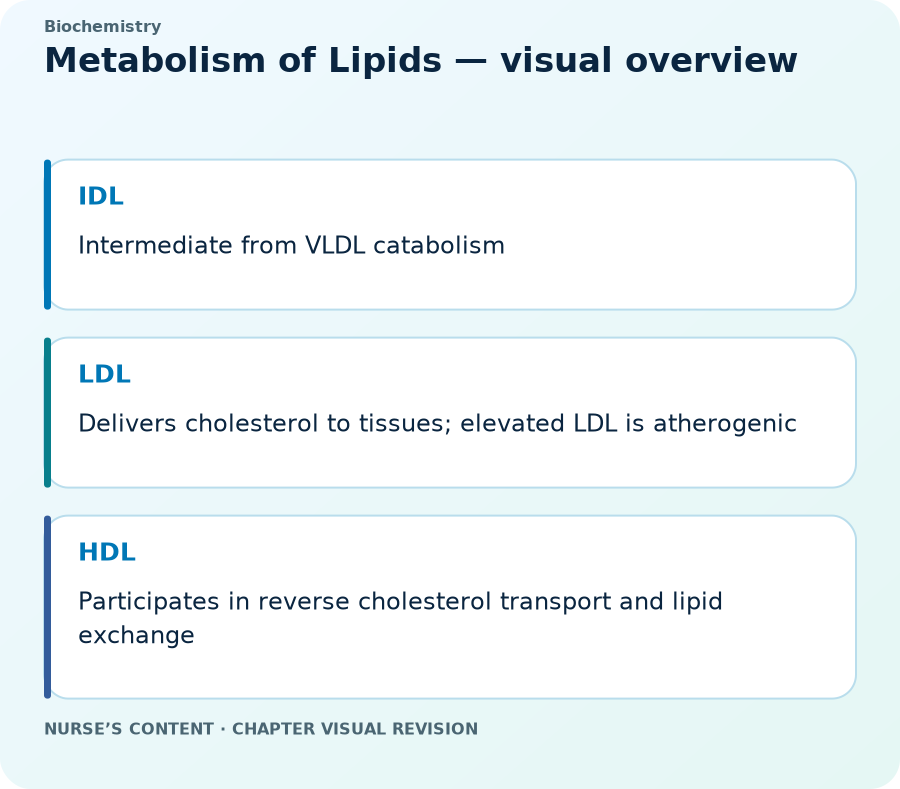
| IDL | Intermediate from VLDL catabolism |
| LDL | Delivers cholesterol to tissues; elevated LDL is atherogenic |
| HDL | Participates in reverse cholesterol transport and lipid exchange |
Lipoprotein lipase hydrolyses triglycerides in chylomicrons/VLDL; Apo C-II activates it. Apo B-48 is characteristic of chylomicrons; Apo B-100 occurs in VLDL, IDL and LDL. Apo A-I is a major HDL protein. HDL cholesterol does not directly measure HDL function and high HDL does not eliminate cardiovascular risk.
7. Comparing fatty acid synthesis and oxidation
| Feature | Fatty acid synthesis | β-oxidation |
|---|---|---|
| Site | Mainly cytosol | Mainly mitochondrial matrix |
| Physiological state | Fed, energy surplus | Fasting or increased energy demand |
| Key molecules | Acetyl-CoA, malonyl-CoA, NADPH | Acyl-CoA, NAD⁺, FAD, CoA |
| Major regulatory point | Acetyl-CoA carboxylase | CPT I for long-chain mitochondrial entry |
| Result | Fatty acid formation | Acetyl-CoA and reducing equivalents |
8. Energy yield of palmitate
Seven β-oxidation cycles yield seven NADH (about 17.5 ATP), seven FADH₂ (about 10.5 ATP) and eight acetyl-CoA (about 80 ATP via the TCA cycle and oxidative phosphorylation). Gross yield is about 108 ATP; subtract two ATP equivalents for fatty acid activation, giving approximately 106 net ATP. Actual cellular yield varies.
9. Endogenous and exogenous lipid transport
Dietary pathway: Intestine → chylomicrons → lipoprotein lipase releases fatty acids → chylomicron remnants → liver.
Endogenous pathway: Liver → VLDL → IDL → LDL → uptake by LDL receptors and other routes. HDL participates in cholesterol transport from tissues and exchanges lipids with other particles. ApoB-containing particle retention in arterial walls contributes to plaque formation.
10. Clinical and nursing applications
Dyslipidaemia increases atherosclerotic risk; severe triglyceride elevation may increase pancreatitis risk. Fatty acid oxidation defects can cause fasting hypoketotic hypoglycaemia. DKA requires urgent assessment (Chapter 20). Explain lipid tests, encourage individualized diet and physical activity, monitor treatment adherence and report severe abdominal pain or metabolic deterioration.
11. Important Examination Questions
Long Answer Questions
- 1. Describe beta-oxidation and ketogenesis.
- 2. Compare fatty acid synthesis and beta-oxidation. Calculate the approximate ATP yield of palmitate.
- 3. Describe cholesterol metabolism and the functions of plasma lipoproteins.
Short Answer Questions
- 1. Write a short note on Carnitine shuttle.
- 2. Write a short note on HMG-CoA reductase.
- 3. Write a short note on lipoprotein functions.
Very Short Answer Questions
- 1. Name the three ketone bodies. – Acetoacetate, β-hydroxybutyrate and acetone.
- 2. Where does fatty acid synthesis occur? – Mainly cytosol.
- 3. Which lipoprotein carries dietary triglyceride? – Chylomicron.
- 4. What is approximate net ATP yield of palmitate? – 106 ATP using modern estimates.
Additional objective question
Major enzyme targeted by statins? – HMG-CoA reductase.
12. Quick Revision
- • Fatty acids are activated before β-oxidation.
- • Carnitine transports long-chain acyl groups into mitochondria.
- • Malonyl-CoA inhibits CPT I.
- • The liver produces ketone bodies but cannot use them as fuel through the usual SCOT pathway.
Conclusion
Lipid metabolism provides fuel during fasting and regulates storage, membrane synthesis and cardiovascular risk; its disturbances are important in metabolic nursing care.
Chapter reference images