Biochemistry
Metabolism of Carbohydrates
Glycolysis, glycogenesis, glycogenolysis, gluconeogenesis, citric acid cycle, blood glucose regulation and clinical importance of carbohydrate metabolism.
Open quizzes and study tools Download PDF
CHAPTER 08
Metabolism of Carbohydrates
Glycolysis, glycogen metabolism, gluconeogenesis, TCA cycle and glucose regulation
1. Introduction and metabolic overview
Metabolism includes chemical reactions that maintain cell function. Glucose is a major fuel. In the fed state insulin promotes glucose utilization and storage; fasting favours glucose release and synthesis. ATP is generated by substrate-level phosphorylation and mitochondrial oxidative phosphorylation. Red blood cells lack mitochondria and depend on glycolysis.
2. Glycolysis (Embden–Meyerhof pathway)
Glycolysis occurs in the cytosol and converts one glucose into two pyruvate molecules. Two ATP are invested and four are generated: net gain 2 ATP and 2 NADH per glucose.
| Step | Reaction / enzyme |
|---|---|
| 1 | Glucose → glucose-6-phosphate; hexokinase or glucokinase; uses ATP |
| 2 | G6P → fructose-6-phosphate; phosphoglucose isomerase |
| 3 | F6P → fructose-1,6-bisphosphate; PFK-1; uses ATP |
| 4–5 | Aldolase splits F1,6BP into GAP and DHAP; triose phosphate isomerase converts DHAP to GAP |
| 6 | GAP → 1,3-bisphosphoglycerate; GAP dehydrogenase; produces NADH |
| 7 | 1,3-BPG → 3-phosphoglycerate; phosphoglycerate kinase; ATP produced |
| 8–9 | 3-PG → 2-PG → phosphoenolpyruvate; mutase and enolase |
| 10 | PEP → pyruvate; pyruvate kinase; ATP produced |
Irreversible regulatory steps: hexokinase/glucokinase, PFK-1 and pyruvate kinase. PFK-1 is stimulated by AMP and fructose-2,6-bisphosphate and inhibited by high ATP and citrate.
3. Fate of pyruvate
In mitochondria, pyruvate dehydrogenase converts pyruvate into acetyl-CoA, CO₂ and NADH. With limited oxidative capacity, pyruvate may be converted to lactate by LDH, regenerating NAD⁺. Lactate can be recycled into glucose in the liver (Cori cycle). Pyruvate may also form oxaloacetate via pyruvate carboxylase or alanine via transamination.
4. Citric acid cycle (TCA / Krebs cycle)
Occurs mainly in the mitochondrial matrix (succinate dehydrogenase is embedded in the inner membrane). Acetyl-CoA combines with oxaloacetate, forming citrate.
Citrate → isocitrate → α-ketoglutarate → succinyl-CoA → succinate → fumarate → malate → oxaloacetate.
| Yield per acetyl-CoA | Amount |
|---|---|
| NADH | 3 |
| FADH₂ | 1 |
| GTP or ATP | 1 |
| CO₂ | 2 |
One glucose produces two acetyl-CoA molecules. NADH and FADH₂ donate electrons to the respiratory chain; oxygen is the final electron acceptor. The proton gradient drives ATP
synthase. Complete glucose oxidation yields around 30–32 ATP, depending on shuttle and coupling efficiency; older estimates of 36–38 use historical assumptions.
5. Glycogen metabolism
Glycogenesis: G6P → G1P → UDP-glucose → glycogen. Glycogen synthase forms α(1→4) bonds and branching enzyme forms α(1→6) branches. Insulin favours synthesis.
Glycogenolysis: glycogen phosphorylase and debranching enzyme release mostly G1P. Liver glucose-6-phosphatase allows free glucose release. Muscle lacks significant glucose-6-phosphatase and uses glycogen locally. Glucagon acts mainly on liver; adrenaline can stimulate liver and muscle glycogen breakdown.
6. Gluconeogenesis
Synthesis of glucose from non-carbohydrate precursors, mainly in liver and increasingly in kidney during prolonged fasting. Substrates: lactate, glycerol and glucogenic amino acids. Bypass enzymes: pyruvate carboxylase, PEP carboxykinase, fructose-1,6-bisphosphatase and glucose-6-phosphatase. It consumes energy. Even-chain fatty acids cannot provide net glucose in humans; glycerol from triglycerides can.
7. Pentose phosphate pathway
Occurs in cytosol, generating NADPH for reductive biosynthesis and antioxidant defence, and ribose-5-phosphate for nucleotides. G6PD deficiency reduces red cell protection against oxidative stress and can lead to haemolysis after certain triggers.
8. Blood glucose regulation
Insulin lowers blood glucose by promoting uptake in muscle/adipose tissue (GLUT4), storage and reduced hepatic glucose output. Glucagon raises hepatic glucose output during fasting; adrenaline, cortisol and growth hormone are counter-regulatory. Fasting plasma glucose of 70–99 mg/dL is commonly used as a typical range, with ADA diagnostic criteria in Chapter 18. Hypoglycaemia is an important clinical concern, particularly during glucose-lowering therapy.
9. Energy generation and the Cori cycle
NADH and FADH₂ provide electrons to the mitochondrial respiratory chain; oxygen serves as terminal electron acceptor. Proton gradients drive ATP synthase. Complete glucose oxidation commonly yields about 30–32 ATP under modern estimates. Lactate produced by muscle or red cells can return to liver and be converted into glucose; this Cori cycle transfers part of the energy burden to the liver.
10. Nursing applications
Monitor glucose as ordered, document meal and treatment timing and recognize sweating, tremor, confusion and altered consciousness. Follow hypoglycaemia protocols.
11. Important Examination Questions
Long Answer Questions
- 1. Explain glycolysis, TCA cycle and glucose regulation.
- 2. Explain glycogenesis, glycogenolysis and gluconeogenesis.
- 3. Describe the regulation of blood glucose in fed and fasting states.
Short Answer Questions
- 1. Write a short note on Cori cycle.
- 2. Write a short note on glycogenolysis.
- 3. Write a short note on gluconeogenesis.
- 4. Write a short note on PPP.
Very Short Answer Questions
- 1. What is the rate-controlling glycolytic enzyme commonly emphasized? – PFK-1.
- 2. How many net ATP are produced directly by glycolysis? – Two per glucose.
- 3. Where does the TCA cycle mainly occur? – Mitochondrial matrix.
- 4. What does the pentose phosphate pathway supply? – NADPH and ribose-5-phosphate.
Additional objective question
Rate-controlling enzyme of glycolysis? – PFK-1.
12. Quick Revision
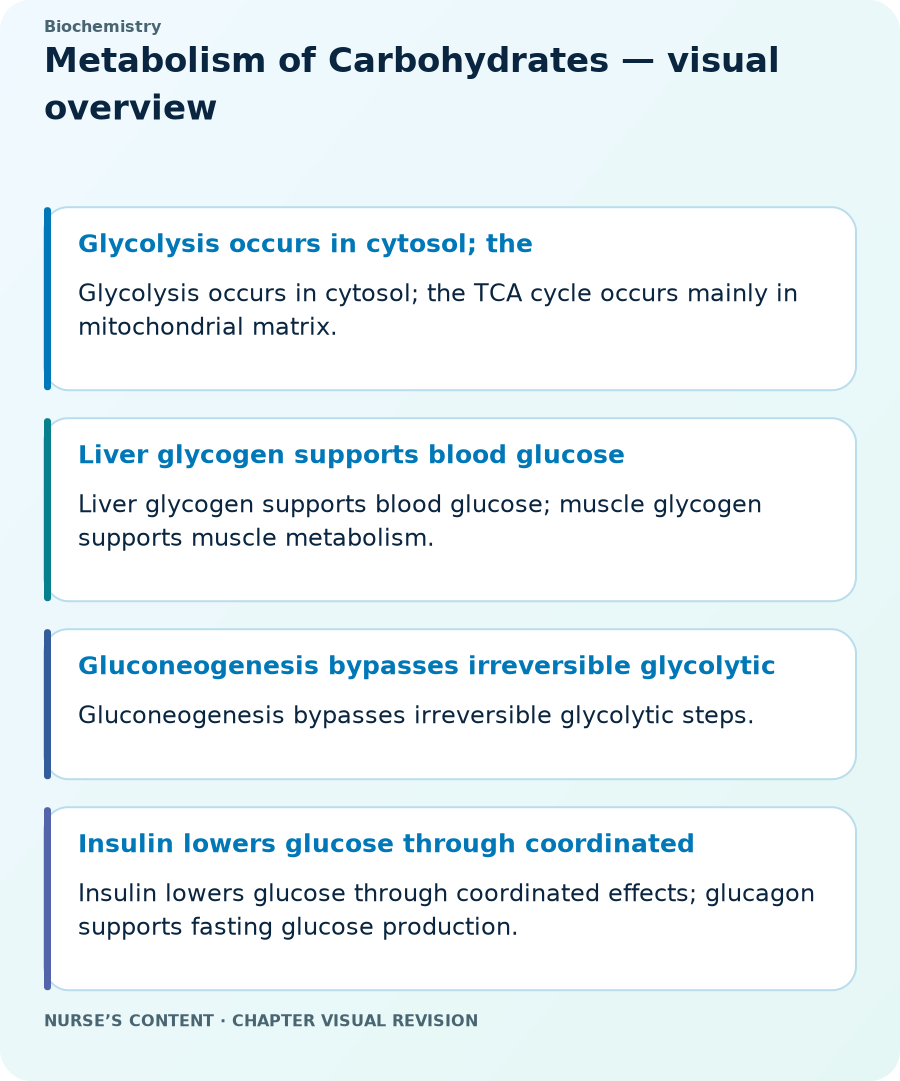
- • Glycolysis occurs in cytosol; the TCA cycle occurs mainly in mitochondrial matrix.
- • Liver glycogen supports blood glucose; muscle glycogen supports muscle metabolism.
- • Gluconeogenesis bypasses irreversible glycolytic steps.
- • Insulin lowers glucose through coordinated effects; glucagon supports fasting glucose production.
Conclusion
Carbohydrate metabolism integrates glucose utilization, storage, production and ATP generation; these pathways explain fasting, exercise and diabetes-related biochemical changes.
Chapter reference images