Biochemistry
Lipids
Definition, classification and functions of lipids, fatty acids, triglycerides, phospholipids, cholesterol, digestion, absorption and lipid metabolism.
Open quizzes and study tools Download PDF
CHAPTER 04
Lipids
Fatty acids, triglycerides, phospholipids, cholesterol and digestion
1. Definition and classification
Lipids are a diverse group of hydrophobic or amphipathic biomolecules that are poorly soluble in water and soluble in appropriate organic solvents. They are important for energy storage and cell structure.
| Traditional class | Examples |
|---|---|
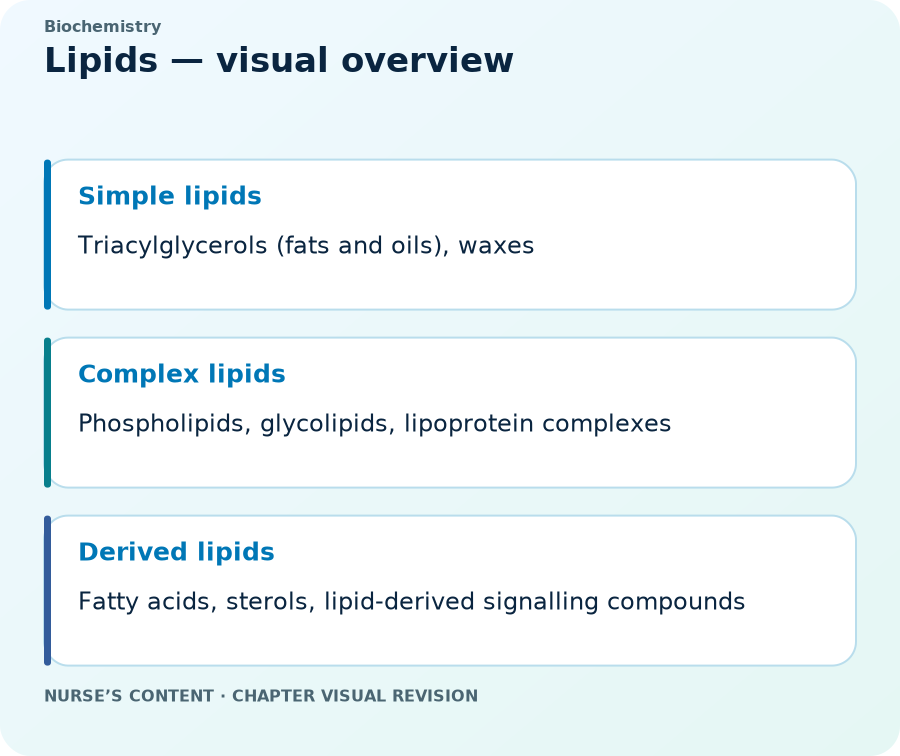
| Simple lipids | Triacylglycerols (fats and oils), waxes |
| Complex lipids | Phospholipids, glycolipids, lipoprotein complexes |
| Derived lipids | Fatty acids, sterols, lipid-derived signalling compounds |
2. Fatty acids
Fatty acids contain a carboxyl group and a hydrocarbon chain. Saturated fatty acids have no carbon–carbon double bonds; monounsaturated have one; polyunsaturated have more than one. Cis double bonds introduce bends; trans configurations are straighter. Essential fatty acids are linoleic acid (omega-6) and α-linolenic acid (omega-3). EPA and DHA are long-chain omega-3 fatty acids; endogenous conversion from α-linolenic acid is limited.
3. Major lipid types
| Lipid | Structure / function |
|---|---|
| Triglyceride | Glycerol + three fatty acids; major energy storage form |
| Phospholipid | Amphipathic head and hydrophobic tails; membrane bilayer |
| Glycolipid | Lipid with carbohydrate group; cell recognition and nervous tissue |
| Cholesterol | Sterol; membrane fluidity and precursor of bile acids, steroid hormones and vitamin D |
| Eicosanoids | Lipid-derived local mediators; inflammation, vascular tone and platelet regulation |
4. Functions
Lipids provide approximately 9 kcal/g, store energy in adipose tissue, protect organs and help insulate the body. Membrane lipids maintain cellular barriers and participate in signalling. Dietary fat supports absorption of vitamins A, D, E and K. Essential fatty acids are required for normal membrane and signalling functions.
5. Digestion and absorption
- • Lingual and gastric lipases initiate some fat digestion; the small intestine is the main site in adults.
- • Bile salts emulsify fat droplets. They are not enzymes.
- • Pancreatic lipase with colipase converts triglycerides mainly into free fatty acids and 2-monoacylglycerol. Other enzymes digest phospholipids and cholesterol esters.
- • Mixed micelles deliver lipid products to enterocyte surfaces. Long-chain fatty acids are re-esterified and packaged with apolipoproteins into chylomicrons.
- • Chylomicrons move through lymphatic lacteals to systemic blood. Shorter-chain fatty acids can enter portal blood more directly.
- • Most bile acids are reabsorbed in the terminal ileum and recycled via the enterohepatic circulation.
6. Overview of lipid metabolism
Lipolysis mobilizes stored triglycerides; fatty acids undergo β-oxidation to produce acetyl-CoA, NADH and FADH₂. In the fed state excess energy may support triglyceride synthesis. The liver makes ketone bodies during prolonged fasting or insulin deficiency. Lipoproteins transport lipids in blood (see Chapter 10).
7. Saturation, configuration and nutritional importance
Saturated fatty acids have no carbon-carbon double bonds; monounsaturated fatty acids have one and polyunsaturated fatty acids have two or more. Naturally occurring unsaturated fatty acids are commonly cis, producing bends that influence membrane fluidity. Industrial trans fats increase cardiovascular risk. Linoleic acid (omega-6) and alpha-linolenic acid (omega-3) are essential fatty acids.
8. Structure of major lipids
| Lipid | Structural features | Function |
|---|---|---|
| Triacylglycerol | Glycerol esterified with three fatty acids | Concentrated energy reserve |
| Glycerophospholipid | Glycerol, two fatty acids, phosphate-containing head | Membrane bilayer and signalling |
| Sphingolipid | Sphingoid backbone; variable head group | Membranes and neural tissue |
| Cholesterol | Four fused rings and hydroxyl group | Membrane fluidity and precursor for steroids, bile acids and vitamin D |
| Glycolipid | Lipid with carbohydrate group | Cell recognition and membrane structure |
Cell membrane
Phospholipids are amphipathic: they contain a water-attracting head and water-avoiding region. In aqueous environments they form bilayers. Cholesterol modifies membrane properties; membrane proteins mediate transport, receptors and cell adhesion.
9. Lipid digestion: sequence
Dietary fat → emulsification by bile salts → enzyme digestion → mixed micelles → enterocyte uptake → re-esterification → chylomicron secretion → lymph → blood. Micelles assist delivery to enterocytes but are not absorbed intact as chylomicrons.
10. Clinical importance and nursing applications
Steatorrhoea (greasy stools) may result from fat malabsorption due to pancreatic, biliary or intestinal disease. Dyslipidaemia increases cardiovascular risk; severe hypertriglyceridaemia can increase pancreatitis risk. Cholestasis may impair absorption of fat-soluble vitamins. Assess diet, stool characteristics and weight; support prescribed dietary and lipid monitoring plans.
11. Important Examination Questions
Long Answer Questions
- 1. Classify lipids and explain their digestion and absorption.
- 2. Describe fatty acids, triglycerides, phospholipids and cholesterol.
- 3. Explain the clinical significance of fat malabsorption and lipid transport.
Short Answer Questions
- 1. Write a short note on Essential fatty acids.
- 2. Write a short note on cholesterol functions.
- 3. Write a short note on phospholipids.
Very Short Answer Questions
- 1. Which two fatty acids are essential? – Linoleic and alpha-linolenic acids.
- 2. Name the main dietary lipid storage form. – Triacylglycerol.
- 3. What is steatorrhoea? – Excess fat in stool, often causing greasy stools.
- 4. What is a micelle? – An aggregate that helps solubilize lipid digestion products.
Additional objective question
What emulsifies fat? – Bile salts.
12. Quick Revision
- • Lipids supply about 9 kcal/g.
- • Bile salts aid emulsification; pancreatic lipase hydrolyses triglycerides.
- • Long-chain dietary lipids generally leave the intestine in chylomicrons.
- • Phospholipids and cholesterol are important membrane constituents.
Conclusion
Lipid chemistry explains energy storage, membrane structure, lipid absorption and clinically important disorders of fat transport and metabolism.
Chapter reference images