Biochemistry
Kidney Function and Biochemistry
Renal biochemical functions, urea formation, creatinine, uric acid, electrolyte regulation, urine composition, renal function tests and clinical significance.
Open quizzes and study tools Download PDF
CHAPTER 17
Kidney Function and Biochemistry
Renal metabolism, nitrogenous wastes, urine composition and RFTs
1. Renal biochemical functions
The kidneys maintain homeostasis by glomerular filtration, tubular reabsorption and tubular secretion. They regulate fluid, electrolytes, osmolality and acid–base balance, excrete waste products and medicines, secrete renin and erythropoietin, and activate vitamin D. Renal gluconeogenesis contributes to blood glucose maintenance during fasting.
2. Nitrogenous waste products
| Marker | Formation and handling |
|---|---|
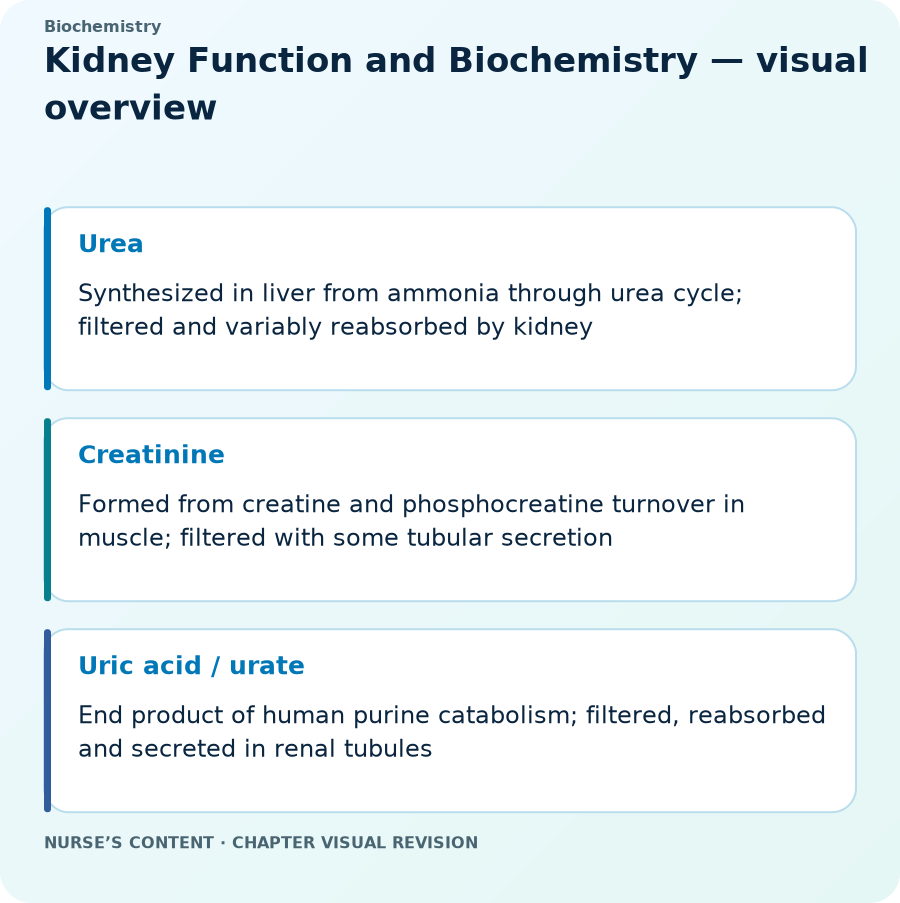
| Urea | Synthesized in liver from ammonia through urea cycle; filtered and variably reabsorbed by kidney |
| Creatinine | Formed from creatine and phosphocreatine turnover in muscle; filtered with some tubular secretion |
| Uric acid / urate | End product of human purine catabolism; filtered, reabsorbed and secreted in renal tubules |
Urea is not normally formed by the kidney as its principal site. A rise in urea can reflect dehydration, GI bleeding or high catabolism as well as impaired renal clearance. Creatinine depends on muscle mass, diet and some medications. Uric acid is influenced by production, renal and intestinal excretion.
3. Glomerular filtration and tubular regulation
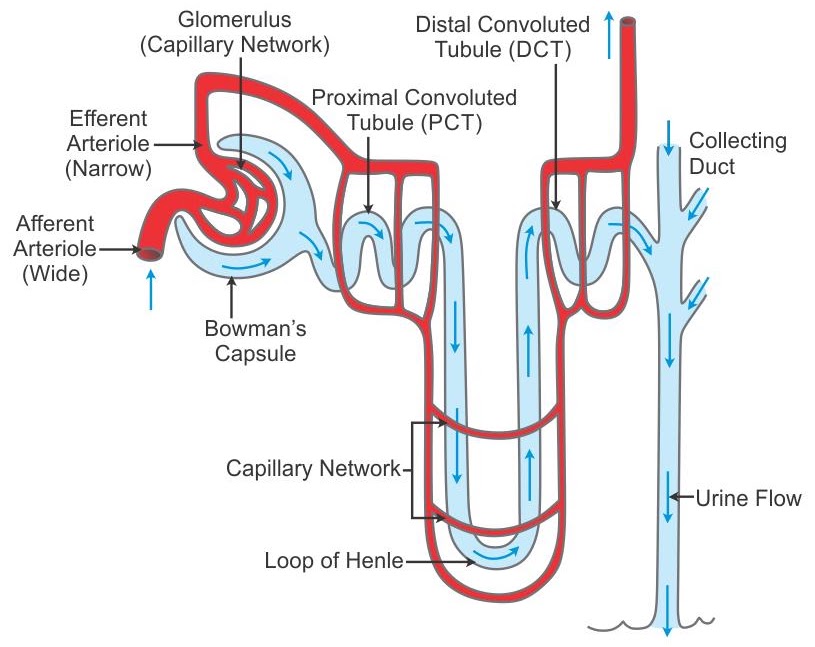
GFR is the volume of filtrate formed per unit time. Glomeruli retain cells and most large proteins. Proximal tubules reabsorb most filtered sodium and water, bicarbonate and normally nearly all filtered glucose and amino acids. The loop of Henle helps establish the medullary gradient. Distal nephron and collecting ducts fine-tune sodium, potassium, water and acid excretion under hormonal control. ADH promotes water retention; aldosterone promotes sodium reabsorption and potassium secretion in relevant nephron segments.
4. Acid–base and endocrine roles
Kidneys reclaim bicarbonate and excrete acid, particularly as ammonium and titratable acids. Erythropoietin supports red cell production. Renal 1α-hydroxylase converts 25-hydroxyvitamin D to active calcitriol. CKD may cause anaemia, metabolic acidosis and mineral-bone abnormalities.
5. Normal urine composition
Urine is mainly water with dissolved urea, creatinine, uric acid, electrolytes and other metabolites. Typical volume is 800–2000 mL/day in many adults, dependent on intake and condition; pH about 4.5–8 and specific gravity about 1.005–1.030. Glucose, ketones and blood are normally negative on routine testing; significant protein is abnormal. Dipstick results need clinical interpretation; some drugs, infections and sampling factors cause interference.
6. Renal function investigations
| Test | Typical result or meaning |
|---|---|
| Serum creatinine | ~0.6–1.3 mg/dL; local ranges and muscle mass matter |
| BUN | ~7–20 mg/dL (urea roughly 15–43 mg/dL) |
| Test | Typical result or meaning |
|---|---|
| eGFR | Estimated filtration in mL/min/1.73 m²; calculated from creatinine and/or cystatin C with demographic factors |
| Urine albumin-to-creatinine ratio (ACR) | A1 <30; A2 30–300; A3 >300 mg/g |
| Urinalysis | Protein, blood, glucose, ketones, sediment and other findings |
| Electrolytes | Sodium, potassium, bicarbonate, calcium and phosphate as indicated |
CKD requires kidney structural or functional abnormalities with health implications for at least 3 months [5]. eGFR <60 or persistent markers such as albuminuria can satisfy criteria. GFR categories: G1 ≥90; G2 60–89; G3a 45–59; G3b 30–44; G4 15–29; G5 <15. G1/G2 alone do not establish CKD without markers of damage. Acute kidney injury involves a rapid creatinine rise or reduced urine output; eGFR is less reliable when creatinine is changing rapidly.
7. Nephron processes and biochemical regulation
| Nephron region | Major biochemical processes |
|---|---|
| Glomerulus | Filtration of water and small solutes; normally restricts most large plasma proteins |
| Proximal tubule | Bulk sodium and water reabsorption; normally reclaims filtered glucose, amino acids and bicarbonate |
| Loop of Henle | Countercurrent mechanisms contribute to medullary concentration gradient |
| Distal tubule | Fine regulation of electrolyte transport, including calcium handling |
| Collecting duct | ADH-regulated water reabsorption; aldosterone-sensitive sodium and potassium handling; acid–base regulation |
8. Kidney function and clinical interpretation
Acute kidney injury involves an acute deterioration in kidney function identified by creatinine change and/or low urine output using defined criteria. Chronic kidney disease involves persistent abnormalities of kidney structure or function for at least three months. eGFR estimates filtration and is not reliable during rapidly changing creatinine. The urine albumin-to-creatinine ratio (ACR) helps detect and quantify albuminuria; abnormal findings often need confirmation in appropriate circumstances.
9. Nursing applications
Measure fluid balance, blood pressure and daily weights where indicated. Review nephrotoxic exposures, prescribed medication dose adjustments and electrolyte changes. Escalate reduced urine output, pulmonary oedema, hyperkalaemia or altered consciousness. Avoid assuming all patients with renal disease need identical protein, fluid or potassium restrictions.
10. Important Examination Questions
Long Answer Questions
- 1. Explain renal biochemical functions and renal function tests.
- 2. Explain renal handling of urea, creatinine and uric acid.
- 3. Discuss urine composition and interpretation of kidney function investigations.
Short Answer Questions
- 1. Write a short note on BUN versus urea.
- 2. Write a short note on creatinine.
- 3. Write a short note on urine ACR.
- 4. Write a short note on eGFR.
Very Short Answer Questions
- 1. What does eGFR estimate? – Glomerular filtration rate.
- 2. Which hormone stimulates erythrocyte production? – Erythropoietin.
- 3. What is glycosuria? – Glucose in urine.
- 4. What is albuminuria? – Abnormally increased urinary albumin excretion.
Additional objective question
Which organ synthesizes urea? – Liver.
11. Quick Revision
- • Glomerular filtration and tubular transport determine urine composition.
- • Urea is made mainly in liver; kidneys excrete much of it.
- • Creatinine is influenced by muscle mass and filtration.
- • Kidneys generate active vitamin D, produce erythropoietin and regulate acid–base balance.
Conclusion
Renal biochemistry provides the basis for interpreting nitrogenous wastes, urine findings, filtration estimates and electrolyte abnormalities.
Chapter reference images