Biochemistry
Introduction to Biochemistry
Definition, scope and importance of biochemistry, chemical composition of the human body, atoms, molecules, chemical bonds, pH, acids, bases and buffers.
Open quizzes and study tools Download PDF
CHAPTER 01
Introduction to Biochemistry
Definition, scope, body composition, chemical bonds, pH and buffers
1. Meaning and scope
Biochemistry is the study of the chemical substances, reactions and molecular processes that occur in living organisms. It explains the relationship between molecular structure and biological function, from the cell to the whole body. Clinical biochemistry applies these principles to the detection, monitoring and understanding of disease.
- • Structural biochemistry: structure and properties of carbohydrates, proteins, lipids and nucleic acids.
- • Metabolic biochemistry: reactions that release energy or build molecules.
- • Molecular biology: storage, transmission and expression of genetic information.
- • Clinical biochemistry: analysis of specimens such as blood and urine to assess organ function and metabolic health.
2. Chemical composition of the human body
Water is the largest component, commonly around 50–60% of adult body weight; the proportion varies with age, sex and body composition. Oxygen, carbon, hydrogen and nitrogen account for most body mass. Calcium, phosphorus, sulfur and other elements are needed for structural and regulatory functions.
| Component | Major role |
|---|---|
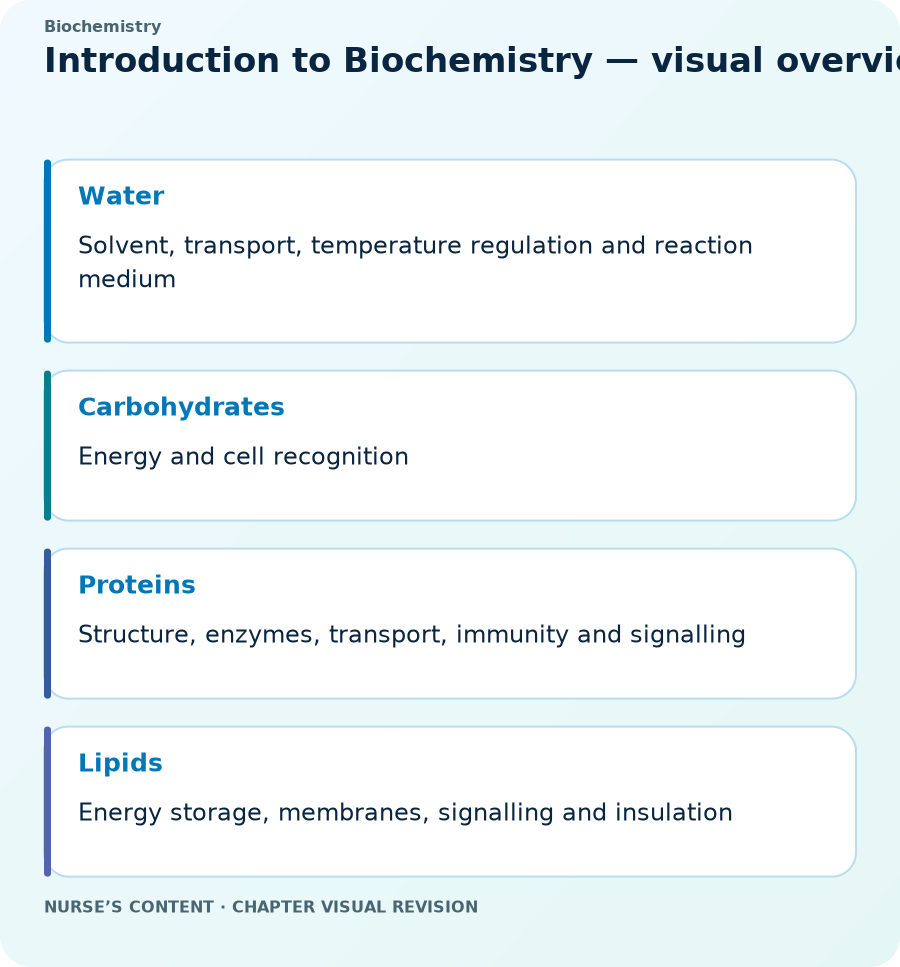
| Water | Solvent, transport, temperature regulation and reaction medium |
| Carbohydrates | Energy and cell recognition |
| Proteins | Structure, enzymes, transport, immunity and signalling |
| Lipids | Energy storage, membranes, signalling and insulation |
| Nucleic acids | Genetic information and protein synthesis |
| Minerals | Bones, electrical activity, cofactors and fluid balance |
3. Atoms, molecules and ions
An atom is the basic unit of an element. Protons are positively charged, neutrons are uncharged and electrons are negatively charged. Atomic number is the number of protons; mass number is the sum of protons and neutrons. Isotopes have the same atomic number but different neutron numbers. A molecule contains atoms bonded together; a compound contains atoms of different elements. An ion carries a charge after loss or gain of electrons (e.g., Na⁺, Cl⁻).
| Bond or interaction | Description and example |
|---|---|
| Covalent | Sharing electrons; peptide and glycosidic bonds |
| Ionic | Electrostatic attraction between oppositely charged ions |
| Hydrogen | Weak attraction involving a hydrogen donor and acceptor; DNA base pairing |
| Van der Waals | Weak short-range interactions; molecular packing |
| Hydrophobic interaction | Nonpolar groups associate in water; membrane formation |
4. Chemical reactions and metabolism
Hydrolysis uses water to split a bond; condensation joins molecules with release of small molecules such as water. Oxidation is electron loss; reduction is electron gain. ATP transfers energy for cellular work. Catabolism breaks molecules down; anabolism builds molecules and usually requires energy. Enzymes accelerate reactions without being consumed overall.
5. Acids, bases, pH and buffers
An acid donates protons; a base accepts protons. pH = −log₁₀[H⁺]. At 25°C, neutral water has pH 7; lower values are acidic and higher values alkaline. Each pH unit represents a tenfold change in hydrogen ion concentration. Normal arterial blood pH is 7.35–7.45.
A buffer resists pH changes by reversibly binding or releasing protons. The major extracellular buffer is bicarbonate: CO₂ + H₂O ⇌ H₂CO₃ ⇌ H⁺ + HCO₃⁻. Phosphate, haemoglobin and other proteins also buffer body fluids. Lungs regulate CO₂; kidneys regulate bicarbonate and acid excretion (see Chapter 14).
6. Water and the chemical basis of life
Water is polar: oxygen bears a partial negative charge and hydrogen atoms partial positive charges. Hydrogen bonding explains much of its high heat capacity, solvent ability and cohesion. Water dissolves ions and many polar molecules, while nonpolar compounds tend to associate with one another. This behaviour is central to the formation of cell membranes and protein folding.
Functions of water in the body
- • Provides a medium for biochemical reactions and the transport of nutrients, hormones and metabolic wastes.
- • Helps maintain body temperature through its high heat capacity and evaporation.
- • Participates directly in hydrolysis reactions and acts as a lubricant in body fluids.
- • Maintains cell volume and contributes to blood volume and tissue perfusion.
7. Cellular organization and biomolecules
| Structure | Biochemical role |
|---|---|
| Nucleus | Stores DNA; site of most nuclear transcription |
| Mitochondria | Oxidative metabolism and ATP production |
| Ribosomes | Protein synthesis |
| Rough endoplasmic reticulum | Synthesis and processing of many membrane and secreted proteins |
| Smooth endoplasmic reticulum | Lipid synthesis, calcium storage and selected drug metabolism |
| Golgi apparatus | Modifies, sorts and packages proteins and lipids |
| Lysosomes | Intracellular degradation of macromolecules |
8. Examples of biochemical calculations
Concentration and units
Molarity expresses moles of solute per litre of solution. Clinical results may be reported as mmol/L, mg/dL or g/dL. Results cannot be compared without checking the substance and unit. For glucose, mg/dL divided by approximately 18 gives mmol/L; this conversion does not apply universally to other substances.
pH example
A solution at pH 6 has ten times the hydrogen ion concentration of one at pH 7. Even small changes in arterial pH can substantially affect enzyme activity, membrane transport and physiological function.
9. Clinical importance and nursing applications
- • Understand laboratory units, reference intervals, medication action and acid–base disturbances.
- • Identify how abnormal glucose, electrolytes or organ markers relate to patient symptoms.
- • Use correct specimen handling, report critical results and explain investigations to patients.
10. Important Examination Questions
Long Answer Questions
- 1. Define biochemistry and explain its scope and nursing importance.
- 2. Describe the chemical composition of the human body and the role of water.
- 3. Explain the main chemical bonds and the concept of acids, bases and buffers.
Short Answer Questions
- 1. Write a short note on Chemical bonds.
- 2. Write a short note on pH and buffers.
- 3. Write a short note on anabolic versus catabolic reactions.
Very Short Answer Questions
- 1. Define an atom and an ion. – Atom: basic unit of an element; ion: charged atom or molecule.
- 2. What is hydrolysis? – Bond cleavage involving water.
- 3. What is normal arterial blood pH? – 7.35–7.45.
- 4. Differentiate anabolic and catabolic reactions. – Anabolism builds molecules; catabolism breaks them down.
Additional objective question
Which is the main extracellular buffer? – Bicarbonate.
11. Quick Revision
- • Biochemistry connects molecular structure, metabolism and disease.
- • Covalent bonds share electrons; hydrogen bonds contribute to molecular organization.
- • ATP couples energy-releasing reactions to energy-requiring processes.
- • Buffers resist changes in pH; lungs and kidneys help maintain blood pH.
Conclusion
Biochemistry provides the chemical foundation for understanding normal physiology, laboratory investigations and clinical nursing care.
Chapter reference images