Biochemistry
Enzymes
Definition, classification, properties and functions of enzymes, mechanism of enzyme action, factors affecting enzyme activity, enzyme inhibition and clinical importance.
Open quizzes and study tools Download PDF
CHAPTER 05
Enzymes
Properties, classification, kinetics, inhibitors and diagnostic enzymes
1. Definition and properties
Enzymes are biological catalysts, mostly proteins; some RNA molecules (ribozymes) also catalyse reactions. They lower activation energy, increase reaction rate and are regenerated after the catalytic cycle. They do not change the equilibrium constant or overall free-energy change of a reaction. They show substrate and reaction specificity, and often have optimal pH and temperature ranges.
2. Enzyme terminology
Apoenzyme is the protein component requiring a cofactor; holoenzyme is its active combination with the required cofactor. Cofactors may be metal ions (Mg²⁺, Zn²⁺) or organic coenzymes. A prosthetic group is tightly bound. Examples of coenzymes include NAD⁺ (niacin), FAD (riboflavin), TPP (thiamine) and CoA (pantothenate). A zymogen is an inactive enzyme precursor, e.g., trypsinogen. Isoenzymes are different molecular forms catalysing the same reaction.
3. Classification (IUBMB EC system)
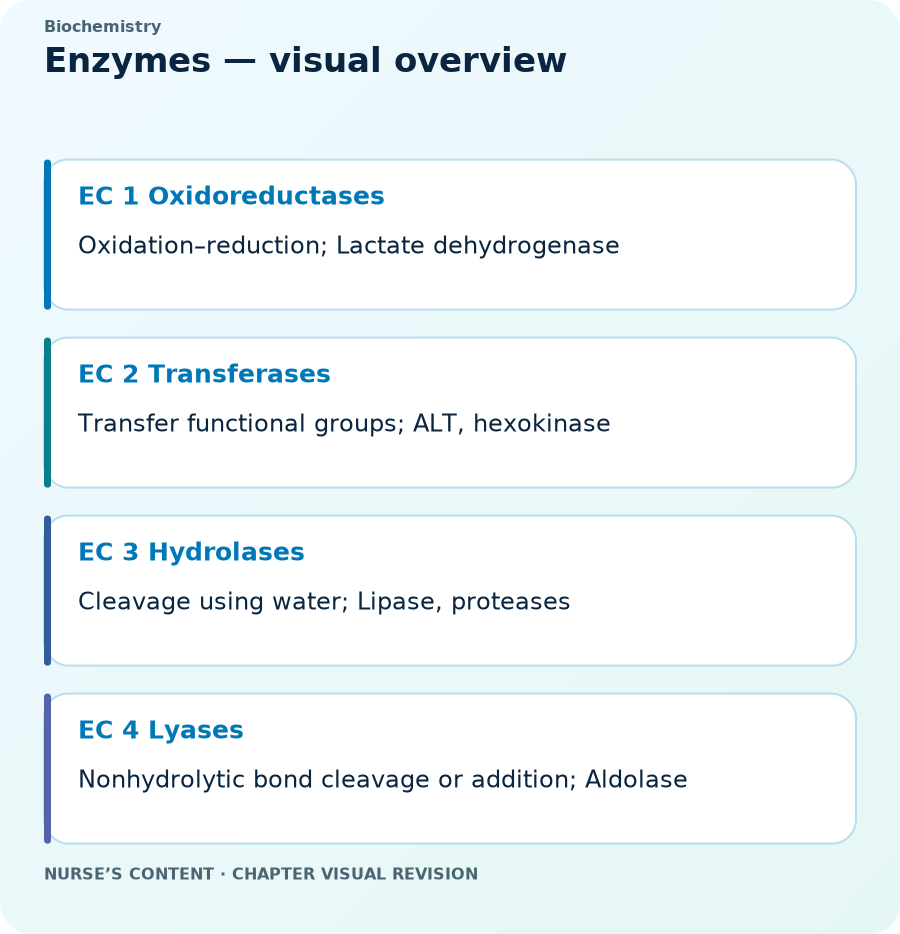
| Class | Reaction | Example |
|---|---|---|
| EC 1 Oxidoreductases | Oxidation–reduction | Lactate dehydrogenase |
| EC 2 Transferases | Transfer functional groups | ALT, hexokinase |
| EC 3 Hydrolases | Cleavage using water | Lipase, proteases |
| EC 4 Lyases | Nonhydrolytic bond cleavage or addition | Aldolase |
| EC 5 Isomerases | Intramolecular rearrangement | Phosphoglucose isomerase |
| EC 6 Ligases | Join molecules coupled to energy use | DNA ligase |
| EC 7 Translocases | Move ions or molecules across membranes | Na⁺/K⁺-ATPase |
Older texts may list six classes; the current system includes translocases [3].
4. Mechanism of enzyme action
Enzyme + substrate ⇌ enzyme–substrate complex → enzyme + product. The active site binds substrate. The lock-and-key model describes complementarity; induced-fit describes conformational adjustment on binding. Transition-state stabilization facilitates catalysis.
5. Factors affecting activity
Temperature increases rate up to an optimum, beyond which denaturation may occur. pH affects ionization and folding; pepsin works best at acidic pH, whereas many intestinal enzymes prefer near-neutral or alkaline conditions. Increasing substrate increases velocity until saturation. Enzyme concentration, cofactors, product concentration and regulatory molecules also affect rate.
For simple Michaelis–Menten kinetics, v = Vmax[S]/(Km + [S]). Vmax is maximum velocity; Km is the substrate concentration at half Vmax. A lower Km may indicate higher apparent substrate affinity in suitable systems.
6. Inhibition and regulation
| Type | Effect on apparent Km / Vmax |
|---|---|
| Competitive | Km rises; Vmax unchanged |
| Pure noncompetitive | Km unchanged; Vmax falls |
| Uncompetitive | Both Km and Vmax fall |
| Mixed | Vmax falls; Km may rise or fall |
Irreversible inhibitors inactivate enzymes, often through strong or covalent binding. Allosteric regulation, feedback inhibition, covalent modification and changes in enzyme synthesis regulate metabolism.
7. Specificity and catalytic mechanisms
Enzymes recognize substrates through active-site geometry and chemical interactions. Absolute specificity refers to a narrow substrate preference; group specificity refers to related substrates; stereospecificity distinguishes stereoisomers. Enzymes may use acid-base catalysis, temporary covalent intermediates, metal ions or orientation of reactants to accelerate biochemical reactions.
8. Enzyme kinetics and inhibition: practical comparison
| Feature | Competitive | Pure noncompetitive | Uncompetitive |
|---|---|---|---|
| Inhibitor binding | Often competes at active site | Binds enzyme and enzyme-substrate complex equally | Binds enzyme-substrate complex |
| Apparent Km | Increases | Unchanged | Decreases |
| Vmax | Unchanged | Decreases | Decreases |
| High substrate concentration | Can overcome simple competitive inhibition | Does not restore original Vmax | Does not restore original Vmax |
Enzyme regulation in metabolism
Feedback inhibition occurs when a pathway product inhibits an earlier enzyme. Allosteric effectors bind regulatory sites; phosphorylation can activate one enzyme and inhibit another. Zymogens permit potentially harmful enzymes to be activated at an appropriate site, for example pancreatic proteases in the intestine.
9. Clinical interpretation of enzyme assays
Enzyme activity is commonly expressed in U/L. One international unit represents catalytic conversion of one micromole of substrate per minute under specified conditions. Measured activity depends on the method, temperature and substrate. Elevated circulating activity may result from cellular injury, altered clearance or increased production. Compare results with the laboratory reference interval and other markers rather than assuming one raised enzyme identifies a particular disease.
10. Clinical importance
| Marker | Clinical association (not diagnostic alone) |
|---|---|
| ALT / AST | Cell injury, especially liver; AST also muscle |
| ALP / GGT | Cholestatic pattern; ALP also bone |
| Lipase | Pancreatic injury, particularly acute pancreatitis |
| Marker | Clinical association (not diagnostic alone) |
|---|---|
| CK | Skeletal muscle injury; CK-MB is less preferred than troponin in acute MI assessment |
| LDH | Nonspecific tissue injury and haemolysis |
Enzymes also serve as therapeutic agents (e.g., selected enzyme replacement) and laboratory reagents. Nurses should understand specimen interference, report significant changes and interpret results with symptoms and other tests.
11. Important Examination Questions
Long Answer Questions
- 1. Define enzymes and explain classification, mechanism and inhibition.
- 2. Discuss factors affecting enzyme activity with examples.
- 3. Explain enzyme inhibition and the clinical significance of diagnostic enzymes.
Short Answer Questions
- 1. Write a short note on Cofactors.
- 2. Write a short note on isoenzymes.
- 3. Write a short note on Km and Vmax.
Very Short Answer Questions
- 1. What is a holoenzyme? – Apoenzyme with its required cofactor.
- 2. Give an example of a zymogen. – Trypsinogen.
- 3. Which enzyme class includes lipase? – Hydrolases.
- 4. What happens to Vmax in pure noncompetitive inhibition? – It decreases.
Additional objective question
Which enzyme class transfers functional groups? – Transferases.
12. Quick Revision
- • Enzymes lower activation energy, not the reaction equilibrium.
- • Seven major enzyme classes are recognized by IUBMB.
- • Km is the substrate concentration at half Vmax for simple Michaelis–Menten behaviour.
- • Isoenzymes catalyse the same reaction but differ in molecular form.
Conclusion
Enzyme activity and regulation are central to metabolism, drug action and the interpretation of biochemical investigations.
Chapter reference images