Biochemistry
Clinical Biochemistry and Laboratory Investigations
Blood glucose tests, lipid profile, liver function tests, renal function tests, serum electrolytes, cardiac biomarkers, thyroid function tests and interpretation of common biochemical investigations.
Open quizzes and study tools Download PDF
CHAPTER 18
Clinical Biochemistry and Laboratory Investigations
Common investigations, interpretation and pre-analytical safety
1. Definition and workflow
Clinical biochemistry measures chemical constituents of blood, urine and other biological specimens. Tests support screening, diagnosis, prognosis and treatment monitoring. Reference intervals describe a reference population; decision thresholds are clinical cut-offs and may differ. Results do not establish disease in isolation.
2. Blood glucose testing (non-pregnant adults)
ADA Standards of Care 2026 criteria [4]; venous plasma and qualified laboratory HbA1c methods. Fasting requires no caloric intake for at least 8 hours. OGTT uses 75 g glucose in adults outside pregnancy.
| Test | Prediabetes | Diabetes threshold |
|---|---|---|
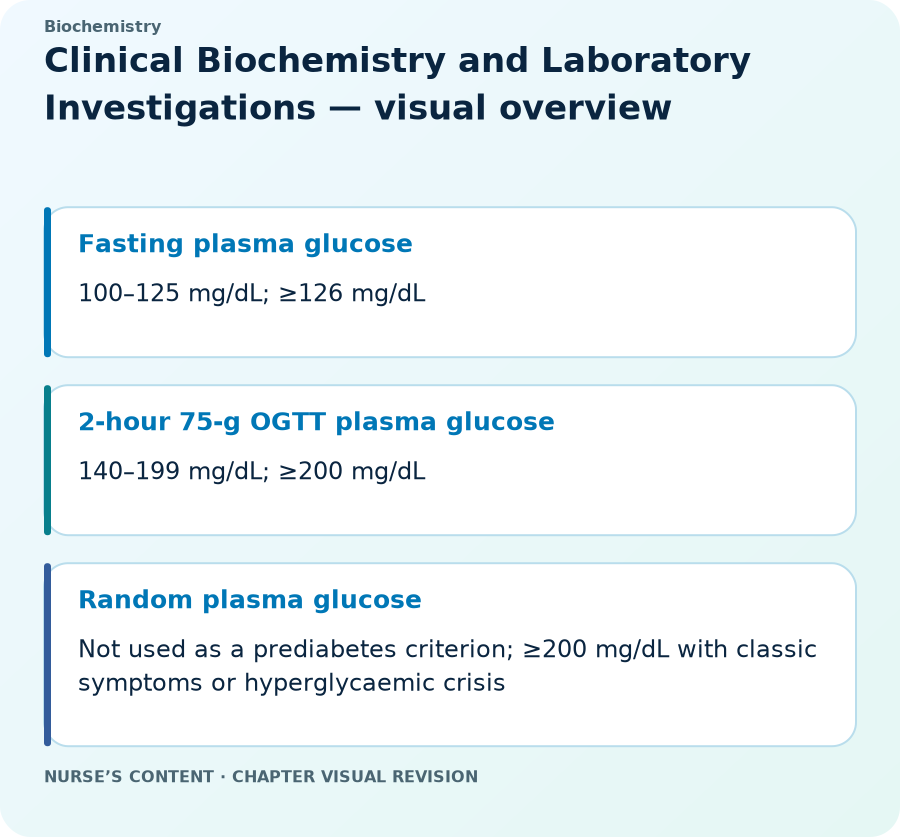
| Fasting plasma glucose | 100–125 mg/dL | ≥126 mg/dL |
| 2-hour 75-g OGTT plasma glucose | 140–199 mg/dL | ≥200 mg/dL |
| HbA1c | 5.7–6.4% | ≥6.5% |
| Random plasma glucose | Not used as a prediabetes criterion | ≥200 mg/dL with classic symptoms or hyperglycaemic crisis |
In the absence of unequivocal hyperglycaemia, diagnosis needs confirmation by two abnormal results, obtained together or at different times as appropriate. Pregnancy-specific criteria differ. A capillary glucometer is primarily a monitoring tool. HbA1c may be unreliable with altered red cell turnover or selected haemoglobin variants.
3. Lipid profile
| Test | Common educational reference (mg/dL) | Interpretation |
|---|---|---|
| Total cholesterol | <200 desirable | Combined cholesterol fractions |
| LDL-C | <100 often termed optimal | Atherogenic cholesterol; individual treatment goals depend on risk |
| HDL-C | Low commonly <40 men / <50 women | Risk marker; not a treatment target in isolation |
| Triglycerides | <150 fasting | Elevation can reflect metabolic or other causes |
| Non-HDL-C | Total cholesterol − HDL-C | Cholesterol in atherogenic lipoproteins |
Traditional reference cut-offs are not universal treatment goals. The 2026 ACC/AHA dyslipidaemia guideline emphasizes risk-based treatment and LDL-C/non-HDL-C goals [6]. Fasting is not mandatory for every lipid profile; follow laboratory instructions, especially when triglycerides are elevated. Calculated LDL may be inaccurate at high triglycerides depending on calculation method.
4. Liver, renal and electrolyte panels
| Panel | Key tests and interpretation |
|---|---|
| Liver | ALT/AST: injury; ALP/GGT: cholestatic pattern; bilirubin: handling/excretion; albumin and PT/INR: synthesis and other factors |
| Renal | Creatinine/eGFR: filtration estimate; BUN: nitrogen waste; urine ACR: albumin leakage |
| Electrolytes | Na 135–145, K 3.5–5.0, Cl 98–106 and bicarbonate ~22–29 mmol/L; interpret lab-specific ranges |
| Calcium / phosphate | Total calcium ~8.5–10.5 mg/dL; phosphate ~2.5–4.5 mg/dL; ionized calcium when indicated |
5. Cardiac biomarkers
High-sensitivity cardiac troponin I or T is preferred for myocardial injury assessment. Values above the assay-specific 99th percentile upper reference limit indicate myocardial injury; a rise/fall suggests acute injury. Myocardial infarction requires clinical evidence of ischaemia in addition to acute injury. Serial sampling and ECG are important. CK-MB has a more limited role where troponin is available. BNP or NT-proBNP may support heart failure evaluation, interpreted with age, renal function and other factors.
6. Thyroid function tests
| Pattern | Typical interpretation |
|---|---|
| High TSH, low free T4 | Primary hypothyroidism |
| Low TSH, high free T4 and/or T3 | Primary hyperthyroidism |
| High TSH, normal free T4 | Possible subclinical hypothyroidism |
| Low TSH, normal free T4/T3 | Possible subclinical hyperthyroidism |
| Low or inappropriately normal TSH, low free T4 | Possible central hypothyroidism or other illness effects |
Typical adult TSH range is approximately 0.4–4.0 mIU/L, but assay, age and pregnancy affect reference intervals. Biotin supplements may interfere with some immunoassays. Acute illness can alter thyroid tests without primary thyroid disease.
7. Specimen handling and nursing responsibilities
Verify order, identity, consent, fasting/time requirements and tube type. Collect using the approved method; avoid prolonged tourniquet use and haemolysis; label at bedside; transport promptly with required temperature/light protection. Delayed separation can lower glucose; haemolysis can elevate potassium, LDH and AST. Document factors influencing results and escalate critical values without delay. Repeat potentially erroneous tests as directed; do not disregard a critical value merely because an error is suspected.
8. Worked clinical interpretation examples
| Example findings | Interpretation and nursing action |
|---|---|
| Fasting glucose 132 mg/dL, no symptoms | Above ADA diagnostic threshold; confirm according to diagnostic criteria. Check fasting status and arrange clinical review. |
| ALT 240 U/L, AST 180 U/L, ALP 95 U/L | Predominant aminotransferase rise suggests hepatocellular injury; review medication history and report findings. Does not establish the cause. |
| Example findings | Interpretation and nursing action |
|---|---|
| ALP 390 U/L, GGT raised, conjugated bilirubin elevated | Suggests a cholestatic pattern; assess jaundice, stool/urine colour, pain and fever; escalate as indicated. |
| Creatinine increased from 0.8 to 1.6 mg/dL over two days | Rapid rise suggests acute kidney injury; assess urine output, perfusion and medication exposure, notify the clinical team promptly. |
| Potassium 6.2 mmol/L | Potentially dangerous hyperkalaemia; urgently notify the team and assess ECG/clinical status according to policy. Consider sample haemolysis but do not delay escalation. |
| TSH 12 mIU/L and low free T4 | Pattern consistent with primary hypothyroidism; clinical review and appropriate confirmation are needed. |
9. Additional clinical investigations
Ferritin reflects iron stores but rises with inflammation; transferrin saturation assists iron assessment. Serum lipase supports pancreatitis assessment in the appropriate clinical context. Lactate can rise in hypoperfusion and other conditions; interpret with symptoms and trends. C-reactive protein is a nonspecific inflammation marker. No single abnormal value should be treated without considering the patient, urgency and full clinical picture.
10. Phases of laboratory testing
Pre-analytical phase
Correct identification, test preparation, specimen type, collection timing, transport and storage are essential. Haemolysis, contamination, unsuitable tubes, prolonged application of a tourniquet and delayed processing can affect findings. Fasting is required only for tests or protocols that specify it.
Analytical and post-analytical phases
Laboratories use calibrated instruments, quality-control procedures and method-specific reference intervals. After analysis, results must be communicated, interpreted and acted upon. Unexpected critical values require immediate attention, including verification of specimen quality when appropriate without delaying urgent assessment.
11. Reference interval versus decision threshold
A reference interval describes values expected in a defined reference population. A clinical decision threshold is selected for diagnosis, risk assessment or management; it may differ from a laboratory reference interval. Examples include diabetes diagnostic criteria and risk-based LDL cholesterol treatment goals.
12. Interpretation of thyroid and cardiac markers
| Finding | Interpretation to consider |
|---|---|
| Raised TSH, low free T4 | Primary hypothyroidism pattern |
| Suppressed TSH, raised free T4 and/or T3 | Thyrotoxicosis pattern |
| Raised troponin with rise or fall | Acute myocardial injury; infarction additionally requires evidence of ischaemia |
| Raised BNP or NT-proBNP | May support assessment of heart failure; affected by age, renal function and other factors |
Clinical history and test timing are essential. A negative early troponin does not necessarily rule out acute coronary syndrome; follow the local serial-testing pathway.
13. Important Examination Questions
Long Answer Questions
- 1. Explain clinical biochemical investigations and their interpretation.
- 2. Explain glucose and HbA1c testing and interpretation of common lipid measurements.
- 3. Describe specimen handling and interpretation of liver, kidney, thyroid and cardiac markers.
Short Answer Questions
- 1. Write a short note on HbA1c.
- 2. Write a short note on lipid profile.
- 3. Write a short note on cardiac troponin.
- 4. Write a short note on thyroid patterns.
- 5. Write a short note on specimen errors.
Very Short Answer Questions
- 1. What does HbA1c measure? – Glycated haemoglobin reflecting recent months of glucose exposure.
- 2. Which marker is preferred for myocardial injury? – Cardiac troponin.
- 3. What does TSH mean? – Thyroid-stimulating hormone.
- 4. Why may haemolysis falsely elevate potassium? – Intracellular potassium is released from disrupted cells.
Additional objective question
Preferred biomarker for myocardial injury? – Cardiac troponin.
14. Quick Revision
- • Use correct specimen type and laboratory-specific reference intervals.
- • Glucose diagnostic criteria differ from targets for established diabetes.
- • LDL cholesterol is interpreted according to cardiovascular risk.
- • Troponin indicates myocardial injury; clinical evidence determines the cause.
Conclusion
Clinical biochemistry combines reliable specimen collection, correct interpretation and timely clinical response to guide patient care.
Chapter reference images