Biochemistry
Carbohydrates
Definition, classification, structure and functions of carbohydrates, monosaccharides, disaccharides, polysaccharides, digestion, absorption and clinical importance.
Open quizzes and study tools Download PDF
CHAPTER 02
Carbohydrates
Classification, structures, functions, digestion and absorption
1. Definition and chemical structure
Carbohydrates are polyhydroxy aldehydes or ketones, or substances that yield them on hydrolysis. Many have a general empirical formula resembling (CH₂O)n, although exceptions occur. They contain carbon, hydrogen and oxygen. Glucose is an aldohexose, fructose a ketohexose and ribose a pentose. Sugars may form cyclic rings in solution. Anomeric carbon configuration gives α and β forms, which influence glycosidic linkages.
2. Classification
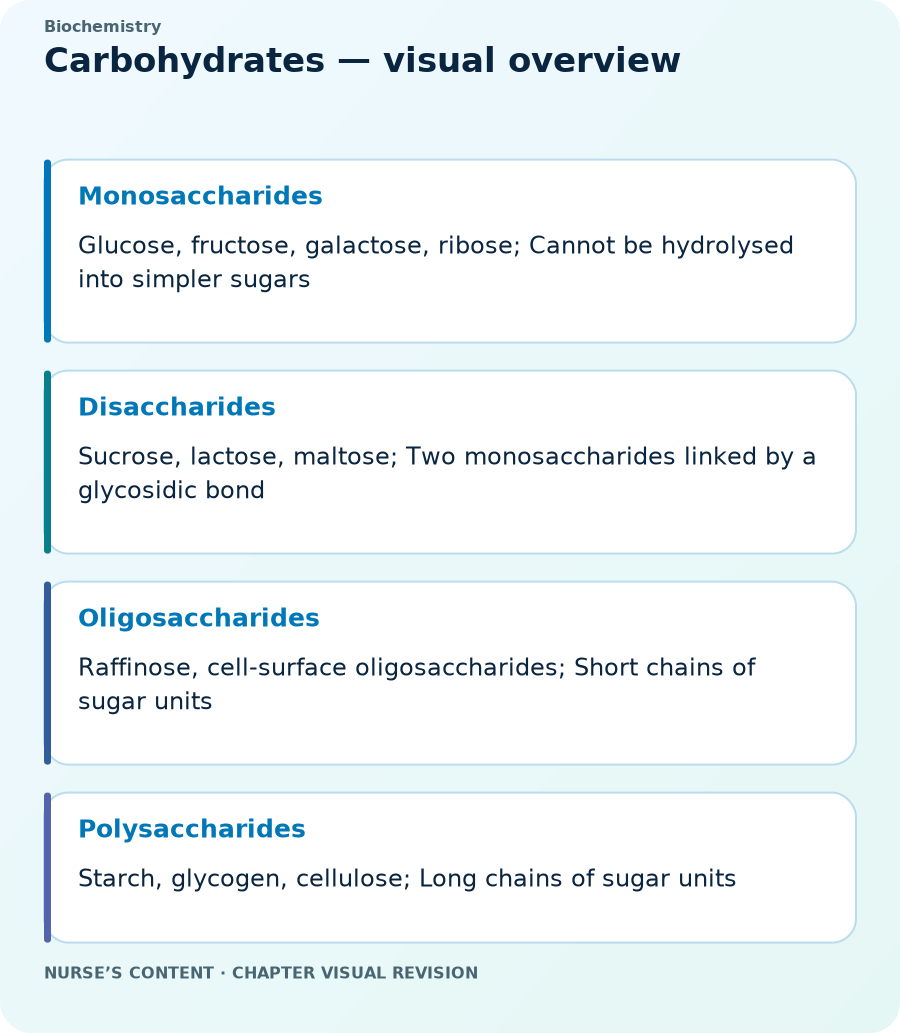
| Class | Examples | Key feature |
|---|---|---|
| Monosaccharides | Glucose, fructose, galactose, ribose | Cannot be hydrolysed into simpler sugars |
| Disaccharides | Sucrose, lactose, maltose | Two monosaccharides linked by a glycosidic bond |
| Oligosaccharides | Raffinose, cell-surface oligosaccharides | Short chains of sugar units |
| Polysaccharides | Starch, glycogen, cellulose | Long chains of sugar units |
| Disaccharide | Components | Bond / property |
|---|---|---|
| Maltose | Glucose + glucose | α(1→4); reducing |
| Lactose | Galactose + glucose | β(1→4); reducing |
| Sucrose | Glucose + fructose | α(1→2)β; non-reducing |
Reducing sugars have an available anomeric group that can reduce certain reagents. Benedict's test detects reducing substances but is not specific for glucose and is not the preferred modern diagnostic blood glucose test.
3. Polysaccharides
- • Starch: plant energy store; amylose is largely linear α(1→4) glucose, amylopectin has α(1→6) branches.
- • Glycogen: highly branched glucose polymer stored mainly in liver and skeletal muscle.
- • Cellulose: β(1→4) glucose polymer; human enzymes cannot digest it. It contributes to dietary fibre.
- • Glycosaminoglycans: complex carbohydrates in connective tissues, e.g., hyaluronic acid and heparin.
4. Functions
Glucose supplies energy (approximately 4 kcal/g of digestible carbohydrate). Glycogen provides a readily mobilized reserve; ribose and deoxyribose form nucleotides. Glycoproteins and glycolipids participate in cell recognition. Dietary fibre supports bowel function and may help improve glycaemic and lipid profiles.
5. Digestion and absorption
| Site | Enzyme / process | Products |
|---|---|---|
| Mouth | Salivary amylase | Shorter starch chains and maltose |
| Stomach | Acid progressively inactivates salivary amylase | Little further carbohydrate digestion |
| Small intestine | Pancreatic amylase | Maltose, maltotriose and limit dextrins |
| Brush border | Maltase, sucrase-isomaltase, lactase | Glucose, galactose, fructose |
Glucose and galactose enter enterocytes through sodium-dependent SGLT1; fructose enters by facilitated diffusion through GLUT5. Monosaccharides leave mainly via GLUT2 and enter the hepatic portal blood. Indigestible fibre reaches the colon, where some is fermented to short-chain fatty acids.
6. Monosaccharides: detailed classification
Monosaccharides can be classified according to the number of carbon atoms and the position of the carbonyl group. Aldoses contain an aldehyde group in their open-chain form; ketoses contain a ketone group.
| Carbon number | Aldose example | Ketose example |
|---|---|---|
| 3 (triose) | Glyceraldehyde | Dihydroxyacetone |
| 5 (pentose) | Ribose | Ribulose |
| 6 (hexose) | Glucose, galactose, mannose | Fructose |
Important monosaccharides
- • Glucose is absorbed from food and can also be formed by the liver. It is the usual major fuel for the brain and the essential energy source for mature red blood cells.
- • Fructose is present in fruits and honey and is a component of sucrose.
- • Galactose is released during lactose digestion and contributes to glycoprotein and glycolipid synthesis.
- • Ribose forms part of RNA, ATP and nucleotide coenzymes; deoxyribose is present in DNA.
7. Comparison of starch, glycogen and cellulose
| Feature | Starch | Glycogen | Cellulose |
|---|---|---|---|
| Occurrence | Plants | Animals | Plant cell walls |
| Glucose linkage | α(1→4), some α(1→6) | α(1→4), frequent α(1→6) | β(1→4) |
| Function | Energy storage | Short-term glucose reserve | Structural support |
| Human digestion | Yes | Yes | No by human enzymes |
8. Carbohydrate derivatives and laboratory identification
Amino sugars contribute to extracellular matrix and cell-surface molecules; sugar acids such as glucuronic acid participate in conjugation reactions. Glycosylation is enzyme-directed attachment of sugars to proteins or lipids; glycation is nonenzymatic attachment, as in HbA1c formation.
The iodine test gives a blue-black colour with amylose-rich starch. Benedict's reagent can indicate reducing substances; it is a historical qualitative test and cannot establish a modern
diagnosis of diabetes.
9. Clinical importance and nursing applications
Lactase deficiency causes lactose malabsorption, bloating and diarrhoea. In diabetes, glucose homeostasis is impaired. In galactosaemia, inherited enzyme defects cause accumulation of galactose metabolites. Recognize diarrhoea, dehydration and symptoms of glucose abnormality; follow prescribed diet and monitor glucose when indicated. Dietary advice must be individualized; carbohydrate restriction is not appropriate for every patient.
10. Important Examination Questions
Long Answer Questions
- 1. Classify carbohydrates and describe digestion and absorption.
- 2. Describe monosaccharide classification and the properties of disaccharides.
- 3. Compare starch, glycogen and cellulose and discuss their functions.
Short Answer Questions
- 1. Write a short note on Reducing sugars.
- 2. Write a short note on glycogen versus starch.
- 3. Write a short note on lactose intolerance.
Very Short Answer Questions
- 1. Name the storage carbohydrate of animals. – Glycogen.
- 2. Which enzyme digests lactose? – Lactase.
- 3. What transporter absorbs fructose at the intestinal apical membrane? – GLUT5.
- 4. Give two examples of reducing disaccharides. – Maltose and lactose.
Additional objective question
Which sugar is non-reducing? – Sucrose.
11. Quick Revision
- • Monosaccharides contain one sugar unit; disaccharides contain two.
- • Sucrose is glucose plus fructose; lactose is galactose plus glucose.
- • Glycogen is more highly branched than amylopectin.
- • Brush-border enzymes release absorbable monosaccharides.
Conclusion
Carbohydrates provide energy and important structural molecules; their digestion and absorption explain common clinical problems such as lactose intolerance and altered glucose metabolism.
Chapter reference images