Biochemistry
Blood Biochemistry
Composition of blood, plasma proteins, haemoglobin, bilirubin, blood glucose, blood urea, creatinine, uric acid and their clinical significance.
Open quizzes and study tools Download PDF
CHAPTER 13
Blood Biochemistry
Plasma proteins, haemoglobin, bilirubin, glucose and nitrogenous waste
1. Composition and functions of blood
Blood comprises plasma (roughly 55% of volume in a typical adult) and formed elements (red cells, white cells and platelets). Plasma is mostly water with proteins, electrolytes, nutrients, hormones and wastes. Transport, buffering, temperature control, immunity and haemostasis are key functions. Serum is the liquid remaining after blood clots; fibrinogen is depleted compared with plasma.
2. Plasma proteins
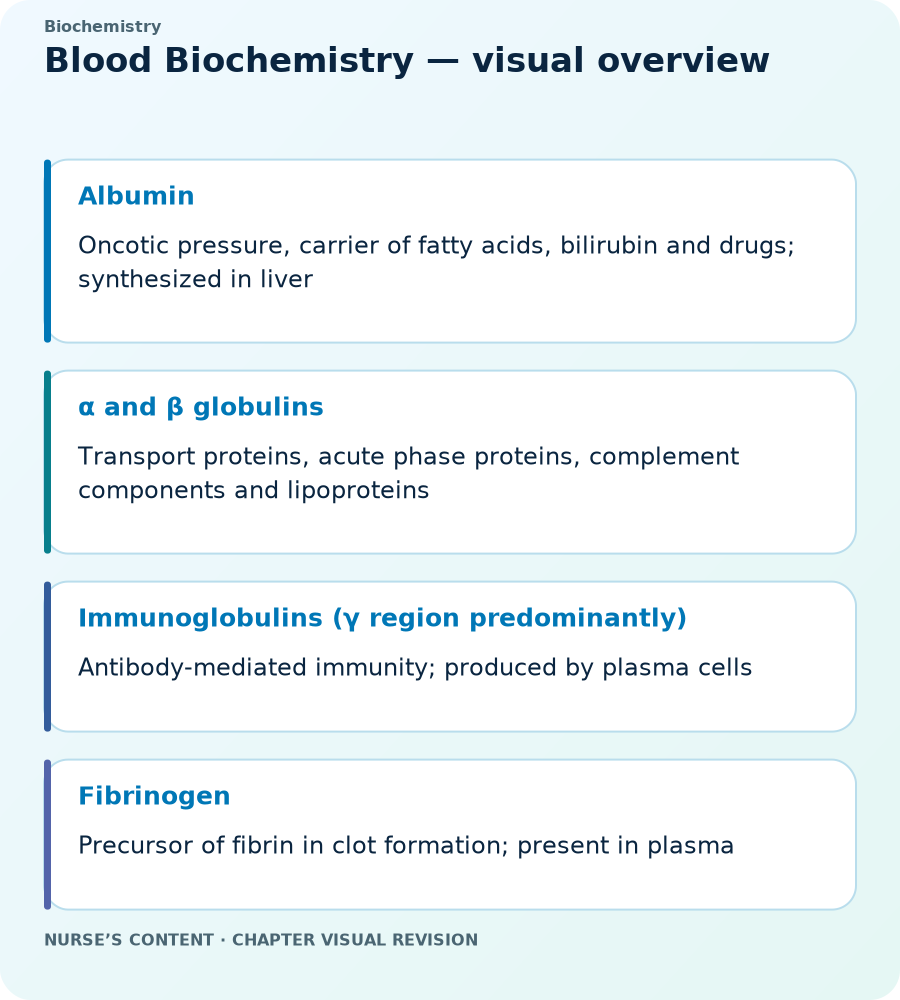
| Protein | Function / clinical significance |
|---|---|
| Albumin | Oncotic pressure, carrier of fatty acids, bilirubin and drugs; synthesized in liver |
| α and β globulins | Transport proteins, acute phase proteins, complement components and lipoproteins |
| Immunoglobulins (γ region predominantly) | Antibody-mediated immunity; produced by plasma cells |
| Fibrinogen | Precursor of fibrin in clot formation; present in plasma |
Total serum protein commonly ranges 6.0–8.3 g/dL and albumin 3.5–5.0 g/dL. Globulin may be estimated as total protein minus albumin. A low albumin can reflect inflammation, decreased synthesis, losses or dilution. Serum protein electrophoresis separates fractions and helps assess abnormal protein patterns.
3. Haemoglobin and haem metabolism
Haemoglobin is a conjugated protein made of four globin chains and four haem groups containing ferrous iron (Fe²⁺); each haem binds one oxygen molecule. Adult HbA (α₂β₂) predominates, with smaller HbA₂ and HbF fractions. HbF (α₂γ₂) has higher oxygen affinity. Falling pH, elevated CO₂ and 2,3-BPG reduce oxygen affinity, facilitating tissue release. Oxidation to Fe³⁺ forms methaemoglobin, which cannot bind oxygen normally.
Old red cells are broken down by macrophages. Haem → biliverdin → unconjugated bilirubin; bilirubin travels bound to albumin and is conjugated in liver before biliary excretion (Chapter 16). Iron is recycled.
4. Common biochemical markers
| Test | Typical adult teaching range | Clinical significance |
|---|---|---|
| Fasting plasma glucose | 70–99 mg/dL | Glucose regulation; diagnostic criteria in Chapter 18 |
| Total bilirubin | 0.2–1.2 mg/dL | Haem breakdown and hepatic excretion |
| Blood urea nitrogen (BUN) | 7–20 mg/dL | Protein metabolism and renal clearance |
| Serum creatinine | ~0.6–1.3 mg/dL | Creatine turnover and renal filtration; varies with muscle mass |
| Uric acid | Approx. 3–7 mg/dL; sex/lab dependent | Purine breakdown; hyperuricaemia may contribute to gout |
| Test | Typical adult teaching range | Clinical significance |
|---|---|---|
| Haemoglobin | Approx. 13–17 g/dL men; 12–15 g/dL women | Oxygen-carrying capacity; varies by lab and population |
BUN measures the nitrogen fraction of urea; urea (mg/dL) ≈ BUN × 2.14. Do not interchange the two blindly. Elevated urea can also reflect dehydration, GI bleeding or catabolic states. Creatinine may be influenced by diet, muscle mass and medicines. Uric acid alone does not diagnose gout.
5. Glucose and glycated haemoglobin
HbA1c results from nonenzymatic glycation of haemoglobin, reflecting glucose exposure over roughly the prior 2–3 months with greater influence from recent weeks. Anaemia, altered erythrocyte lifespan, transfusion and some haemoglobin variants can make results misleading. Laboratory and bedside glucose values are not always interchangeable for diagnosis.
6. Blood cells: biochemical significance
| Cell | Key biochemical features |
|---|---|
| Erythrocyte | Haemoglobin transports oxygen; mature cells lack mitochondria and rely on glycolysis for ATP |
| Leukocyte | Immune cells use enzymes, signalling pathways and energy metabolism for defence |
| Platelet | Cell fragments containing granules and signalling systems supporting haemostasis |
Red-cell pentose phosphate pathway activity produces NADPH, which helps maintain reduced glutathione and protect against oxidative damage. Deficiency of G6PD can make red cells vulnerable to oxidant-induced haemolysis.
7. Haemoglobin types and oxygen affinity
Normal adult haemoglobin consists predominantly of HbA with minor HbA₂ and HbF. Oxygen binding is cooperative: binding of oxygen to one haem group increases affinity at other sites. The Bohr effect describes decreased oxygen affinity with increased CO₂ and hydrogen ion concentration. Carbon monoxide binds haemoglobin strongly and impairs oxygen delivery; standard pulse oximetry can be misleading in significant carbon monoxide exposure.
Serum and plasma comparison
| Feature | Serum | Plasma |
|---|---|---|
| How obtained | Blood allowed to clot before separation | Blood collected with appropriate anticoagulant |
| Fibrinogen | Substantially depleted | Present |
| Use | Many routine chemistry and serology assays | Selected chemistry and coagulation assays |
Use the specified specimen for each laboratory method.
8. Biochemical interpretation of common abnormalities
Raised bilirubin with anaemia may indicate increased haem breakdown or other causes; bilirubin fractionation and additional findings guide interpretation. An increased creatinine may reflect impaired filtration, but its trajectory and muscle mass matter. Low albumin is not a direct measure of dietary protein intake alone. A raised glucose during acute illness does not automatically establish chronic diabetes.
9. Nursing applications
Use correct tube and handling instructions. Avoid haemolysis; it can spuriously raise potassium, LDH and AST. Verify the laboratory units, patient identity, sampling conditions and trends. Assess fatigue, pallor, jaundice, bleeding, hydration and glucose-related symptoms. Escalate critical values according to institutional policy.
10. Important Examination Questions
Long Answer Questions
- 1. Describe composition of blood, plasma proteins and important biochemical markers.
- 2. Describe haemoglobin structure, function and breakdown.
- 3. Explain the importance of glucose, urea, creatinine and bilirubin measurements.
Short Answer Questions
- 1. Write a short note on Serum vs plasma.
- 2. Write a short note on Hb structure.
- 3. Write a short note on HbA1c.
- 4. Write a short note on BUN vs urea.
Very Short Answer Questions
- 1. Which iron form binds oxygen in haemoglobin? – Ferrous iron (Fe²⁺).
- 2. Which haemoglobin is predominant in adults? – HbA.
- 3. Where are most plasma proteins synthesized? – Liver (immunoglobulins are produced by plasma cells).
- 4. Which protein transports iron in blood? – Transferrin.
Additional objective question
Main plasma protein maintaining oncotic pressure? – Albumin.
11. Quick Revision
- • Plasma contains clotting proteins; serum is obtained after clotting.
- • Albumin supports oncotic pressure and transports many substances.
- • Haemoglobin contains four haem groups and globin chains.
- • HbA1c reflects longer-term glucose exposure; urea and BUN have different units of mass.
Conclusion
Blood biochemistry links oxygen transport, protein function and metabolic waste measurement with routine laboratory assessment in nursing.
Chapter reference images