Biochemistry
Acid–Base Balance
Acids, bases and buffers, bicarbonate buffer system, respiratory and renal regulation of pH, acidosis, alkalosis and their biochemical basis.
Open quizzes and study tools Download PDF
CHAPTER 14
Acid–Base Balance
Buffers, respiratory and renal pH regulation, acidosis and alkalosis
1. Basic concepts
Acids donate H⁺; bases accept H⁺. Blood pH is tightly regulated. Acidaemia is a measured arterial pH below 7.35; alkalaemia is above 7.45. Acidosis and alkalosis refer to processes tending to decrease or increase pH, respectively; mixed processes can coexist with a normal pH.
2. Buffer systems
| Buffer | Role |
|---|---|
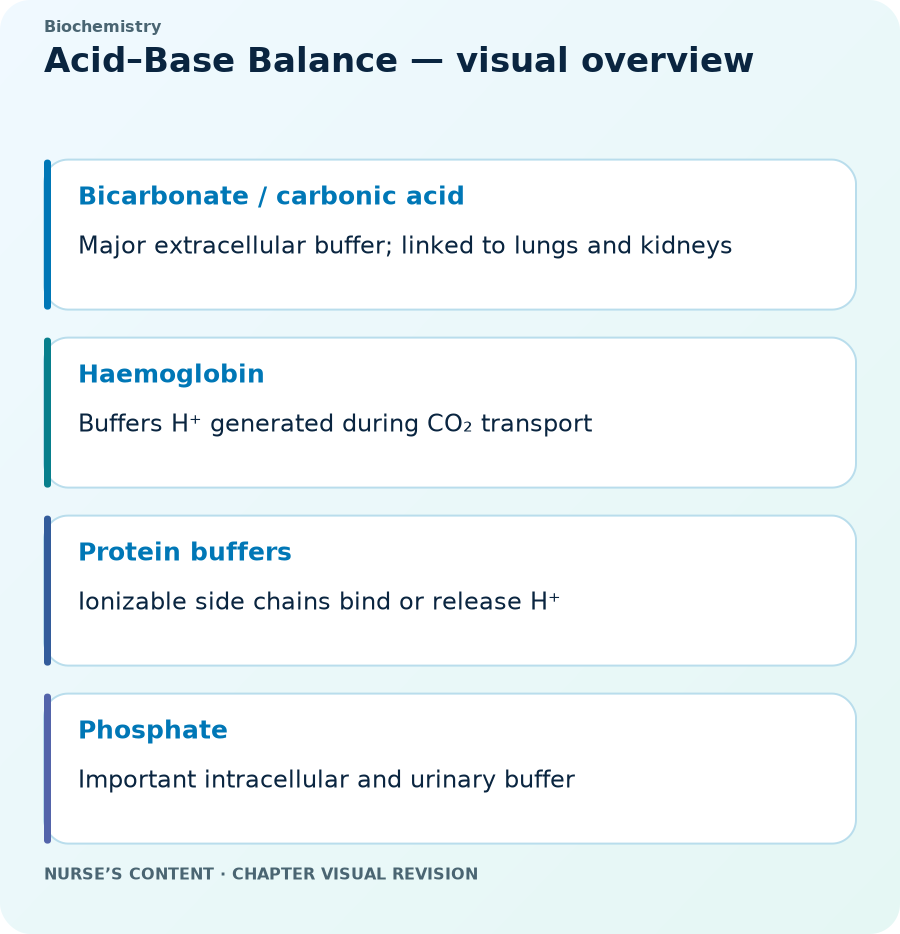
| Bicarbonate / carbonic acid | Major extracellular buffer; linked to lungs and kidneys |
| Haemoglobin | Buffers H⁺ generated during CO₂ transport |
| Protein buffers | Ionizable side chains bind or release H⁺ |
| Phosphate | Important intracellular and urinary buffer |
Bicarbonate equilibrium: CO₂ + H₂O ⇌ H₂CO₃ ⇌ H⁺ + HCO₃⁻. Carbonic anhydrase accelerates interconversion. Henderson–Hasselbalch equation for arterial blood: pH = 6.1 + log₁₀(HCO₃⁻ / (0.03 × PaCO₂)), with bicarbonate in mmol/L and PaCO₂ in mmHg. A ratio near 20:1 gives pH near 7.4.
3. Regulation of body pH
Chemical buffers act rapidly. Lungs regulate volatile acid by changing ventilation: faster ventilation lowers PaCO₂, while inadequate ventilation raises it. Kidneys reclaim filtered bicarbonate, excrete H⁺ as titratable acid and ammonium, and generate new bicarbonate. Renal compensation develops more slowly (hours to days).
4. Normal adult arterial blood gas (ABG) values
| Parameter | Typical reference |
|---|---|
| pH | 7.35–7.45 |
| PaCO₂ | 35–45 mmHg |
| HCO₃⁻ | 22–26 mmol/L |
| PaO₂ | ~80–100 mmHg in healthy adults at sea level, age and context dependent |
5. Primary acid–base disorders
| Disorder | Primary change | Possible causes | Compensatory direction |
|---|---|---|---|
| Metabolic acidosis | HCO₃⁻ ↓ | DKA, lactic acidosis, renal failure, diarrhoea | PaCO₂ ↓ |
| Metabolic alkalosis | HCO₃⁻ ↑ | Vomiting, gastric suction, diuretics | PaCO₂ ↑ |
| Respiratory acidosis | PaCO₂ ↑ | Hypoventilation, opioid respiratory depression, lung disease | HCO₃⁻ ↑ |
| Disorder | Primary change | Possible causes | Compensatory direction |
|---|---|---|---|
| Respiratory alkalosis | PaCO₂ ↓ | Hyperventilation from hypoxaemia, pain, sepsis or other causes | HCO₃⁻ ↓ |
Compensation limits pH disturbance and does not usually overshoot; unexpected values suggest a mixed disorder.
6. Anion gap and compensation
Anion gap (AG) = Na⁺ − (Cl⁻ + HCO₃⁻), using mmol/L. A typical gap without potassium is approximately 8–12 mmol/L, but analyzer-specific intervals vary. Low albumin may lower the gap. High-gap acidosis suggests unmeasured anions, e.g., lactate or ketones. Normal-gap acidosis can occur with bicarbonate loss.
For metabolic acidosis, Winter's formula estimates expected respiratory compensation: PaCO₂ ≈ 1.5 × HCO₃⁻ + 8 ± 2 mmHg. A measured result outside this range suggests an additional respiratory process.
7. Worked ABG examples
| pH / PaCO₂ / HCO₃⁻ | Interpretation |
|---|---|
| 7.28 / 55 / 25 | Primary respiratory acidosis; evaluate acuity and compensation |
| 7.25 / 25 / 11 | Metabolic acidosis; expected PaCO₂ ~24.5 ± 2, consistent with compensation |
| 7.50 / 30 / 23 | Primary respiratory alkalosis |
| 7.48 / 48 / 35 | Metabolic alkalosis with compensatory CO₂ increase |
8. Chemical basis of acid production
Normal metabolism produces carbon dioxide and nonvolatile acids. Carbon dioxide combines reversibly with water, and ventilation controls its elimination. Nonvolatile acid arises from metabolism, including sulfur-containing amino acids; the kidney contributes to net acid excretion. Buffering, respiratory regulation and renal regulation operate together rather than independently.
Bicarbonate reclamation and new bicarbonate
In renal tubules, secreted hydrogen ions combine with filtered bicarbonate; carbonic anhydrase facilitates conversion to carbon dioxide and water. Bicarbonate is returned to blood. Net acid excretion as ammonium and titratable acid permits addition of new bicarbonate to the circulation. Reclaiming filtered bicarbonate alone does not represent net acid excretion.
9. Recognizing mixed disorders
| Finding | Possible interpretation |
|---|---|
| Low pH, low bicarbonate, low PaCO₂ | Metabolic acidosis with possible respiratory compensation |
| Low pH, high PaCO₂ | Respiratory acidosis, with bicarbonate assessed for compensation |
| High pH, high bicarbonate | Metabolic alkalosis, with PaCO₂ assessed for compensation |
| High pH, low PaCO₂ | Respiratory alkalosis, with bicarbonate assessed for compensation |
Normal pH does not exclude significant abnormality if bicarbonate and PaCO₂ are abnormal. Evaluate compensation expectations, anion gap, symptoms and timing.
10. Nursing assessment of acid–base disturbances
- • Monitor respiratory pattern, oxygenation, circulation, consciousness and fluid losses.
- • Recognize deep rapid breathing as a possible compensatory response to metabolic acidosis; do not assume anxiety is the cause.
- • Obtain specimens according to arterial blood gas protocol and prevent sampling errors such as air exposure or processing delay.
- • Report severe or worsening abnormalities promptly; bicarbonate administration is not appropriate for every acidosis.
11. Nursing applications
Assess airway, breathing, circulation, mental status and underlying causes. Confirm specimen type (arterial vs venous), oxygen therapy and collection conditions. Promptly report severe pH disturbances, respiratory deterioration or altered consciousness. Treat the cause under the medical plan; bicarbonate or oxygen is not automatically indicated for every abnormal ABG.
12. Important Examination Questions
Long Answer Questions
- 1. Explain buffer systems and regulation of acid–base balance.
- 2. Describe the four primary acid–base disorders and their compensatory responses.
- 3. Explain the bicarbonate buffer system and the Henderson–Hasselbalch equation.
Short Answer Questions
- 1. Write a short note on Henderson–Hasselbalch equation.
- 2. Write a short note on anion gap.
- 3. Write a short note on four disorders.
Very Short Answer Questions
- 1. What is acidaemia? – Arterial pH below 7.35.
- 2. Which organ controls carbon dioxide elimination? – Lungs.
- 3. Name the typical change in metabolic alkalosis. – Increased bicarbonate.
- 4. What respiratory response often compensates for metabolic acidosis? – Increased ventilation with decreased PaCO₂.
Additional objective question
Primary change in respiratory acidosis? – Increased PaCO₂.
13. Quick Revision
- • Normal arterial pH: 7.35–7.45; PaCO₂: 35–45 mmHg; bicarbonate: 22–26 mmol/L.
- • Respiratory disturbances primarily change PaCO₂; metabolic disturbances primarily change bicarbonate.
- • The bicarbonate buffer system depends on both pulmonary and renal regulation.
- • Anion gap helps distinguish several causes of metabolic acidosis.
Conclusion
Acid–base interpretation requires a systematic assessment of pH, carbon dioxide, bicarbonate, compensation and the clinical situation.
Chapter reference images