Anatomy & Physiology
Special Senses Physiology
Physiology of vision, hearing, equilibrium, smell, taste and touch, including sensory receptors and their functions.
Open quizzes and study tools Download PDF
Sensory transduction and receptor comparison
Sensory physiology explains how receptors convert environmental or internal stimuli into signals interpreted by the nervous system. Sensation is detection of a stimulus; perception is the brain’s interpretation of sensory information. Receptor potentials are graded, and information reaches the CNS through patterns of neural activity. Stimulus type, location, intensity and duration are encoded through receptor properties and pathways.
| Receptor class | Adequate stimulus | Examples |
|---|---|---|
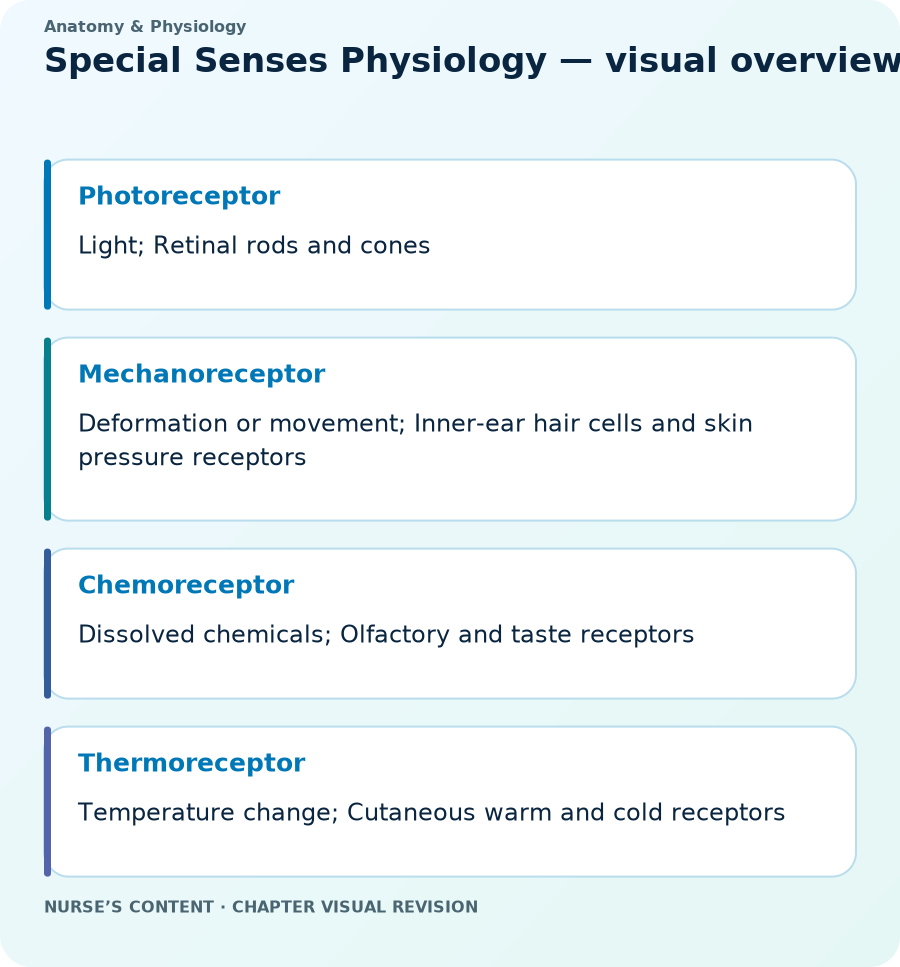
| Photoreceptor | Light | Retinal rods and cones |
| Mechanoreceptor | Deformation or movement | Inner-ear hair cells and skin pressure receptors |
| Chemoreceptor | Dissolved chemicals | Olfactory and taste receptors |
| Thermoreceptor | Temperature change | Cutaneous warm and cold receptors |
| Nociceptor | Potentially damaging stimuli | Many free nerve endings |
| Proprioceptor | Muscle length, tension or joint movement | Muscle spindles and tendon organs |
Some receptors adapt rapidly to sustained stimulation, emphasizing change, while others continue signaling. Reduced awareness of a steady stimulus does not mean that every sensory pathway has stopped working.
Vision: focusing and retinal processing
Light passes through the cornea, aqueous humour, pupil, lens and vitreous before reaching the retina. The cornea provides much of the refractive power, while the lens adjusts focus. For near accommodation, ciliary muscle contraction reduces tension on suspensory fibres, allowing the lens to become rounder. The iris regulates pupil size and light entry; pupil adjustment and accommodation are related but distinct responses.
Rods provide sensitive dim-light vision, whereas cones support colour and high-acuity vision, especially centrally. Light changes photopigments and hyperpolarizes photoreceptors, altering transmitter release. Retinal circuits process the signal, and ganglion-cell axons form the optic nerve. Signals pass through central pathways to visual cortex for interpretation. The optic disc has no photoreceptors, producing the physiological blind spot. Loss of lens elasticity with age reduces accommodation.
Hearing: sound to neural signals
Sound waves travel through the external canal and vibrate the tympanic membrane. The malleus, incus and stapes transmit vibration to the oval window and cochlear fluid. A travelling wave displaces the basilar membrane. Hair-cell stereocilia bend, altering ion flow and transmitter release onto auditory nerve fibres. The cochlear division of cranial nerve VIII carries the resulting information toward brain-stem and higher auditory pathways.
Different basilar-membrane regions respond best to different frequencies: the stiffer base favours high frequencies and the more flexible apex favours low frequencies. Intensity is represented through neural firing and recruitment patterns. Conductive impairment limits sound transmission through outer or middle-ear structures, while sensorineural impairment involves cochlear or neural mechanisms. These categories describe different stages of the pathway and help organize assessment findings.
Equilibrium and postural integration
Vestibular hair cells detect mechanical forces in the inner ear. Semicircular ducts detect angular acceleration through movement of endolymph and deflection of the cupula. The utricle and saccule detect linear acceleration and head orientation relative to gravity. Otoconia weight their gelatinous receptor coverings, so gravity or acceleration can bend the underlying stereocilia.
Vestibular signals travel through cranial nerve VIII and are integrated with visual and proprioceptive information. Brain-stem and cerebellar circuits help maintain posture and stabilize gaze through vestibulo-ocular responses. Balance is therefore a multisystem function. Removing visual input can expose reliance on vision when other inputs are impaired. Dizziness is a broad symptom; vertigo specifically describes an illusory sense of movement and does not establish a particular diagnosis.
Smell, taste and somatic sensation
Odorant molecules dissolve in nasal mucus and activate receptors on olfactory sensory neurons. Signals pass through the olfactory nerve to the bulb and central olfactory pathways. Smell contributes to flavour, appetite and detection of hazards. Olfactory adaptation reduces awareness of persistent odours. Chemical irritation from substances such as menthol involves additional pathways and should not be confused with smell alone.
Dissolved food chemicals stimulate taste-receptor cells in taste buds. The basic taste qualities are sweet, sour, salty, bitter and umami. Different mechanisms transduce these qualities, and signals travel mainly through cranial nerves VII, IX and X. Taste qualities are not confined to a rigid tongue map. Touch is a general sense carried by receptors distributed through skin and deeper tissues; pressure, vibration, temperature, pain and proprioception follow organized pathways to central processing.
Nursing applications and exam organization
Establish usual vision, hearing, sensation and mobility, including use of glasses or hearing devices. Communicate face-to-face with a clear view of the speaker and confirm understanding. Sensory loss can affect medication comprehension, nutrition, mobility and recognition of injury. Reduced smell can interfere with detection of smoke or spoiled food, while reduced protective sensation increases unnoticed skin-injury risk.
Assess sudden sensory change promptly, particularly when accompanied by neurological findings. Maintain safe assistance during balance testing or mobility assessment. For exams, follow each pathway from stimulus through receptor, transduction, nerve and central interpretation. Compare rods with cones, conductive with sensorineural hearing impairment, and semicircular with otolith function. Include touch as a general sensory system while distinguishing it from the anatomically specialized senses. Explain sensory findings without equating a screening result with a definitive diagnosis.
Quick Revision
- Receptors transduce stimuli, while central pathways construct perception.
- Rods support dim-light vision and cones support colour and high acuity.
- Cochlear hair cells convert mechanical movement into neural signaling.
- Semicircular ducts and otolith organs detect different movement-related stimuli.
- Smell and taste cooperate in flavour perception.
- Sensory changes influence communication, nutrition, mobility and injury risk.
Important Examination Questions
- Explain visual accommodation and compare rods with cones.
- Trace the hearing pathway from sound wave to auditory cortex.
- Compare semicircular-duct and otolith-organ functions.
- Describe olfactory and taste transduction and relevant cranial nerves.
- Classify sensory receptors and explain nursing implications of impaired touch or balance.
References and further reading
Newly written physiology study notes. Read the supporting textbook sections for diagrams, mechanisms and further explanation.
- OpenStax Anatomy and Physiology 2e: Sensory Perception
- OpenStax Anatomy and Physiology 2e: Central Processing
- OpenStax Anatomy and Physiology 2e: The Cranial Nerve Exam
- OpenStax Anatomy and Physiology 2e: The Sensory and Motor Exams
- National Eye Institute: How the Eyes Work
- NIDCD: How Do We Hear?
- NIDCD: Balance Disorders
- NIDCD: Taste Disorders
- NIDCD: Smell Disorders
Chapter reference images