Anatomy & Physiology
Nervous System Physiology
Neuron physiology, nerve impulse transmission, synapse, reflex action, functions of the brain and spinal cord, autonomic nervous system and sensory and motor functions.
Open quizzes and study tools Download PDF
Organization, neurons and glial support
Nervous physiology explains rapid communication, sensory detection, integration and motor control. The central nervous system includes brain and spinal cord; the peripheral nervous system connects these with receptors and effectors. Afferent pathways carry information toward the CNS, while efferent pathways carry commands toward muscles and glands. Somatic and autonomic outputs differ in targets and circuit organization.
A neuron has a cell body, receptive processes and an axon specialized for signaling to target cells. Dendrites usually receive inputs, while axon terminals release chemical signals. Glia maintain the environment, provide support and participate in defence and signaling. Oligodendrocytes form CNS myelin and Schwann cells form peripheral myelin. Myelin insulates axonal segments and permits rapid saltatory conduction between nodes of Ranvier.
Resting potential and action potentials
The resting membrane potential reflects unequal ion distributions and selective membrane permeability, especially potassium leak conductance. The sodium–potassium pump maintains the underlying concentration gradients. A typical textbook neuronal resting value is around −70 mV, but actual values vary by cell. Local graded potentials change in size with stimulus strength and can sum across time and space.
When depolarization reaches threshold at a trigger region, voltage-gated sodium channels generate a rapid inward current. Sodium-channel inactivation and increased potassium conductance then support repolarization. A transient after-hyperpolarization may follow. The action potential is all-or-none at a given membrane region. Stronger stimuli are encoded mainly through firing frequency and recruitment, rather than a larger action-potential amplitude. Refractory periods limit firing and favour forward propagation along an activated axon.
Synapses and integration
At a chemical synapse, an arriving action potential opens presynaptic voltage-gated calcium channels. Calcium entry triggers neurotransmitter release by vesicle fusion. Transmitter crosses the synaptic cleft and binds postsynaptic receptors, producing an excitatory, inhibitory or modulatory effect depending on receptor and ion-channel properties. The same transmitter can therefore have different effects at different targets.
Excitatory postsynaptic potentials increase the likelihood of threshold being reached; inhibitory effects reduce it. Temporal and spatial summation allow a neuron to integrate many inputs. Transmitter action ends through reuptake, enzymatic breakdown or diffusion. Electrical synapses transmit current through gap junctions and can support rapid coordinated activity. Synaptic delay and fatigue differ from axonal conduction and explain why a neural circuit is more than an insulated wire.
Brain, spinal cord and reflex function
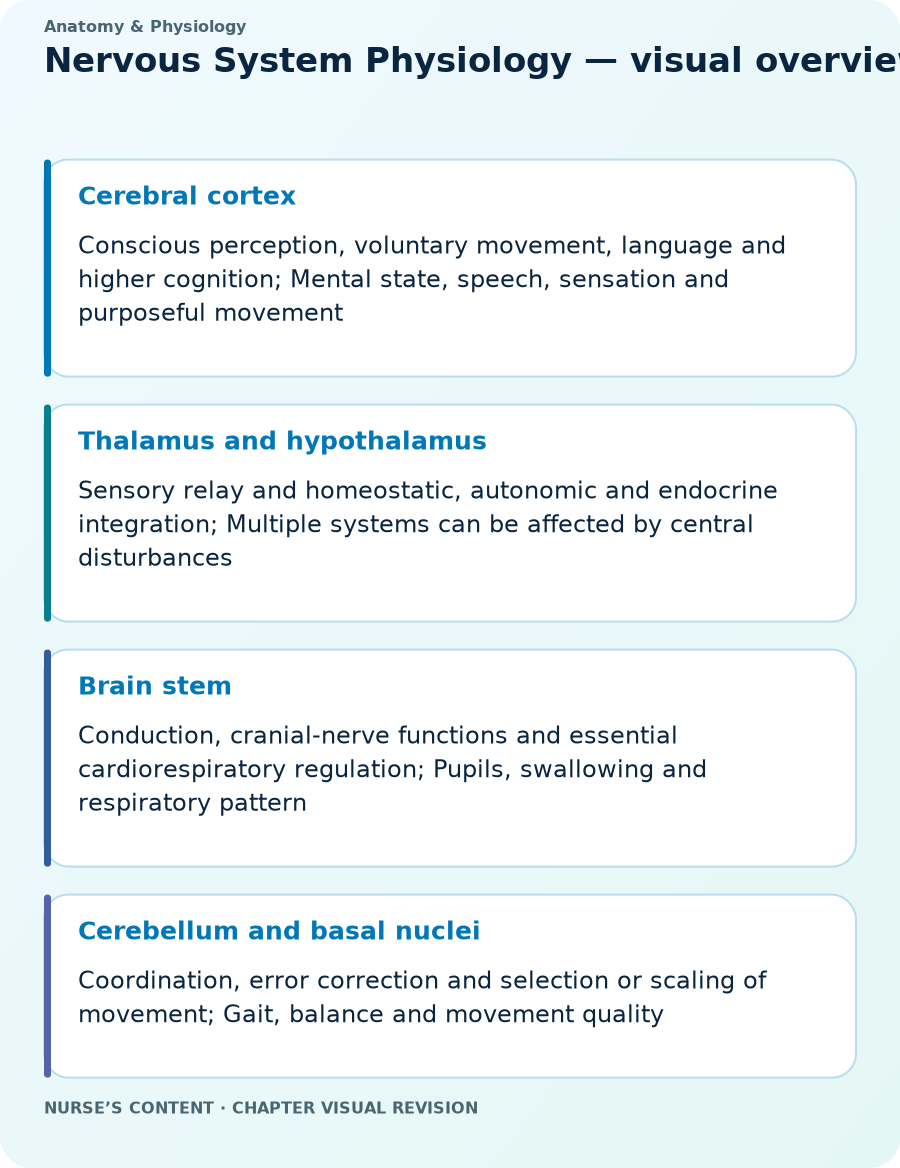
| Region or pathway | Major physiological contribution | Assessment connection |
|---|---|---|
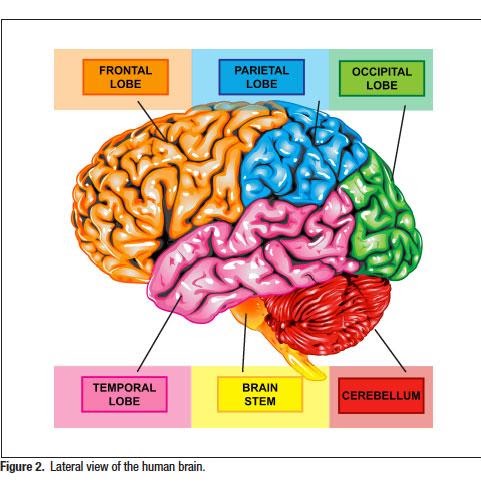
| Cerebral cortex | Conscious perception, voluntary movement, language and higher cognition | Mental state, speech, sensation and purposeful movement |
| Thalamus and hypothalamus | Sensory relay and homeostatic, autonomic and endocrine integration | Multiple systems can be affected by central disturbances |
| Brain stem | Conduction, cranial-nerve functions and essential cardiorespiratory regulation | Pupils, swallowing and respiratory pattern |
| Cerebellum and basal nuclei | Coordination, error correction and selection or scaling of movement | Gait, balance and movement quality |
| Spinal cord | Ascending sensation, descending motor pathways and reflex integration | Segmental patterns and reflex responses |
A reflex arc includes a receptor, afferent neuron, integration centre, efferent neuron and effector. A stretch reflex can use a direct sensory-to-motor synapse, whereas withdrawal involves interneurons and coordinated reciprocal inhibition. Reflexes can occur before conscious perception, but higher centres still influence their expression. Spinal reflexes therefore do not require a conscious decision.
Autonomic, sensory and motor comparisons
| Feature | Somatic output | Autonomic output |
|---|---|---|
| Main target | Skeletal muscle | Cardiac muscle, smooth muscle and glands |
| Peripheral motor pathway | Usually one motor neuron from CNS to muscle | Usually preganglionic and postganglionic neurons |
| Typical transmitter pattern | Acetylcholine at neuromuscular junction | Acetylcholine at ganglia; acetylcholine or norepinephrine at many effectors |
| Functional role | Voluntary movement and somatic reflexes | Homeostatic regulation and visceral reflexes |
Sympathetic activity supports responses such as increased cardiac activity and redistribution of blood flow; parasympathetic activity often slows the heart and supports digestion. Effects depend on receptors, and the divisions are not simple on–off opposites in every organ. Sympathetic innervation of most sweat glands uses acetylcholine, an important exception to the common transmitter pattern. Sensory modalities travel in organized ascending pathways, while descending pathways influence lower motor neurons that ultimately activate skeletal muscle.
Nursing applications and examination approach
Establish a baseline and compare consciousness, orientation, speech, pupils, limb strength, sensation, coordination and gait over time. Document side, onset and pattern rather than only writing “neurologically normal.” A sudden focal deficit, new reduced consciousness or rapidly changing neurological function needs prompt escalation. Pain, fatigue, language, hearing and sedating medicines can affect examination performance and must be considered.
For exams, draw an action-potential curve and label ion movements, then explain a chemical synapse separately. Use a five-component reflex diagram, a brain-function table and a somatic–autonomic comparison. In a case answer, trace input, integration and output to connect findings with possible pathway disruption. Preserve the distinction between an observed deficit and a confirmed anatomical diagnosis; several disturbances can produce similar bedside findings.
Quick Revision
- Afferent pathways enter the CNS and efferent pathways leave it.
- Ion gradients and selective permeability establish neuronal excitability.
- Action potentials are all-or-none and propagate along axons.
- Chemical synapses use calcium-dependent transmitter release and receptor-specific effects.
- Spinal reflexes integrate sensory input with motor output.
- Autonomic effects depend on the target receptor and organ.
Important Examination Questions
- Explain resting membrane potential and the phases of an action potential.
- Describe chemical synaptic transmission and postsynaptic summation.
- Explain reflex action using a labelled reflex arc.
- Discuss major brain and spinal-cord functions with nursing assessment examples.
- Compare somatic, sympathetic and parasympathetic control.
References and further reading
Newly written physiology study notes. Read the supporting textbook sections for diagrams, mechanisms and further explanation.
- OpenStax Anatomy and Physiology 2e: Nervous Tissue
- OpenStax Anatomy and Physiology 2e: The Action Potential
- OpenStax Anatomy and Physiology 2e: Communication Between Neurons
- OpenStax Anatomy and Physiology 2e: The Central Nervous System
- OpenStax Anatomy and Physiology 2e: Central Processing
- OpenStax Anatomy and Physiology 2e: Motor Responses
- OpenStax Anatomy and Physiology 2e: Divisions of the Autonomic Nervous System
- OpenStax Anatomy and Physiology 2e: Autonomic Reflexes and Homeostasis
- OpenStax Anatomy and Physiology 2e: The Sensory and Motor Exams
Chapter reference images