Anatomy & Physiology
Musculoskeletal and Skin Physiology
Muscle contraction, neuromuscular transmission, functions of skeletal, smooth and cardiac muscles, bone growth and remodeling, skin functions and body temperature regulation.
Open quizzes and study tools Download PDF
Functions and integrated movement
Musculoskeletal physiology explains force production, movement, posture, skeletal renewal and mineral storage. Muscle contraction also generates heat, assists venous return and supports breathing. Bones provide support and protection, act as levers, store calcium and phosphate and contain marrow. Skin provides a protective and sensory interface and participates in temperature and water regulation. These functions interact during mobility, recovery and adaptation to the environment.
A motor unit consists of one motor neuron and all skeletal muscle fibres it supplies. Increasing motor-unit recruitment or firing frequency can increase whole-muscle force. Muscle tone reflects continuing low-level activity and neural influences. Isometric contraction produces tension without an overall change in muscle length, whereas isotonic movement changes length; concentric shortening and eccentric lengthening are useful functional comparisons.
Neuromuscular transmission and sliding filaments
At the neuromuscular junction, a motor-neuron action potential triggers calcium-dependent acetylcholine release. Acetylcholine binds nicotinic receptors on the motor end plate, producing depolarization that can initiate a muscle action potential. Acetylcholinesterase limits transmitter action. Excitation spreads along the sarcolemma and T tubules, activating sarcoplasmic-reticulum calcium release. This links electrical excitation with mechanical contraction.
In skeletal muscle, calcium binds troponin and shifts tropomyosin away from actin’s binding sites. Myosin binds actin and generates force through cross-bridge cycling. ATP binding allows myosin detachment; ATP hydrolysis energizes the next cycle. Actin and myosin filaments slide past one another rather than shortening themselves. Calcium pumping back into the sarcoplasmic reticulum also requires energy and permits relaxation. ATP is therefore necessary for both effective contraction and relaxation.
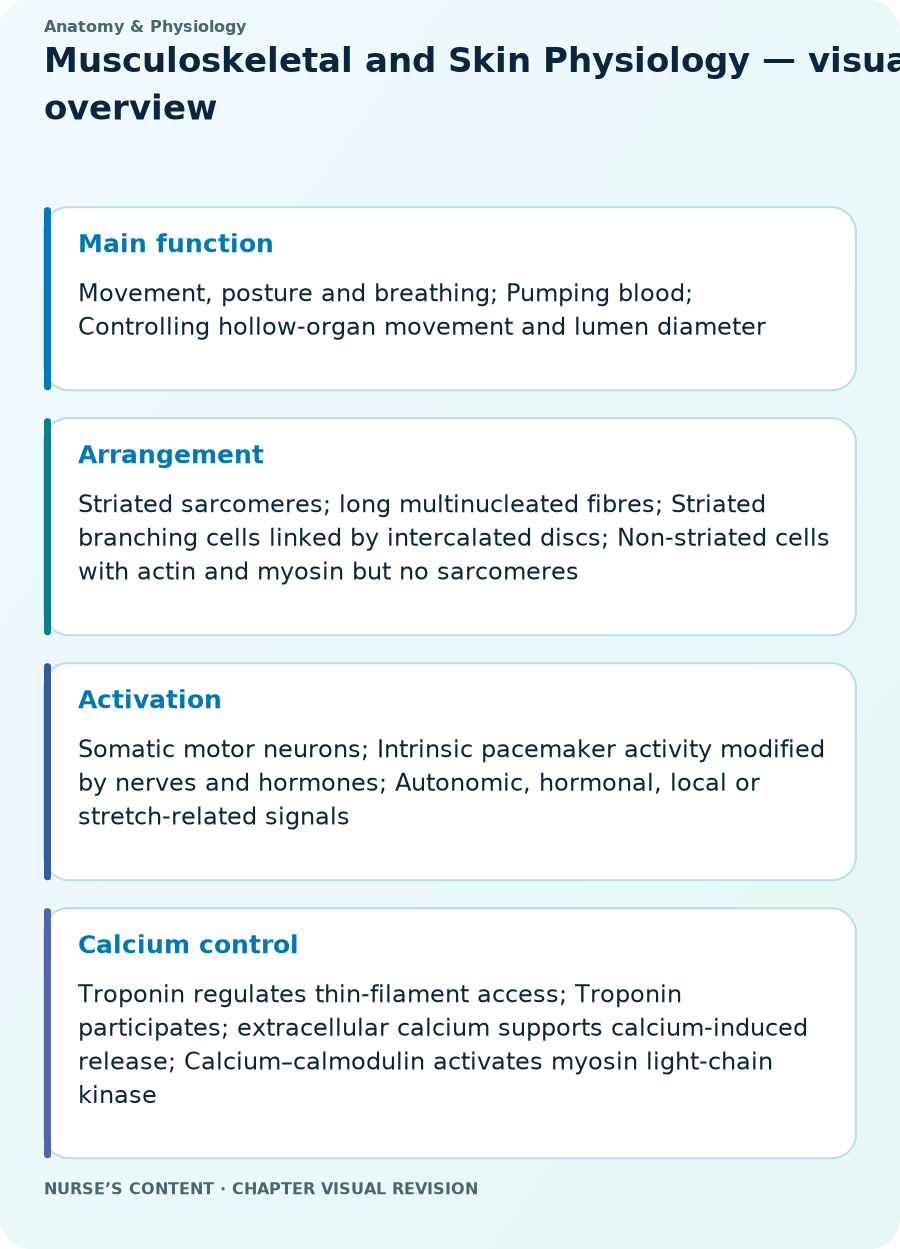
Compare the three muscle tissues
| Feature | Skeletal | Cardiac | Smooth |
|---|---|---|---|
| Main function | Movement, posture and breathing | Pumping blood | Controlling hollow-organ movement and lumen diameter |
| Arrangement | Striated sarcomeres; long multinucleated fibres | Striated branching cells linked by intercalated discs | Non-striated cells with actin and myosin but no sarcomeres |
| Activation | Somatic motor neurons | Intrinsic pacemaker activity modified by nerves and hormones | Autonomic, hormonal, local or stretch-related signals |
| Calcium control | Troponin regulates thin-filament access | Troponin participates; extracellular calcium supports calcium-induced release | Calcium–calmodulin activates myosin light-chain kinase |
| Functional pattern | Brief or sustained contractions through recruitment and summation | Long refractory period limits tetanic contraction | Often slow, sustained and energy-efficient force |
Cardiac gap junctions allow current to spread between cells and coordinate contraction. Smooth-muscle characteristics vary between organs; some cells are electrically coupled, while others receive more individual neural control. Voluntary control is therefore not the only useful distinction between muscle types.
Energy, fatigue and functional adaptation
Muscle initially uses available ATP and creatine phosphate, while glycolysis and oxidative metabolism replenish ATP according to demand and supply. Sustained activity depends on oxygen and nutrient delivery, mitochondrial capacity and waste handling. Fatigue has multiple causes, including altered ion handling, substrate availability and neural factors; it should not be explained solely as lactic acid accumulation.
Force also depends on starting muscle length, cross-sectional area and the pattern of activation. Repeated appropriate loading can support strength and endurance, while disuse promotes atrophy and reduced functional reserve. Immobility affects more than muscle size: it reduces the skeletal-muscle pump and mechanical loading of bone. Nursing mobility assessment should therefore connect strength, tolerance, circulation, balance and the person’s usual level of activity.
Bone growth, remodeling and mineral balance
Intramembranous ossification forms bone directly from connective-tissue precursors, while endochondral ossification replaces a cartilage model. Long-bone lengthening occurs at growth plates until closure; appositional growth increases width. Remodeling continues throughout life, coupling resorption by osteoclasts with formation by osteoblasts. Osteocytes help sense mechanical conditions and coordinate maintenance. Modeling changes bone shape, whereas remodeling renews existing tissue.
Mechanical loading, nutrition, vitamin D and hormones influence skeletal balance. Calcium and phosphate provide mineral strength, and collagen contributes tensile properties. Parathyroid hormone, calcitriol and renal function coordinate calcium availability with bone and intestinal handling. Reduced loading or altered endocrine balance can favour bone loss. Bone turnover is dynamic, so a mineral reservoir is not an inert store.
Skin functions and thermoregulation
The epidermal barrier reduces water loss and limits entry of pathogens and chemicals. Skin contains sensory receptors, contributes immune defence, and begins vitamin D synthesis after suitable ultraviolet exposure. Dermal vessels and sweat glands participate in heat exchange, while subcutaneous tissue provides insulation and cushioning. Barrier damage can therefore disturb fluid balance, sensation and infection protection as well as appearance.
The hypothalamus integrates temperature information and coordinates responses. Heat production arises from metabolism and can increase through shivering. Cutaneous vasoconstriction conserves heat; vasodilation increases heat transfer to the surface. Sweat cools mainly when it evaporates. Radiation transfers heat without direct contact, conduction requires contact, and convection involves moving air or fluid. Environmental temperature, humidity, clothing and skin perfusion affect the effectiveness of these processes.
Nursing applications and exam organization
Assess strength, joint movement, gait, skin integrity, sensation and temperature in context. Support prescribed mobility and repositioning plans, inspect vulnerable skin and document changes in function. Reduced sensation, poor perfusion and inability to move can combine to increase tissue-injury risk. Temperature comparisons should use the same measurement site and method when possible; a single textbook value does not account for daily variation and measurement differences.
For exams, draw the sequence from motor-neuron impulse to calcium release, cross-bridge cycling and relaxation. Follow with a muscle-type table, then distinguish growth, modeling and remodeling. In temperature questions, separate heat production, conservation and loss and provide an example of each transfer mechanism. Explain nursing observations through the relevant physiology and escalate unexpected weakness, rapidly changing skin findings or deterioration according to the clinical setting.
Quick Revision
- Motor-unit recruitment and firing patterns influence skeletal-muscle force.
- Acetylcholine links motor-neuron activity with skeletal-muscle excitation.
- Calcium regulates contractile access and ATP supports cycling and relaxation.
- Skeletal, cardiac and smooth muscle use different control arrangements.
- Bone is continuously renewed through coordinated resorption and formation.
- Skin supports barrier defence, sensation and controlled heat exchange.
Important Examination Questions
- Explain neuromuscular transmission and excitation–contraction coupling.
- Describe sliding-filament contraction and the roles of calcium and ATP.
- Compare skeletal, cardiac and smooth muscle physiology.
- Explain bone growth, modeling, remodeling and calcium regulation.
- Describe skin functions and hypothalamic thermoregulation.
- Connect immobility and sensory loss with musculoskeletal and skin assessment priorities.
References and further reading
Newly written physiology study notes. Read the supporting textbook sections for diagrams, mechanisms and further explanation.
- OpenStax Anatomy and Physiology 2e: Muscle Fiber Contraction and Relaxation
- OpenStax Anatomy and Physiology 2e: Nervous System Control of Muscle Tension
- OpenStax Anatomy and Physiology 2e: Cardiac Muscle Tissue
- OpenStax Anatomy and Physiology 2e: Smooth Muscle
- OpenStax Anatomy and Physiology 2e: Bone Formation and Development
- OpenStax Anatomy and Physiology 2e: Exercise, Nutrition, Hormones, and Bone Tissue
- OpenStax Anatomy and Physiology 2e: Calcium Homeostasis
- OpenStax Anatomy and Physiology 2e: Functions of the Integumentary System
- OpenStax Anatomy and Physiology 2e: Energy and Heat Balance
Chapter reference images