Anatomy & Physiology
Introduction to Anatomy
Anatomical terminology, body organization, planes, cavities and positions
Open quizzes and study tools Download PDF
INTRODUCTION TO ANATOMY
B.Sc. Nursing – Applied Anatomy | Chapter 1
1. Definition of Anatomy
Anatomy is the branch of medical science that deals with the study of the structure, shape, size, location and relationship of different parts of the human body.
The word Anatomy is derived from the Greek words:
Ana = Apart
Tomy = Cutting
Branches of Anatomy
Gross Anatomy: Study of body structures visible to the naked eye.
Microscopic Anatomy: Study of structures that require a microscope.
Histology: Study of tissues.
Cytology: Study of cells.
Developmental Anatomy: Study of structural changes from fertilization to adulthood.
Embryology: Study of development of the embryo.
Regional Anatomy: Study of all structures in a particular body region.
Systemic Anatomy: Study of the body system by system.
Surface Anatomy: Study of external body landmarks.
Radiological Anatomy: Study of body structures using X-rays, CT scans, MRI and ultrasound.
2. Levels of Organization of the Human Body
The human body is organized into six main levels, from simple to complex.
Chemical Level: Atoms and molecules form the basic building blocks of the body.
Cellular Level: Molecules form cells, which are the basic structural and functional units of life.
Tissue Level: Groups of similar cells perform a common function.
Organ Level: Different tissues combine to form an organ.
Organ System Level: Several organs work together to perform specific functions.
Organism Level: All organ systems work together to maintain the complete human body.
Four Basic Types of Tissues
Tissue
Main Function
Epithelial
Protection, absorption and secretion
Connective
Support, binding and protection
Muscular
Movement and contraction
Nervous
Transmission of nerve impulses
3. Anatomical Position
The anatomical position is the standard reference position used to describe the location of body parts and their relationships.
Characteristics
Body stands upright.
Head and eyes face forward.
Arms are positioned at the sides.
Palms face forward.
Fingers are extended.
Feet are flat and directed forward.
Importance: Anatomical position provides a universal reference for describing body structures and prevents confusion in medical communication.
4. Anatomical Terminology (Directional Terms)
Directional terms describe the location of one body structure in relation to another.
Term
Meaning
Example
Superior
Towards the head or upper part
Head is superior to the chest.
Inferior
Towards the feet or lower part
Stomach is inferior to the heart.
Anterior
Towards the front
Sternum is anterior to the heart.
Posterior
Towards the back
Spine is posterior to the heart.
Medial
Towards the midline
Nose is medial to the eyes.
Lateral
Away from the midline
Ears are lateral to the eyes.
Proximal
Nearer to the point of attachment
Shoulder is proximal to the elbow.
Distal
Farther from the point of attachment
Fingers are distal to the wrist.
Superficial
Near the body surface
Skin is superficial to muscles.
Deep
Away from the body surface
Bones are deep to muscles.
Ipsilateral
On the same side
Right arm and right leg.
Contralateral
On opposite sides
Right arm and left leg.
Intermediate
Between two structures
Collarbone is intermediate between sternum and shoulder.
5. Anatomical Planes of the Body
Anatomical planes are imaginary flat surfaces used to divide the body into sections for studying structures and describing movements.
A. Sagittal Plane
Divides the body into right and left portions.
Median (Midsagittal) Plane: Divides the body into equal right and left halves.
Parasagittal Plane: Divides the body into unequal right and left portions.
B. Coronal (Frontal) Plane
Divides the body into anterior (front) and posterior (back) portions.
C. Transverse (Horizontal) Plane
Divides the body into superior (upper) and inferior (lower) portions.
D. Oblique Plane
Passes through the body at an angle rather than parallel to the standard anatomical planes.
6. Anatomical Sections
A section is a cut or slice through the body or an organ.
Longitudinal Section: Cut along the long axis of a structure.
Cross Section (Transverse Section): Cut perpendicular to the long axis.
Oblique Section: Cut at an angle to the long axis.
7. Body Cavities
Body cavities are spaces within the body that contain, support and protect internal organs.
They are divided into two major groups:
A. Dorsal Body Cavity
Located along the posterior side of the body.
1. Cranial Cavity
Located inside the skull.
Contains the brain.
Protects the brain from injury.
2. Vertebral (Spinal) Cavity
Located within the vertebral column.
Contains the spinal cord.
Protects the spinal cord.
B. Ventral Body Cavity
Located along the anterior side of the body.
1. Thoracic Cavity
Located in the chest.
Contains the lungs and heart.
Separated from the abdominal cavity by the diaphragm.
The thoracic cavity includes:
Right and left pleural cavities: Contain the lungs.
Mediastinum: Central region between the lungs.
Pericardial cavity: Contains the heart.
2. Abdominopelvic Cavity
It is divided into:
a. Abdominal Cavity
Contains the stomach, liver, spleen, pancreas, intestines and kidneys.
b. Pelvic Cavity
Contains the urinary bladder, internal reproductive organs and rectum.
8. Serous Membranes
Serous membranes are thin membranes that line certain body cavities and cover the organs within them. They produce serous fluid to reduce friction during organ movement.
Membrane
Location
Pleura
Surrounds the lungs
Pericardium
Surrounds the heart
Peritoneum
Lines the abdominopelvic cavity and covers many abdominal organs
Each serous membrane has:
Parietal Layer: Lines the cavity wall.
Visceral Layer: Covers the organ.
9. Abdominal Regions
For clinical examination, the abdomen is divided into nine regions.
Right Side
Middle
Left Side
Right Hypochondriac
Epigastric
Left Hypochondriac
Right Lumbar
Umbilical
Left Lumbar
Right Iliac (Inguinal)
Hypogastric
Left Iliac (Inguinal)
Clinical Importance
Epigastric: Common site of upper abdominal discomfort.
Umbilical: Region around the navel.
Right hypochondriac: Contains most of the liver and gallbladder.
Right iliac: Contains the appendix region.
10. Four Quadrants of the Abdomen
The abdomen can also be divided into four quadrants using a vertical and horizontal line crossing at the umbilicus.
Quadrant
Major Organs
Right Upper Quadrant (RUQ)
Liver, gallbladder, right kidney and parts of intestine
Left Upper Quadrant (LUQ)
Stomach, spleen, left kidney and parts of pancreas
Right Lower Quadrant (RLQ)
Appendix, caecum and parts of small intestine
Left Lower Quadrant (LLQ)
Sigmoid colon and parts of small intestine
Clinical Importance: Abdominal regions and quadrants help healthcare professionals identify and document the location of pain, tenderness and other clinical findings.
11. Body Organization by Organ Systems
The human body consists of 11 major organ systems.
Organ System
Main Function
Integumentary
Protects the body through skin, hair and nails
Skeletal
Supports the body and protects organs
Muscular
Produces movement and maintains posture
Nervous
Controls and coordinates body activities
Endocrine
Regulates functions through hormones
Cardiovascular
Transports blood, oxygen and nutrients
Lymphatic/Immune
Provides immunity and returns tissue fluid to blood
Respiratory
Exchanges oxygen and carbon dioxide
Digestive
Digests food and absorbs nutrients
Urinary
Removes waste and regulates fluid balance
Reproductive
Responsible for reproduction
12. Importance of Anatomy in Nursing
Anatomy is essential in nursing because it helps nurses to:
Understand the normal structure of the human body.
Identify the location of organs and body systems.
Perform physical assessments accurately.
Administer injections at appropriate anatomical sites.
Understand the effects of diseases and injuries.
Provide safe patient care during procedures.
Understand medical terminology and diagnostic reports.
Communicate effectively with other healthcare professionals.
13. Important Examination Questions
Long Answer Questions
Define anatomy and explain its branches.
Describe the levels of structural organization of the human body.
Explain the anatomical position and directional terms.
Describe the anatomical planes with examples.
Classify body cavities and explain their contents.
Short Answer Questions
Define anatomical position.
What is a sagittal plane?
Differentiate between proximal and distal.
Name the three major serous membranes.
What are the four basic types of tissues?
Name the nine abdominal regions.
Differentiate between dorsal and ventral body cavities.
Very Short Answer Questions
What is anatomy?
What is histology?
Which cavity contains the brain?
Which membrane surrounds the lungs?
Which muscle separates the thoracic and abdominal cavities?
What is the anatomical term for towards the midline?
What does distal mean?
14. Quick Revision
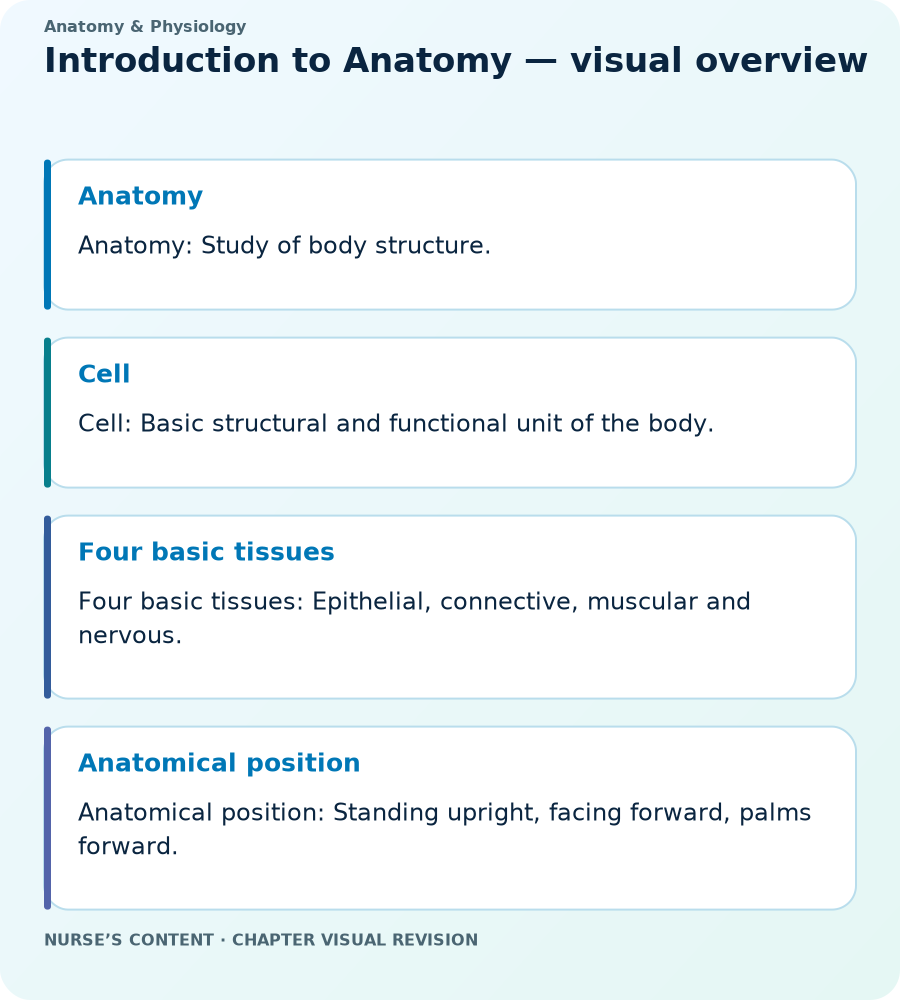
Anatomy: Study of body structure.
Cell: Basic structural and functional unit of the body.
Four basic tissues: Epithelial, connective, muscular and nervous.
Anatomical position: Standing upright, facing forward, palms forward.
Sagittal plane: Divides right and left.
Coronal plane: Divides anterior and posterior.
Transverse plane: Divides superior and inferior.
Dorsal cavity: Cranial and vertebral cavities.
Ventral cavity: Thoracic and abdominopelvic cavities.
Pleura: Membrane surrounding lungs.
Pericardium: Membrane surrounding heart.
Peritoneum: Serous membrane of the abdominopelvic cavity.
Diaphragm: Separates thoracic and abdominal cavities.
Four basic tissue types: Epithelial, connective, muscular and nervous.
Conclusion: Anatomy provides the foundation for understanding the structure of the human body. Knowledge of anatomical terminology, positions, planes, cavities and organ systems is essential for accurate nursing assessment, clinical procedures and patient care.
Chapter reference images