Anatomy & Physiology
General Physiology
Cell physiology, cell membrane, transport mechanisms, homeostasis, body fluids and basic physiological processes.
Open quizzes and study tools Download PDF
Definition, levels and cellular work
Physiology studies how living structures function. Applied physiology connects those mechanisms with observations made during nursing assessment. A cell exchanges materials, generates energy, responds to signals, synthesizes substances and reproduces when appropriate. Related cells form tissues; tissues form organs; organ systems cooperate to preserve a suitable internal environment. A change at one level can therefore produce findings at several other levels.
The nucleus contains genetic instructions. Ribosomes synthesize proteins, rough endoplasmic reticulum processes many exported proteins, and the Golgi apparatus modifies and packages them. Mitochondria generate much of the ATP used in aerobic cellular work. Lysosomes digest cellular material. Oxygen delivery, nutrient availability and waste removal matter because membrane pumps and repair processes require energy.
Cell membrane and selective permeability
The plasma membrane is a flexible phospholipid bilayer containing cholesterol, proteins and surface carbohydrates. Its hydrophobic interior permits some small lipid-soluble molecules to cross while restricting most ions and large polar molecules. Channel proteins, carriers and pumps provide selective routes. Receptors convert chemical signals into cellular responses; adhesion proteins connect cells with their surroundings.
Concentration gradients describe unequal solute concentrations. Electrical gradients describe unequal charge. Together they form an electrochemical gradient. Sodium is concentrated mainly outside cells and potassium mainly inside. The sodium–potassium pump uses ATP to move three sodium ions out and two potassium ions in per cycle. This maintains gradients used for excitability, cell volume control and secondary transport.
Compare membrane transport
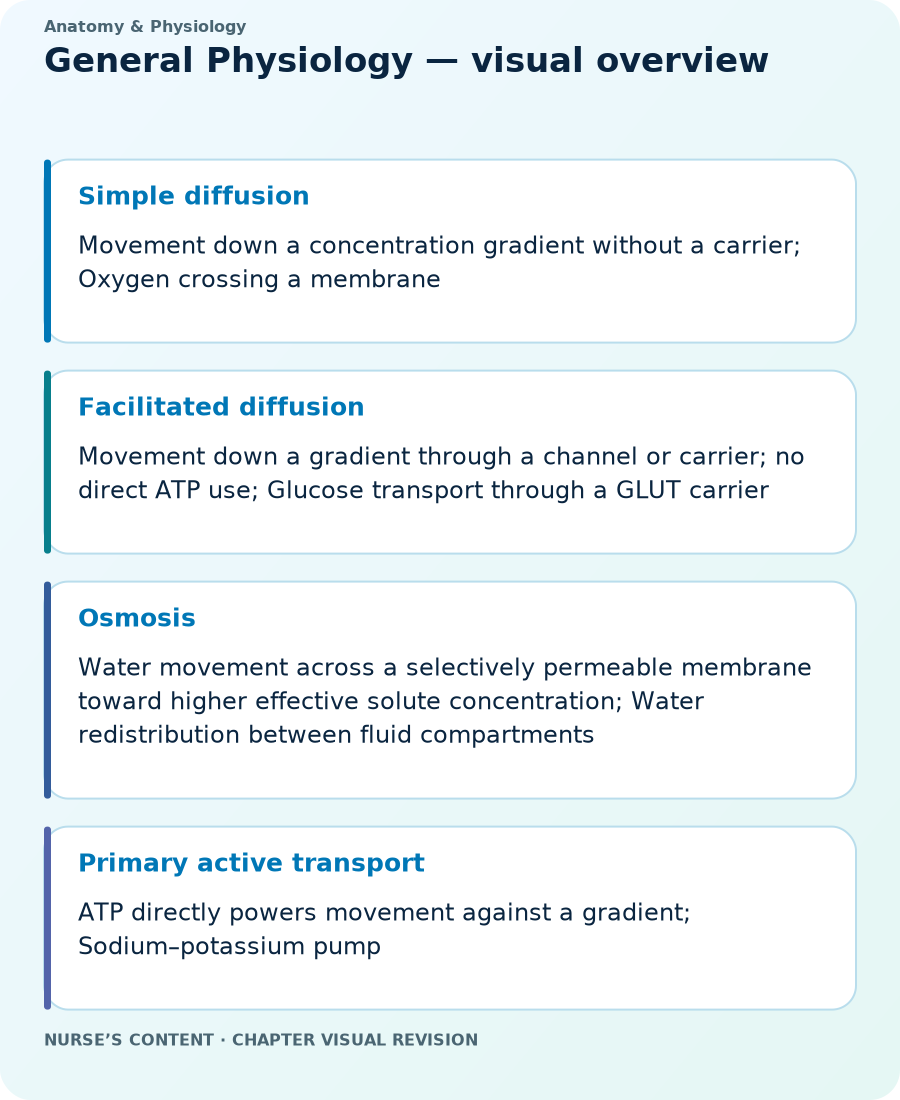
| Process | Driving force and route | Physiological example |
|---|---|---|
| Simple diffusion | Movement down a concentration gradient without a carrier | Oxygen crossing a membrane |
| Facilitated diffusion | Movement down a gradient through a channel or carrier; no direct ATP use | Glucose transport through a GLUT carrier |
| Osmosis | Water movement across a selectively permeable membrane toward higher effective solute concentration | Water redistribution between fluid compartments |
| Primary active transport | ATP directly powers movement against a gradient | Sodium–potassium pump |
| Secondary active transport | One solute moving down its gradient drives another uphill | Sodium-linked glucose absorption |
| Vesicular transport | Membrane vesicles move larger material | Phagocytosis and hormone exocytosis |
Filtration is bulk fluid movement driven by a pressure difference, such as movement across a glomerular filtration barrier. Carrier-mediated transport can saturate when available carriers are occupied. Diffusion becomes faster with a larger gradient or surface area and slower with a longer diffusion distance. These principles explain why membrane damage and tissue swelling can impair exchange.
Homeostasis and feedback
Homeostasis means dynamic regulation of internal conditions within limits compatible with function. It does not mean that every value stays fixed. A feedback loop contains a receptor or sensor, an integrating control centre and an effector. The sensor detects change, the centre compares information with the regulated state, and the effector produces a response.
Negative feedback opposes the initiating change. For example, rising body temperature promotes heat loss, which reduces the original rise. Positive feedback amplifies a process until a defined endpoint, as cervical stretch and oxytocin reinforce labour contractions until birth. Feedforward responses anticipate a need, such as increased salivation before food arrives. A compensatory response may protect function temporarily without removing the underlying cause.
Body fluids, tonicity and acid–base basics
Total body water varies with age and body composition; roughly 50–60% of adult body mass is water, with considerable individual variation. About two-thirds of body water is intracellular and one-third extracellular. Extracellular fluid includes interstitial fluid and plasma. Sodium is the principal extracellular cation; potassium is the principal intracellular cation. Plasma proteins contribute to oncotic pressure and help retain water within the vascular compartment.
Tonicity describes the effect of nonpenetrating solutes on cell volume. An isotonic environment preserves cell volume; a hypotonic environment favours water entry and swelling; a hypertonic environment favours water exit and shrinkage. Osmolarity counts dissolved particles, whereas tonicity depends on their ability to cross a membrane. Buffers limit abrupt pH changes; lungs regulate carbon dioxide and kidneys regulate hydrogen ions and bicarbonate.
Nursing applications and exam organization
Interpret observations as a pattern: intake, output, weight trend, pulse, blood pressure, mucous membranes, oedema and mental state provide complementary information about fluid distribution and perfusion. Oedema indicates excess interstitial fluid and can coexist with reduced effective circulating volume. A single measurement rarely establishes the mechanism. Compare laboratory results with the reporting laboratory range and the person’s clinical context.
For an examination answer, begin with a definition, draw the relevant membrane or feedback loop, explain the direction and energy requirement of each movement, then connect the mechanism to a nursing observation. In a fluid-shift question, identify the compartments, compare effective solute concentrations and predict water movement before describing cell size. Distinguish an adaptive response from correction of the primary disturbance.
Quick Revision
- Physiology connects cellular processes with organ and nursing observations.
- Membrane proteins provide selective transport and signaling routes.
- Passive movement follows a gradient; active movement requires energy directly or indirectly.
- Negative feedback opposes change, whereas positive feedback has a defined endpoint.
- Intracellular and extracellular fluids differ in ion composition.
- Tonicity predicts changes in cell volume.
Important Examination Questions
- Describe the fluid mosaic membrane and relate its components to function.
- Compare simple diffusion, facilitated diffusion and active transport with examples.
- Explain a negative feedback loop using temperature regulation.
- Differentiate osmolarity, tonicity and filtration.
- Discuss the nursing significance of intracellular and extracellular fluid shifts.
References and further reading
Newly written physiology study notes. Read the supporting textbook sections for diagrams, mechanisms and further explanation.
- OpenStax Anatomy and Physiology 2e: Homeostasis
- OpenStax Anatomy and Physiology 2e: The Cell Membrane
- OpenStax Anatomy and Physiology 2e: The Cytoplasm and Cellular Organelles
- OpenStax Anatomy and Physiology 2e: Inorganic Compounds Essential to Human Functioning
- OpenStax Anatomy and Physiology 2e: Body Fluids and Fluid Compartments
Chapter reference images