Anatomy & Physiology
Endocrine Physiology
Functions of hormones, pituitary gland, thyroid, parathyroid, adrenal glands, pancreas and hormonal regulation of body functions.
Open quizzes and study tools Download PDF
Definition, receptors and hormone action
Endocrine glands release hormones into extracellular fluid and blood to regulate distant target cells. A cell responds only when it has the appropriate receptor and signaling machinery. Hormones coordinate metabolism, growth, stress responses, reproduction and water and electrolyte balance. Endocrine effects often develop more slowly and last longer than neural effects, although catecholamine responses can occur within seconds.
Peptide hormones and catecholamines generally bind membrane receptors, activating intracellular signaling such as second-messenger or kinase pathways. Steroid hormones and thyroid hormones mainly act through intracellular receptors that influence gene expression. Hormone concentration, receptor number, binding proteins, clearance and target-cell sensitivity all affect the response. A normal circulating concentration can therefore coexist with reduced responsiveness when resistance develops.
Feedback and hypothalamic–pituitary coordination
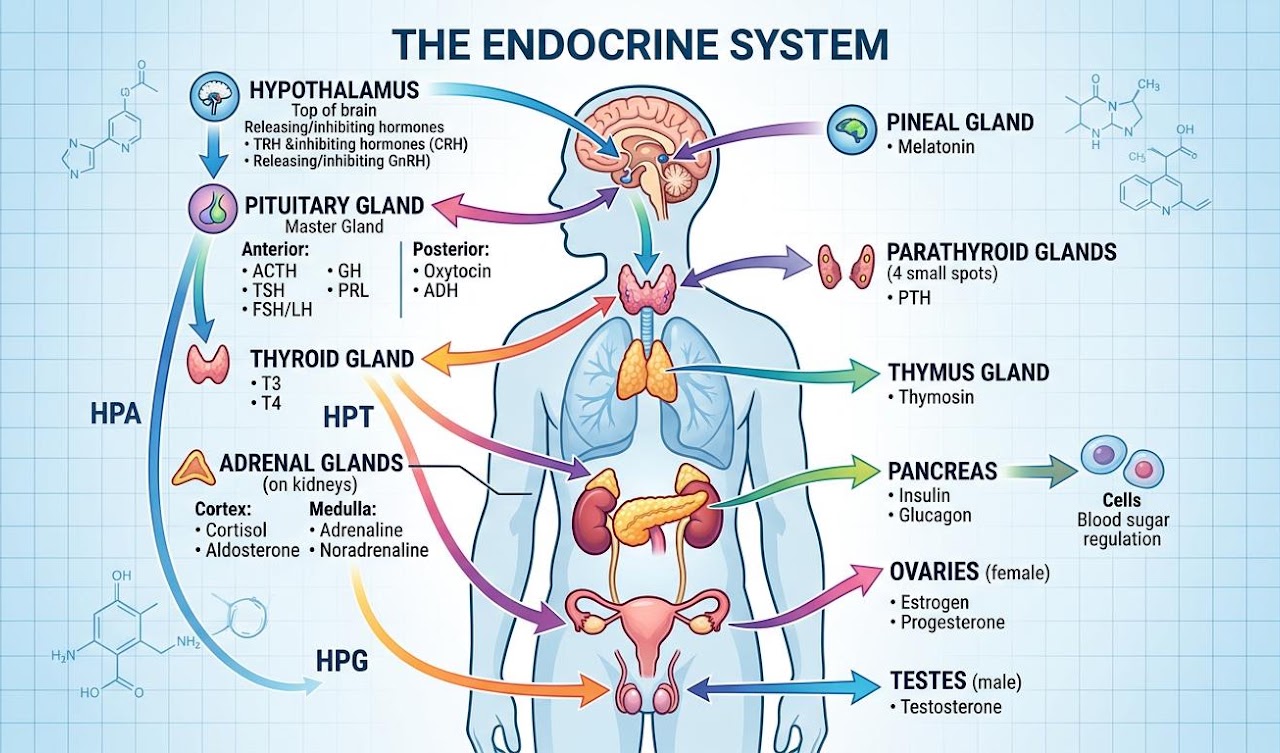
Most endocrine axes use negative feedback: increasing target-gland hormone reduces upstream stimulation. In the thyroid axis, hypothalamic thyrotropin-releasing hormone stimulates pituitary TSH, which stimulates thyroid hormone production; thyroid hormones then restrain the upstream signals. Hormones may be released in pulses and follow daily rhythms, so collection time and physiological state can matter when interpreting a result.
The anterior pituitary synthesizes growth hormone, prolactin, TSH, ACTH, FSH and LH under hypothalamic control through portal blood. Growth hormone supports tissue growth partly through insulin-like growth factors. Prolactin supports milk production and is normally restrained by hypothalamic dopamine. ACTH mainly stimulates adrenal cortisol secretion; FSH and LH support gonadal function. The posterior pituitary stores and releases ADH and oxytocin made in hypothalamic neurons; it does not synthesize them.
Compare key endocrine organs
| Organ or cells | Major hormone | Central physiological effect |
|---|---|---|
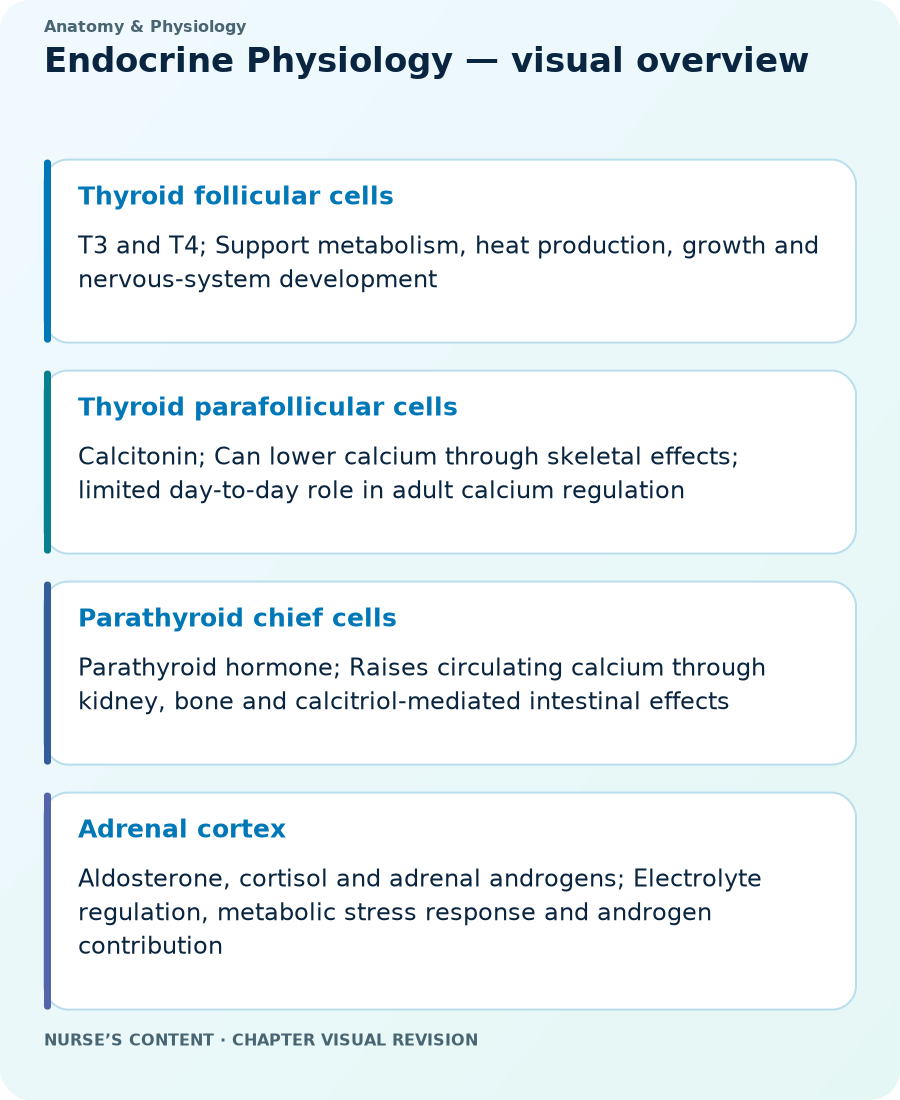
| Thyroid follicular cells | T3 and T4 | Support metabolism, heat production, growth and nervous-system development |
| Thyroid parafollicular cells | Calcitonin | Can lower calcium through skeletal effects; limited day-to-day role in adult calcium regulation |
| Parathyroid chief cells | Parathyroid hormone | Raises circulating calcium through kidney, bone and calcitriol-mediated intestinal effects |
| Adrenal cortex | Aldosterone, cortisol and adrenal androgens | Electrolyte regulation, metabolic stress response and androgen contribution |
| Adrenal medulla | Epinephrine and norepinephrine | Support rapid sympathetic responses |
| Pancreatic beta and alpha cells | Insulin and glucagon | Coordinate nutrient storage and fasting glucose supply |
For an examination table, add the controlling stimulus and the feedback relationship rather than listing hormone names alone. Distinguish secretion into blood from exocrine secretion into a duct, especially when discussing the pancreas.
Thyroid and parathyroid mechanisms
Thyroid follicular cells use iodine and tyrosine-containing thyroglobulin to form thyroid hormones. Much secreted hormone is T4, and many tissues convert it to the more active T3. Most circulating hormone is protein-bound; the free fraction is available to interact with target cells. TSH regulates synthesis and release. Excess thyroid activity tends to increase heat production and metabolic demand, whereas deficiency can slow many functions.
Low ionized calcium stimulates parathyroid hormone release. PTH increases renal calcium recovery, promotes phosphate excretion and stimulates renal calcitriol formation. Calcitriol increases intestinal calcium absorption. PTH can indirectly increase osteoclast-mediated bone resorption through signals from other bone cells. Rising calcium restrains PTH secretion. These linked actions explain why renal function, vitamin D status, calcium and phosphate must be considered together.
Adrenal and pancreatic regulation
The adrenal cortex has three functional zones: glomerulosa produces aldosterone, fasciculata produces cortisol and reticularis produces adrenal androgens. Aldosterone secretion responds especially to angiotensin II and elevated potassium. Cortisol is regulated by hypothalamic CRH and pituitary ACTH and supports fuel availability and the stress response. The adrenal medulla receives sympathetic stimulation and releases catecholamines that influence cardiac function, vascular tone and fuel mobilization.
Insulin from pancreatic beta cells favours nutrient storage, increases glucose uptake in skeletal muscle and adipose tissue, promotes glycogen and lipid synthesis and suppresses hepatic glucose production. Glucagon from alpha cells promotes hepatic glucose output during fasting. Somatostatin from delta cells moderates islet and digestive activity. Blood glucose control also involves the liver, nervous system, other hormones, meal composition and activity; it is not a two-hormone switch operating in isolation.
Nursing applications and exam structure
Assess endocrine function using patterns across weight, temperature tolerance, skin, pulse, blood pressure, bowel habits, thirst, urine output and mental state. Symptoms are often nonspecific. Interpret glucose and electrolytes with sampling conditions and current illness. In paired-axis results, distinguish a target-gland problem from inadequate upstream stimulation; a hormone value should not be interpreted without its feedback context when the relevant partner test is available.
Acute altered consciousness, marked weakness, circulatory deterioration or severe dehydration requires escalation rather than assumption that a chronic endocrine diagnosis explains it. For exams, structure each gland under stimulus, hormone, target, action and feedback. Draw one complete axis, compare anterior with posterior pituitary, and explain insulin–glucagon responses after a meal and during fasting. Connect physiological actions with assessment findings without giving medication regimens or treating a textbook pattern as a diagnosis.
Quick Revision
- Hormones act through specific receptors and coordinated intracellular pathways.
- Most endocrine axes are regulated by negative feedback.
- The anterior pituitary makes hormones; the posterior pituitary releases hypothalamic hormones.
- Thyroid hormones support metabolic activity and development.
- PTH, calcitriol, kidneys, intestine and bone coordinate calcium balance.
- Adrenal and pancreatic hormones coordinate stress, electrolyte and fuel responses.
Important Examination Questions
- Compare membrane-receptor and intracellular-receptor hormone action.
- Explain hypothalamic–pituitary relationships and a negative feedback axis.
- Describe thyroid hormone synthesis, actions and regulation.
- Explain PTH effects on calcium, phosphate and calcitriol.
- Compare adrenal cortical, medullary and pancreatic hormone functions.
References and further reading
Newly written physiology study notes. Read the supporting textbook sections for diagrams, mechanisms and further explanation.
- OpenStax Anatomy and Physiology 2e: An Overview of the Endocrine System
- OpenStax Anatomy and Physiology 2e: Hormones
- OpenStax Anatomy and Physiology 2e: The Pituitary Gland and Hypothalamus
- OpenStax Anatomy and Physiology 2e: The Thyroid Gland
- OpenStax Anatomy and Physiology 2e: The Parathyroid Glands
- OpenStax Anatomy and Physiology 2e: The Adrenal Glands
- OpenStax Anatomy and Physiology 2e: The Endocrine Pancreas
Chapter reference images