Adult Health Nursing
Rehabilitation and Palliative Nursing
Rehabilitation principles, disability management, supportive care, pain relief, symptom control, end-of-life care and family support.
Open quizzes and study tools Download PDF
CHAPTER 22 / ADULT HEALTH NURSING 22. Rehabilitation and Palliative Nursing
1. Rehabilitation concept
Rehabilitation optimizes functioning and participation in people with health conditions and disabilities. Assess impairments, activity limitations, participation, goals, environment and caregiver resources. ICF framework emphasizes interaction between health condition and contextual factors.
2. Rehabilitation process
- 1. Establish baseline mobility, cognition, communication, self-care and pain.
- 2. Set shared SMART goals (e.g., transfer safely with one-person assistance by discharge).
- 3. Provide interdisciplinary therapy: physiotherapy, occupational therapy, speech/swallow care, nursing, psychology and social work.
- 4. Prevent secondary complications, teach assistive devices and home modifications.
- 5. Evaluate function, adjust and coordinate community reintegration.
3. Disability support
Use person-preferred language and accessible communication. Promote ADLs (feeding, bathing, dressing, toileting, transfers) and instrumental ADLs (shopping, medicines, finances). Avoid unnecessary dependence. Ensure pressure injury prevention, fall risk assessment, bowel/bladder plan, nutrition, sexuality and caregiver training. Use prostheses, orthoses, walkers and wheelchairs after assessment and fitting.
4. Palliative care
Palliative care improves quality of life for people with serious illness and families through relief of physical, psychological, social and spiritual suffering. It can begin at diagnosis and accompany disease treatment; hospice focuses on end-of-life support according to service eligibility.
| Symptom | Nursing approach |
|---|---|
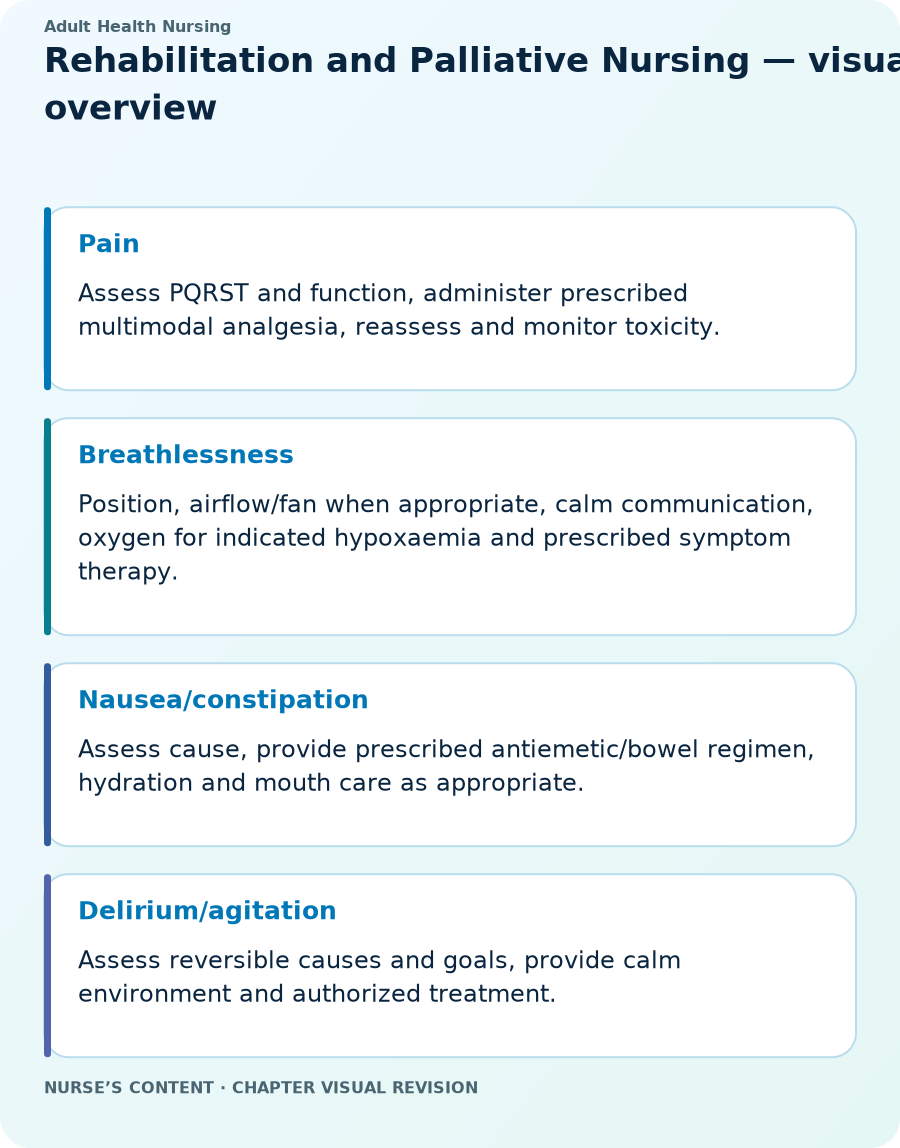
| Pain | Assess PQRST and function, administer prescribed multimodal analgesia, reassess and monitor toxicity. |
| Breathlessness | Position, airflow/fan when appropriate, calm communication, oxygen for indicated hypoxaemia and prescribed symptom therapy. |
| Nausea/constipation | Assess cause, provide prescribed antiemetic/bowel regimen, hydration and mouth care as appropriate. |
| Delirium/agitation | Assess reversible causes and goals, provide calm environment and authorized treatment. |
| Fatigue/anorexia | Energy conservation, comfort-focused nutrition, avoid forcing food near dying. |
5. End-of-life care
Clarify patient preferences and legally applicable decisions through the clinical team. Discuss expected changes (reduced intake, sleep, breathing pattern) sensitively, maintain mouth/skin care, privacy, comfort and family support. Do not equate withholding non-beneficial treatment with abandoning care. Document symptom interventions and decisions; provide bereavement support and culturally respectful after-death care per law/policy.
6. Important Examination Questions
Long Answer Questions
- 1. Explain rehabilitation principles and palliative nursing management.
Short Answer Questions
- 1. Differentiate ADL and IADL
- 2. describe symptom control
- 3. write a note on family support.
Very Short Answer Questions (with answers)
- 1. Is palliative care only for the last days of life? — No.
- 2. What is ICF? — International Classification of Functioning, Disability and Health.
7. Quick Revision
- • Rehabilitation is goal-directed.
- • Palliative care can accompany curative therapy.
- • Respect autonomy and comfort.
8. Conclusion
Rehabilitation is goal-directed. Palliative care can accompany curative therapy. Respect autonomy and comfort.
Chapter reference images