Adult Health Nursing
Nursing Management of Patients with Genetic and Congenital Disorders in Adults
Common genetic conditions presenting in adulthood, inherited disorders, genetic counselling, screening, patient education and nursing responsibilities.
Open quizzes and study tools Download PDF
CHAPTER 21 / ADULT HEALTH NURSING 21. Nursing Management of Patients with Genetic and Congenital Disorders in Adults
1. Basic concepts
A genetic disorder results from variation in genes/chromosomes; congenital means present at birth and may be genetic or environmental. Adult-onset inherited disease can remain unrecognized until adulthood. A three-generation pedigree helps assess family history, age at onset and inheritance.
| Pattern | Examples and meaning |
|---|---|
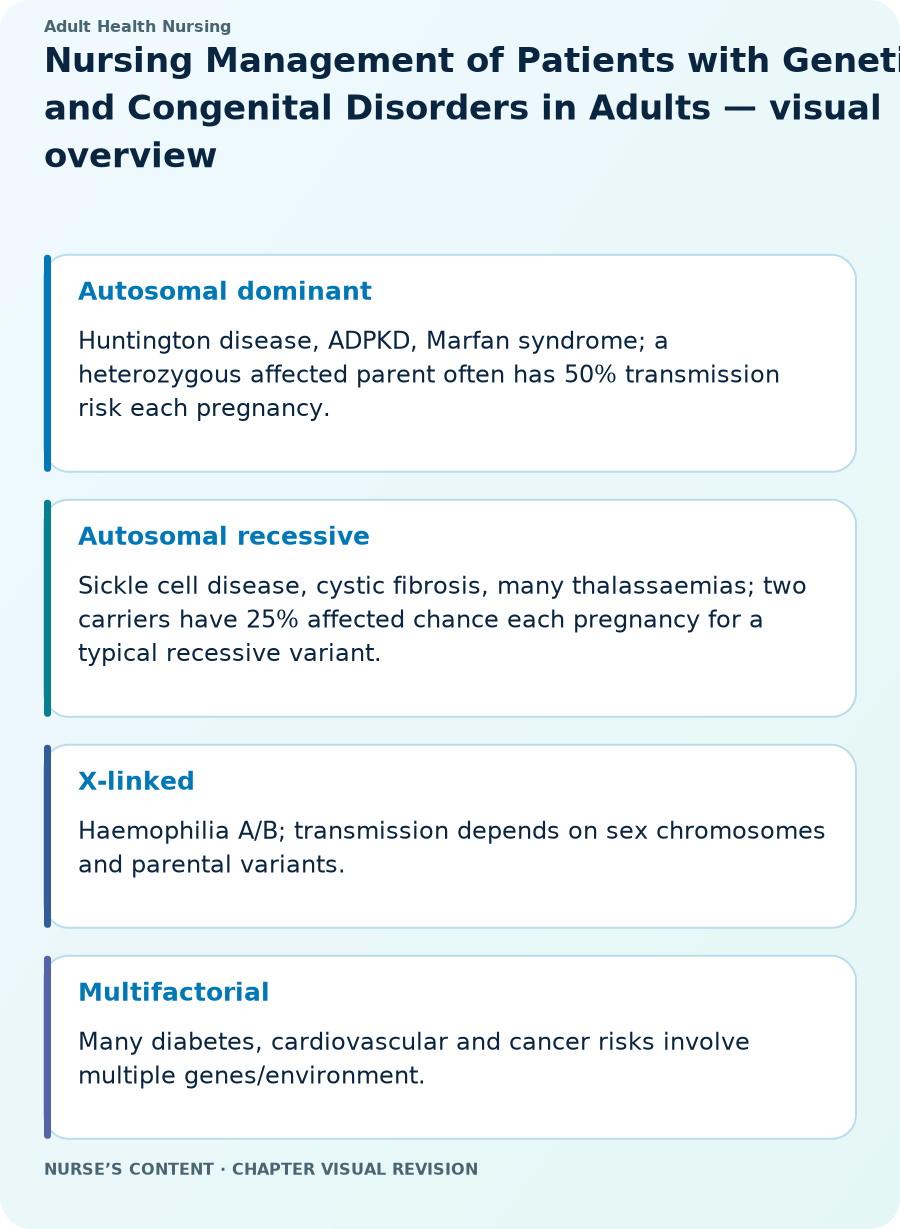
| Autosomal dominant | Huntington disease, ADPKD, Marfan syndrome; a heterozygous affected parent often has 50% transmission risk each pregnancy. |
| Autosomal recessive | Sickle cell disease, cystic fibrosis, many thalassaemias; two carriers have 25% affected chance each pregnancy for a typical recessive variant. |
| X-linked | Haemophilia A/B; transmission depends on sex chromosomes and parental variants. |
| Multifactorial | Many diabetes, cardiovascular and cancer risks involve multiple genes/environment. |
2. Important adult presentations
ADPKD
Definition and pathophysiology: Inherited renal cyst formation, often autosomal dominant.
Clinical features and investigations: Hypertension, flank pain, haematuria and progressive CKD; family history, imaging/genetic testing when indicated.
Management and nursing care: BP management, renal follow-up and counselling about familial risk; assess extrarenal manifestations per specialist advice.
Huntington disease
Definition and pathophysiology: Autosomal dominant CAG repeat disorder causing neurodegeneration.
Clinical features and investigations: Chorea, behavioural/cognitive change, swallowing difficulty; specialist genetic testing.
Management and nursing care: Support mobility, swallowing, mental health, family care and non-directive predictive testing counselling.
Marfan syndrome
Definition and pathophysiology: Connective-tissue disorder often due to FBN1 variants.
Clinical features and investigations: Tall habitus, skeletal/ocular signs, aortic dilation; clinical criteria, echo and genetic assessment.
Management and nursing care: Aortic surveillance, specialist activity advice and therapy; sudden chest/back pain needs emergency assessment.
Inherited blood and cancer risk
Definition and pathophysiology: Sickle cell/thalassaemia affect haemoglobin; BRCA-related syndromes increase some cancer risks.
Clinical features and investigations: Family history, blood testing or targeted genetic testing; variant interpretation requires expertise.
Management and nursing care: Prevent complications, arrange genetic counselling and risk-based screening. A variant of uncertain significance is not proof of disease.
3. Screening and counselling
Explain purpose, limitations, potential incidental findings, familial implications and consent. Screening estimates risk; diagnostic tests establish specific conditions in context. Protect confidentiality, avoid coercion, facilitate specialist referral and respect decisions about testing. Offer psychosocial support and discuss prevention/surveillance options with genetics team.
4. Important Examination Questions
Long Answer Questions
- 1. Explain inheritance patterns and nursing role in genetic counselling.
Short Answer Questions
- 1. Describe ADPKD
- 2. differentiate genetic and congenital
- 3. explain pedigree.
Very Short Answer Questions (with answers)
- 1. What is a pedigree? — Family relationship and trait diagram.
- 2. Does carrier status always cause illness? — No.
5. Quick Revision
- • Genetic risk is not destiny.
- • Consent is essential.
- • Refer complex results to genetics specialists.
6. Conclusion
Genetic risk is not destiny. Consent is essential. Refer complex results to genetics specialists.
Chapter reference images