Adult Health Nursing
Nursing Management of Patients with Immunological Disorders
Hypersensitivity reactions, autoimmune diseases, systemic lupus erythematosus, rheumatoid arthritis, immunodeficiency disorders, organ transplantation and immunosuppressive therapy.
Open quizzes and study tools Download PDF
CHAPTER 20 / ADULT HEALTH NURSING 20. Nursing Management of Patients with Immunological Disorders
1. Immune response
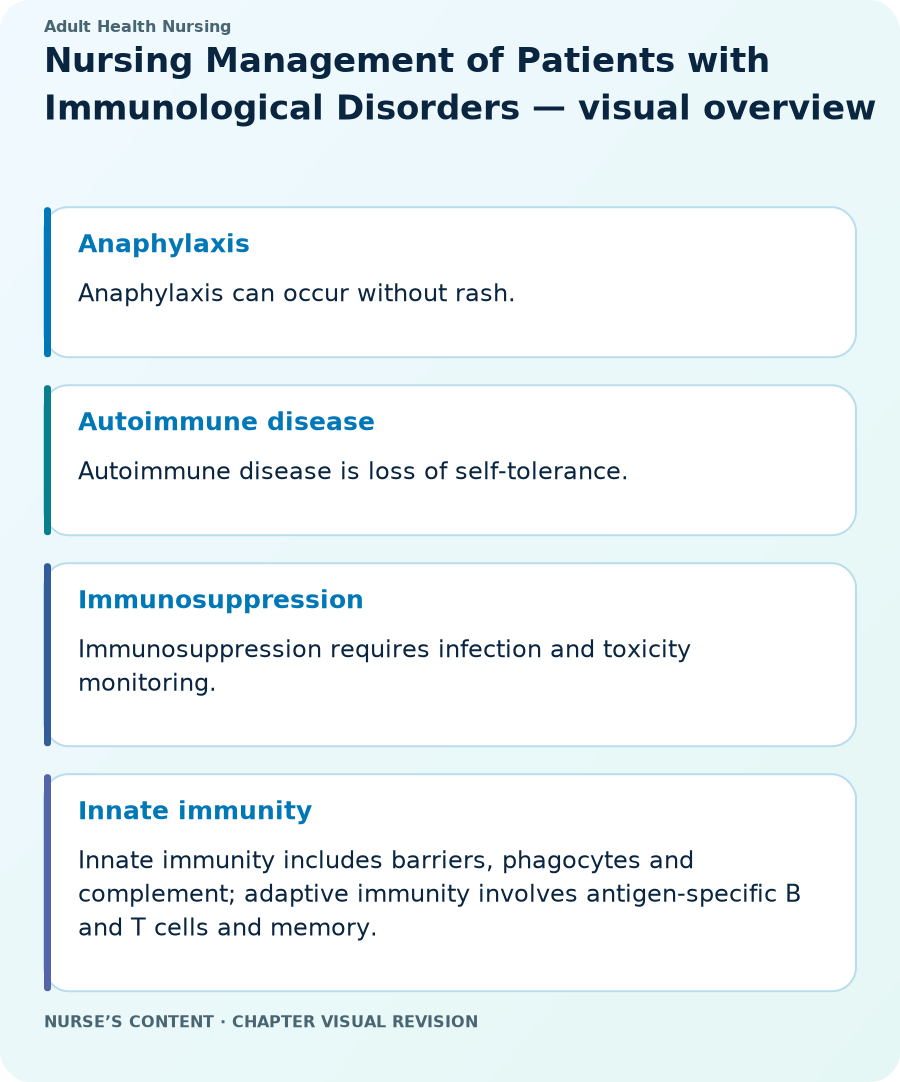
Innate immunity includes barriers, phagocytes and complement; adaptive immunity involves antigen-specific B and T cells and memory. Immunological disease includes excessive response, loss of tolerance or insufficient defence.
2. Hypersensitivity classification
| Type | Mechanism | Example |
|---|---|---|
| I | IgE-mediated mast cell activation | Anaphylaxis, allergic rhinitis |
| II | Antibody against cell/tissue targets | Autoimmune haemolysis |
| III | Immune complex deposition | Some lupus manifestations |
| IV | T-cell-mediated delayed reaction | Contact dermatitis, tuberculin reaction |
Anaphylaxis
Definition and pathophysiology: Rapid systemic hypersensitivity with airway, breathing or circulatory compromise; skin findings may be absent.
Clinical features and investigations: Wheeze, stridor, hypotension, swelling, urticaria or GI symptoms after exposure.
Management and nursing care: Call emergency team; IM adrenaline in anterolateral thigh is first-line according to protocol, position safely, oxygen and fluids as indicated. Antihistamines/steroids do not replace adrenaline. Observe recurrence risk and teach prevention.
Systemic lupus erythematosus (SLE)
Definition and pathophysiology: Multisystem autoimmune disease with immune-complex-mediated injury.
Clinical features and investigations: Fatigue, photosensitive rash, arthritis, nephritis, cytopenias; ANA, anti-dsDNA, complement, urinalysis and specialist criteria.
Management and nursing care: Hydroxychloroquine and individualized immunotherapy, monitor renal function, infection and medication toxicity; sun protection, pregnancy planning and flare education.
Rheumatoid arthritis
Definition and pathophysiology: Autoimmune synovitis with joint damage and systemic disease.
Clinical features and investigations: Symmetrical inflammatory arthritis, prolonged morning stiffness, fatigue; RF/anti-CCP and imaging.
Management and nursing care: DMARD therapy early, monitor CBC/liver/renal tests as indicated, infection screening and joint protection; support exercise and independence.
Immunodeficiency
Definition and pathophysiology: Primary inherited defects or secondary to HIV, malnutrition, malignancy, medications or other conditions.
Clinical features and investigations: Recurrent, severe or unusual infections; CBC, immunoglobulins, HIV and specialized tests.
Management and nursing care: Prompt infection evaluation, indicated prophylaxis/replacement and vaccination planning. Live vaccines may be contraindicated in significant immunosuppression; consult specialist.
3. Transplantation and immunosuppression
Organ transplantation replaces failing organ; matching and immunosuppression reduce rejection. Hyperacute, acute and chronic rejection differ in timing/mechanisms. Tacrolimus/ciclosporin, mycophenolate, corticosteroids and other agents have specific adverse effects. Monitor graft function, drug levels when indicated, BP, glucose, renal function, infection and malignancy risk. Never stop immunosuppression without transplant-team direction. Teach food/infection safety, adherence, vaccination review and urgent signs of rejection/infection.
4. Important Examination Questions
Long Answer Questions
- 1. Describe hypersensitivity types and nursing management of anaphylaxis.
Short Answer Questions
- 1. Explain SLE
- 2. discuss immune deficiency
- 3. list transplant nursing responsibilities.
Very Short Answer Questions (with answers)
- 1. Which antibody mediates type I hypersensitivity? — IgE.
- 2. First-line drug in anaphylaxis? — IM adrenaline.
5. Quick Revision
- • Anaphylaxis can occur without rash.
- • Autoimmune disease is loss of self-tolerance.
- • Immunosuppression requires infection and toxicity monitoring.
6. Conclusion
Anaphylaxis can occur without rash. Autoimmune disease is loss of self-tolerance. Immunosuppression requires infection and toxicity monitoring.
Chapter reference images