Adult Health Nursing
Perioperative Nursing Management
Preoperative assessment, preparation for surgery, informed consent, intraoperative nursing care, postoperative monitoring, prevention of complications and surgical wound care.
Open quizzes and study tools Download PDF
CHAPTER 19 / ADULT HEALTH NURSING 19. Perioperative Nursing Management
1. Phases and preoperative assessment
Preoperative: decision for surgery to transfer to theatre. Intraoperative: theatre care through transfer to recovery. Postoperative: recovery through discharge and follow-up. Assess health history, allergies, medicines (including anticoagulants and diabetes agents), airway risk, previous anaesthesia, baseline observations, nutrition, infection, labs and functional status.
2. Preparation and consent
Verify procedure and site, identity, consent documentation, surgical checklist, fasting instructions based on anaesthesia protocol and relevant medications. Consent is an informed voluntary process led by the responsible clinician; nurses verify, witness as authorized and raise unresolved questions. Give clear explanations, psychosocial support, prescribed prophylaxis and skin preparation; clip hair only if necessary (avoid routine shaving).
3. Intraoperative responsibilities
- • Circulating nurse supports safety, equipment, documentation, positioning and communication.
- • Scrub nurse maintains sterile field, instruments and counts using approved procedures.
- • WHO surgical safety checklist: sign in before anaesthesia; time out before incision; sign out before leaving theatre.
- • Prevent pressure/nerve injury, hypothermia, wrong-site surgery and retained items; manage specimens and counts accurately.
4. Postoperative assessment
Monitor airway, breathing, oxygenation, circulation, consciousness, pain, nausea, temperature and surgical site/drains. Recovery discharge based on approved criteria. Assess urine output and fluid balance, neurological status after regional anaesthesia and return of function.
5. Common complications
| Complication | Signs and nursing response |
|---|---|
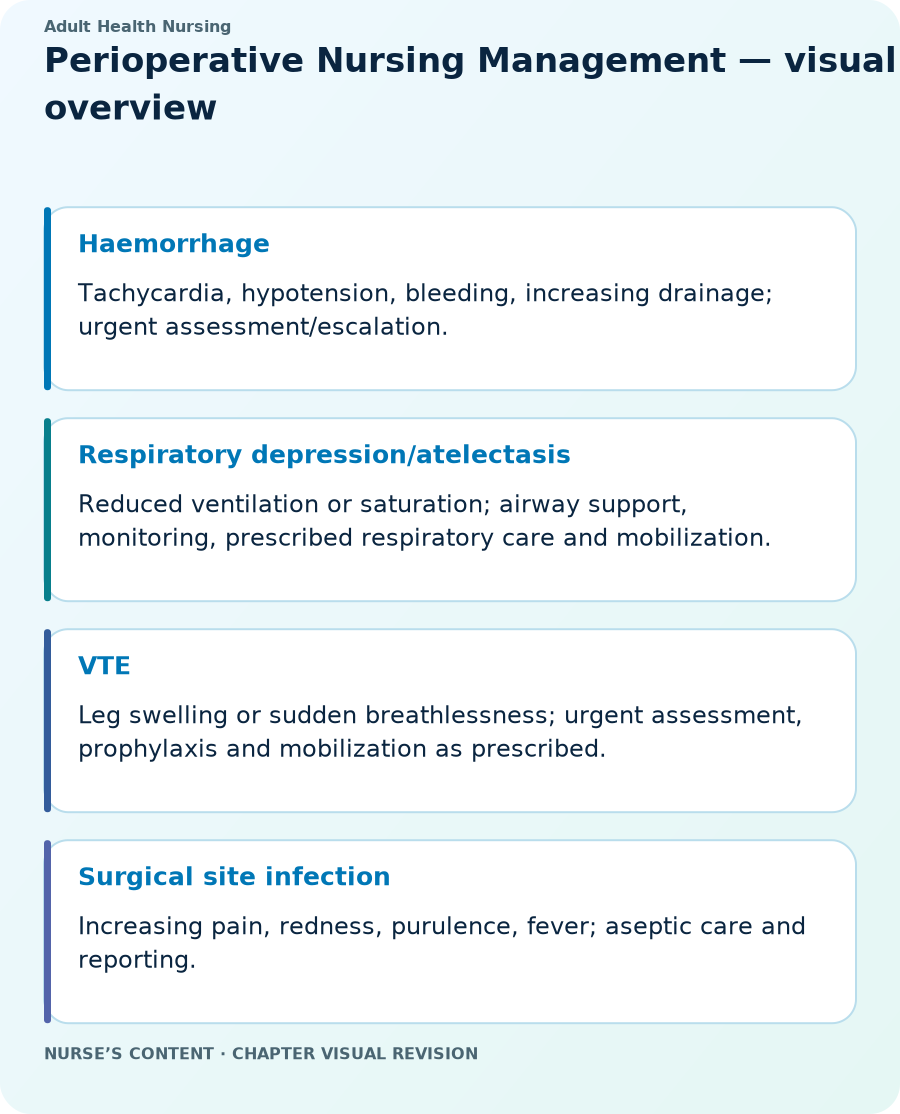
| Haemorrhage | Tachycardia, hypotension, bleeding, increasing drainage; urgent assessment/escalation. |
| Respiratory depression/atelectasis | Reduced ventilation or saturation; airway support, monitoring, prescribed respiratory care and mobilization. |
| VTE | Leg swelling or sudden breathlessness; urgent assessment, prophylaxis and mobilization as prescribed. |
| Surgical site infection | Increasing pain, redness, purulence, fever; aseptic care and reporting. |
| Ileus/retention | Distension, vomiting or inability to void; assess and escalate appropriately. |
| Dehiscence/evisceration | Wound separation; emergency escalation, protect exposed tissue with sterile saline-moistened dressing, do not push organs back. |
6. Discharge and wound management
Assess readiness, reconcile medications, explain activity/weight-bearing restrictions, dressing, bathing, pain control and danger signs. Use teach-back. Support follow-up, pathology review and caregiver participation. Document handover, counts, adverse events and recovery observations.
7. Important Examination Questions
Long Answer Questions
- 1. Explain pre-, intra- and postoperative nursing care.
Short Answer Questions
- 1. Describe surgical checklist
- 2. explain informed consent
- 3. list postoperative complications.
Very Short Answer Questions (with answers)
- 1. What is the time out? — Team verification before incision.
- 2. Should routine shaving precede surgery? — No.
8. Quick Revision
- • Verify patient, procedure and site.
- • Monitor airway first in recovery.
- • Discharge instructions require teach-back.
9. Conclusion
Verify patient, procedure and site. Monitor airway first in recovery. Discharge instructions require teach-back.
Chapter reference images