Adult Health Nursing
Nursing Management of Patients with Integumentary Disorders
Burns, pressure injuries, dermatitis, psoriasis, skin infections, cellulitis, skin ulcers and skin cancer.
Open quizzes and study tools Download PDF
CHAPTER 13 / ADULT HEALTH NURSING 13. Nursing Management of Patients with Integumentary Disorders
1. Skin assessment
Assess colour, temperature, moisture, integrity, pain, lesions, wound size/depth, drainage and surrounding tissue. Consider skin tone when identifying erythema or pressure damage. Risk factors include immobility, diabetes, poor perfusion, malnutrition and immunosuppression.
Burns
Definition and pathophysiology: Thermal, chemical, electrical or radiation injury; superficial, partial-thickness or full-thickness. Estimate TBSA using adult rule of nines or Lund–Browder chart (exclude superficial erythema).
Clinical features and investigations: Pain, blistering, leathery tissue, swelling; inhalation injury, shock and hypothermia risks.
Management and nursing care: Stop burning, cool thermal burn with cool running water for about 20 min when feasible (avoid ice/hypothermia), remove constricting items, cover cleanly, emergency assessment for major burns. Fluid resuscitation is prescribed/titrated to perfusion and output; monitor airway, pain, wounds and infection; nutrition/rehab.
Pressure injury
Definition and pathophysiology: Localized tissue damage from pressure or pressure with shear.
Clinical features and investigations: Stage 1 intact nonblanchable discoloration; 2 partial thickness exposed dermis; 3 full skin loss; 4 exposed/palpable deep structures; unstageable obscured depth; deep tissue injury persistent deep red/maroon/purple changes.
Management and nursing care: Risk assessment, individualized repositioning, heel offloading, pressure-redistributing surface, moisture management and nutrition. Do not massage damaged skin. Document location/stage and response.
Dermatitis and eczema
Definition and pathophysiology: Inflammatory skin conditions, e.g. irritant/allergic contact or atopic dermatitis.
Clinical features and investigations: Pruritus, erythema, dryness, sometimes vesicles; assess triggers and infection.
Management and nursing care: Avoid irritants, regular emollients, prescribed topical anti-inflammatory treatment; teach appropriate use and monitor secondary infection.
Psoriasis
Definition and pathophysiology: Immune-mediated chronic inflammatory disease.
Clinical features and investigations: Well-demarcated scaly plaques, nail changes, possible inflammatory arthritis.
Management and nursing care: Emollients, topical therapy, phototherapy or systemic treatment according to severity; assess joints, infection and psychosocial impact.
Skin infections and cellulitis
Definition and pathophysiology: Bacterial, fungal or viral skin disease; cellulitis affects dermis/subcutaneous tissue.
Clinical features and investigations: Warmth, swelling, tenderness, spreading erythema and fever; differentiate abscess and other causes.
Management and nursing care: Prescribed antimicrobials, elevation if appropriate, wound care, monitor borders and systemic illness; severe pain, necrosis or instability suggests deep necrotizing infection.
Acne
Definition and pathophysiology: Inflammation/obstruction of pilosebaceous units.
Clinical features and investigations: Comedones, papules, pustules or nodules; scarring and distress.
Management and nursing care: Gentle skin care, prescribed topical retinoid/benzoyl peroxide or systemic agents; pregnancy precautions for retinoids and antimicrobial stewardship.
Skin ulcers
Definition and pathophysiology: Chronic wound related to venous disease, arterial ischaemia, neuropathy or pressure.
Clinical features and investigations: Assess perfusion, sensation, infection and depth; venous ulcers often oedematous, arterial ulcers painful/distal, neuropathic ulcers at pressure sites.
Management and nursing care: Treat cause, dress by wound characteristics, offload neuropathic pressure; compression only after appropriate arterial assessment. Escalate infection/ischaemia.
Skin cancer
Definition and pathophysiology: Basal cell, squamous cell and melanoma are important types.
Clinical features and investigations: Non-healing lesions or changing pigmented lesions; ABCDE: asymmetry, border, colour, diameter, evolving; biopsy confirms.
Management and nursing care: Support excision or oncology treatment, sun protection education, wound care and follow-up. Do not diagnose by appearance alone.
2. Nursing care
Maintain comfort, asepsis where indicated, nutrition and mobility. Use consistent wound measurements, drainage description and photography only with consent and policy. Provide emotional support for body-image changes.
3. Important Examination Questions
Long Answer Questions
- 1. Explain burns and pressure injury classification and management.
Short Answer Questions
- 1. Describe cellulitis
- 2. compare arterial and venous ulcers
- 3. explain melanoma warning signs.
Very Short Answer Questions (with answers)
- 1. What does TBSA mean? — Total body surface area.
- 2. Is ice appropriate on a burn? — No.
4. Quick Revision
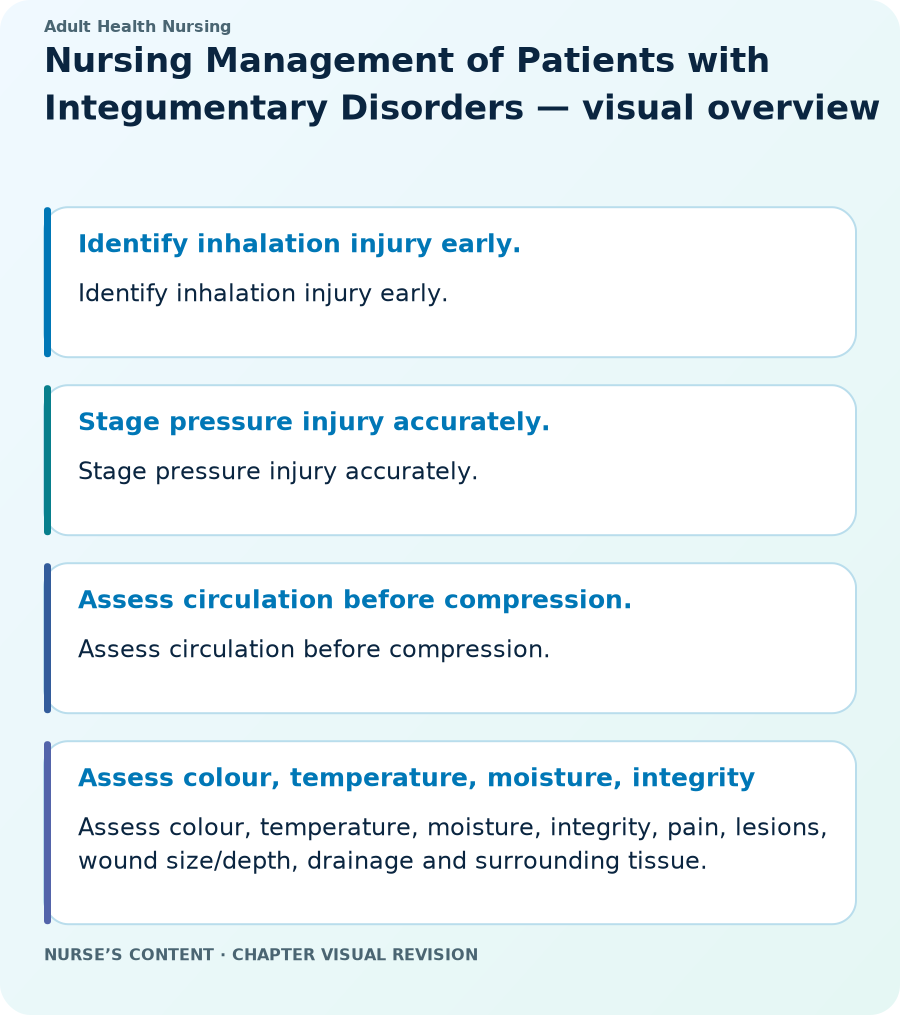
- • Identify inhalation injury early.
- • Stage pressure injury accurately.
- • Assess circulation before compression.
5. Conclusion
Identify inhalation injury early. Stage pressure injury accurately. Assess circulation before compression.
Chapter reference images