Adult Health Nursing
Nursing Management of Patients with Musculoskeletal Disorders
Fractures, dislocations, sprains, osteoarthritis, rheumatoid arthritis, osteoporosis, osteomyelitis, spinal disorders, amputations and joint replacement.
Open quizzes and study tools Download PDF
CHAPTER 12 / ADULT HEALTH NURSING 12. Nursing Management of Patients with Musculoskeletal Disorders
1. Assessment
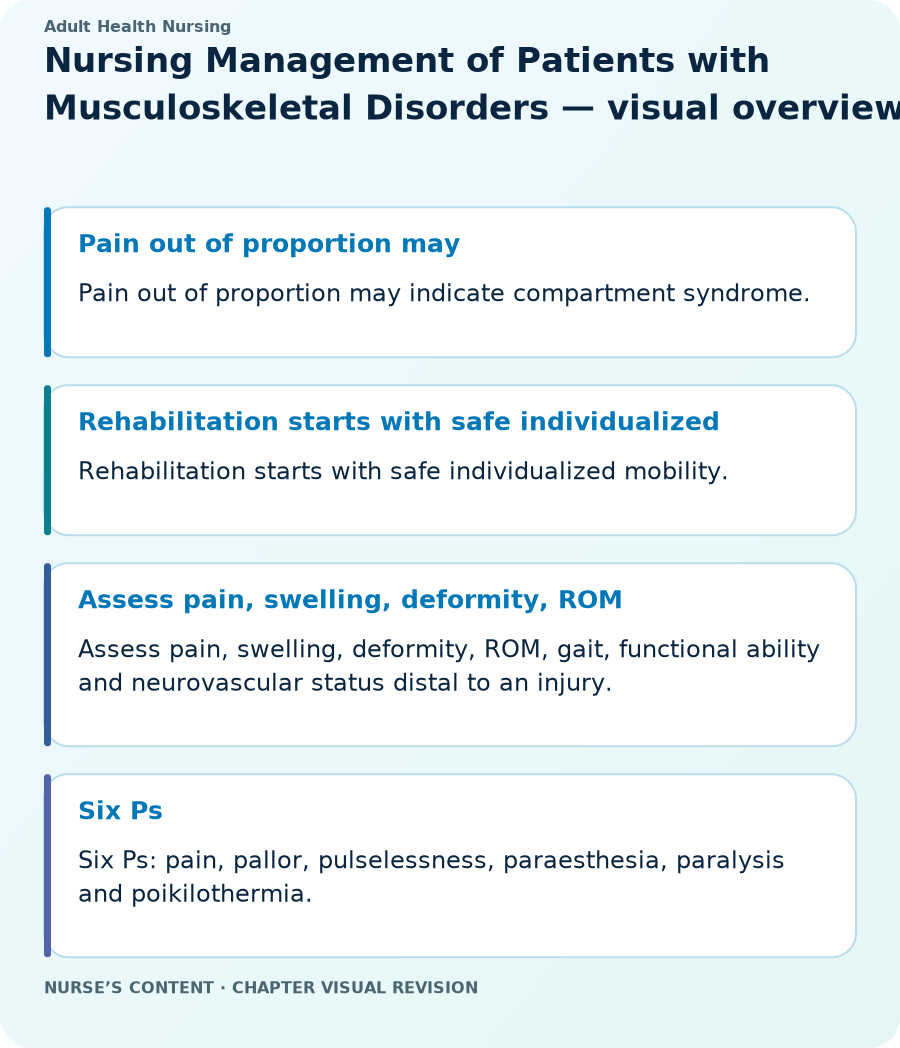
Assess pain, swelling, deformity, ROM, gait, functional ability and neurovascular status distal to an injury. Six Ps: pain, pallor, pulselessness, paraesthesia, paralysis and poikilothermia. Pain out of proportion or on passive stretch may precede pulse loss in compartment syndrome. X-ray, CT/MRI, inflammatory markers and joint aspiration are used as indicated.
Fractures
Definition and pathophysiology: Loss of bone continuity; closed/open, displaced/nondisplaced, complete/incomplete, pathological or stress fracture.
Clinical features and investigations: Pain, swelling, deformity, loss of function; X-ray; assess skin and distal neurovascular status.
Management and nursing care: Immobilize, analgesia, reduction and fixation/cast as indicated. Open fracture requires urgent sterile covering, antibiotics/tetanus evaluation and surgery. Monitor compartment syndrome, infection, fat embolism and VTE.
Dislocations and sprains
Definition and pathophysiology: Dislocation disrupts joint alignment; sprain injures ligaments.
Clinical features and investigations: Pain, swelling, instability/deformity; examination and imaging as indicated.
Management and nursing care: Immobilize in position found, do not force reduction, urgent neurovascular assessment; controlled rehabilitation after treatment. For sprain use protection, appropriate cooling and graded loading.
Osteoarthritis
Definition and pathophysiology: Degenerative joint disorder with cartilage and subchondral changes.
Clinical features and investigations: Activity-related pain, short morning stiffness, reduced ROM; clinical assessment and X-ray if indicated.
Management and nursing care: Exercise, weight management, joint protection, individualized analgesia and joint replacement when required.
Rheumatoid arthritis
Definition and pathophysiology: Autoimmune inflammatory synovitis leading to erosions and systemic manifestations.
Clinical features and investigations: Symmetrical small-joint swelling, prolonged stiffness, fatigue; RF, anti-CCP, inflammatory markers and imaging.
Management and nursing care: Early specialist disease-modifying therapy; balance rest with exercise, monitor infection and adverse effects, promote joint protection.
Osteoporosis
Definition and pathophysiology: Reduced bone strength and increased fragility fracture risk.
Clinical features and investigations: Often silent until low-trauma fracture; DXA and risk assessment.
Management and nursing care: Fall prevention, resistance/weight-bearing exercise when appropriate, adequate calcium/vitamin D and prescribed antiresorptive or anabolic therapy. Teach safe administration of medicines.
Osteomyelitis
Definition and pathophysiology: Bone infection, haematogenous or contiguous after trauma/surgery.
Clinical features and investigations: Localized pain, fever, swelling, chronic draining sinus; cultures, MRI and inflammatory markers.
Management and nursing care: Culture-directed antimicrobial and possible debridement; aseptic wound care, monitor treatment toxicity and adherence.
Gout
Definition and pathophysiology: Monosodium urate crystal deposition due to hyperuricaemia.
Clinical features and investigations: Acute red, hot, painful joint, often first MTP; synovial crystal analysis when indicated, exclude septic arthritis.
Management and nursing care: Prescribed anti-inflammatory treatment for flare; long-term urate-lowering therapy when indicated, lifestyle education. Fever with hot joint needs urgent assessment.
Spinal disorders
Definition and pathophysiology: Degeneration, disc herniation, stenosis or other structural disease.
Clinical features and investigations: Back pain, radiculopathy, weakness; neurological exam, imaging for indications.
Management and nursing care: Analgesia, physical therapy and surgery in selected cases. New bladder/bowel dysfunction, saddle anaesthesia or progressive weakness may indicate cauda equina syndrome.
Amputation and joint replacement
Definition and pathophysiology: Surgical removal of limb or replacement of a damaged joint.
Clinical features and investigations: Postoperative pain, wound/drain findings, mobility changes; phantom pain may occur.
Management and nursing care: Monitor bleeding, infection, VTE, pain and circulation; positioning to avoid contracture, stump/skin care, physiotherapy and prosthetic fitting. Joint precautions depend on procedure.
2. Nursing responsibilities
Check cast edges, swelling, capillary refill, sensation and movement; avoid inserting objects under cast. Support safe transfers and prescribed weight-bearing. Explain exercises and analgesia before rehabilitation. Escalate acute neurovascular compromise immediately.
3. Important Examination Questions
Long Answer Questions
- 1. Describe fracture management and nursing care
- 2. compare OA and RA.
Short Answer Questions
- 1. Explain six Ps
- 2. list complications of immobility
- 3. discuss osteoporosis and amputation care.
Very Short Answer Questions (with answers)
- 1. What is haemarthrosis? — Bleeding into a joint.
- 2. Which test measures bone density? — DXA.
4. Quick Revision
- • Pain out of proportion may indicate compartment syndrome.
- • Avoid forced reduction.
- • Rehabilitation starts with safe individualized mobility.
5. Conclusion
Pain out of proportion may indicate compartment syndrome. Avoid forced reduction. Rehabilitation starts with safe individualized mobility.
Chapter reference images