Adult Health Nursing
Nursing Management of Patients with Neurological Disorders
Stroke, epilepsy, meningitis, encephalitis, Parkinson's disease, Alzheimer's disease, multiple sclerosis, myasthenia gravis, increased intracranial pressure and head injury.
Open quizzes and study tools Download PDF
CHAPTER 11 / ADULT HEALTH NURSING 11. Nursing Management of Patients with Neurological Disorders
1. Neurological assessment
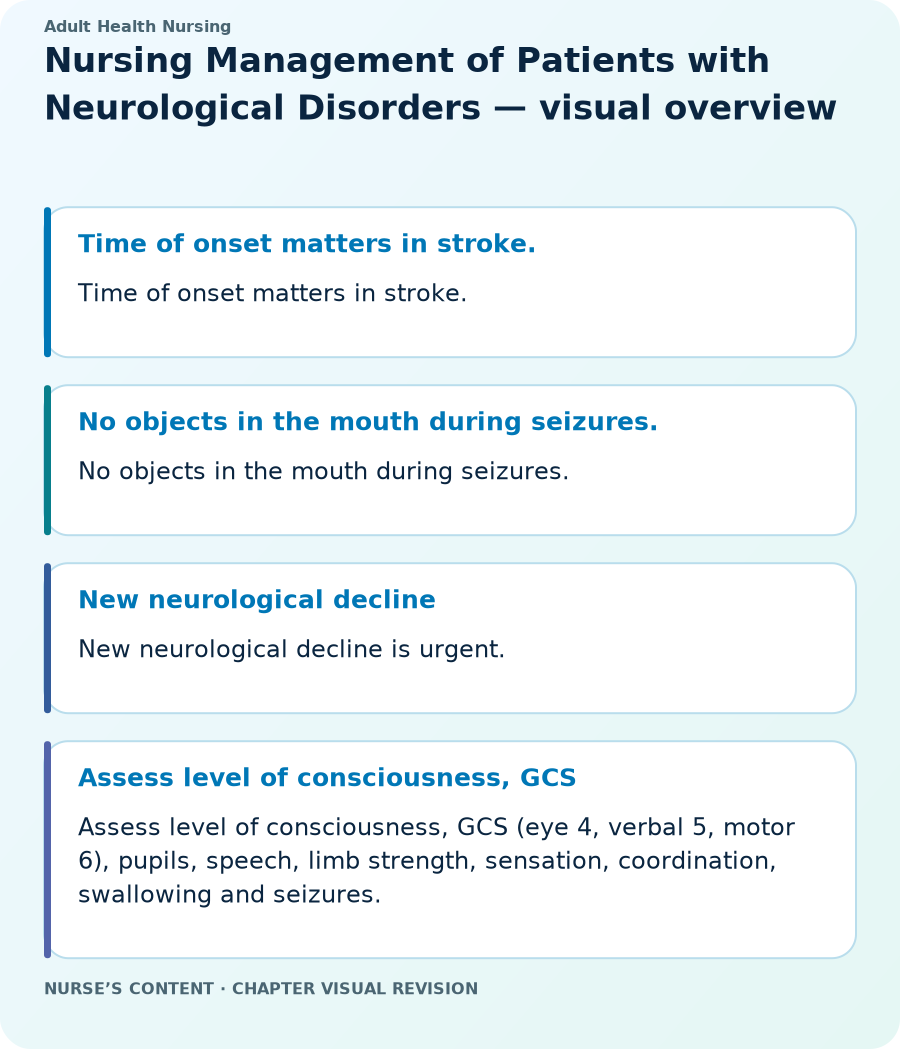
Assess level of consciousness, GCS (eye 4, verbal 5, motor 6), pupils, speech, limb strength, sensation, coordination, swallowing and seizures. Record baseline and trends. Investigations: glucose, CT/MRI, EEG, CSF when appropriate and targeted blood tests. Sudden focal deficit or falling consciousness is urgent.
Stroke
Definition and pathophysiology: Acute brain injury due to ischaemia or haemorrhage.
Clinical features and investigations: FAST: face droop, arm weakness, speech change, time; also vision, balance and severe headache. Record last known well; urgent brain CT/MRI and glucose.
Management and nursing care: Activate stroke pathway; protect airway, urgent imaging and eligible reperfusion for ischaemia or haemorrhage management. Keep NPO until swallow screen; maintain prescribed BP and oxygen goals, prevent aspiration, immobility and pressure injury, begin rehabilitation when stable.
Epilepsy
Definition and pathophysiology: Enduring predisposition to recurrent unprovoked seizures; focal or generalized.
Clinical features and investigations: Altered awareness, motor activity or sensory phenomena; witness history, EEG and imaging when indicated.
Management and nursing care: During seizure protect from injury, time it, do not restrain or insert objects in mouth, turn side when safe. Seizure ≥5 min or repeated without recovery is emergency; give authorized rescue therapy. Teach adherence and safety.
Meningitis and encephalitis
Definition and pathophysiology: Meningitis is inflammation of meninges; encephalitis affects brain tissue, often infectious.
Clinical features and investigations: Fever, headache, neck stiffness, photophobia; encephalitis often confusion/seizures. CSF, blood cultures and imaging if indicated.
Management and nursing care: Urgent assessment and timely empiric treatment; indicated droplet precautions for suspected meningococcal disease, monitor consciousness, seizures, perfusion and public-health requirements. Do not delay lifesaving therapy for tests.
Parkinson disease
Definition and pathophysiology: Progressive dopaminergic neurodegeneration.
Clinical features and investigations: Bradykinesia with rest tremor or rigidity; gait, swallowing and autonomic difficulties.
Management and nursing care: Give prescribed levodopa on time, assess orthostasis and aspiration, support exercise, physiotherapy, constipation care and fall prevention. Avoid abrupt medication interruption.
Alzheimer disease
Definition and pathophysiology: Progressive neurodegenerative disorder causing cognitive and functional decline.
Clinical features and investigations: Insidious memory impairment, disorientation, loss of ADL independence; cognitive assessment and investigation of reversible contributors.
Management and nursing care: Maintain routines and dignity, safety, communication aids, caregiver support; selected symptomatic or disease-specific therapy with specialist monitoring. Sudden change suggests delirium, not inevitable dementia.
Multiple sclerosis
Definition and pathophysiology: Immune-mediated CNS demyelination and neuroaxonal injury.
Clinical features and investigations: Variable optic neuritis, weakness, sensory symptoms, fatigue and bladder problems; MRI and specialist criteria.
Management and nursing care: Disease-modifying therapy, relapse treatment when indicated, fatigue conservation, mobility and bladder care; monitor infection with immunotherapy.
Myasthenia gravis
Definition and pathophysiology: Autoimmune impairment of neuromuscular transmission.
Clinical features and investigations: Fluctuating fatigable weakness, ptosis, diplopia, dysphagia; antibody/electrophysiology tests.
Management and nursing care: Time prescribed pyridostigmine, plan rest, monitor swallowing and respiratory strength. Bulbar or respiratory deterioration may indicate crisis and requires urgent support.
Raised intracranial pressure and head injury
Definition and pathophysiology: Trauma, oedema, haemorrhage or mass may increase pressure inside rigid skull, reducing cerebral perfusion.
Clinical features and investigations: Worsening headache, vomiting, declining GCS, pupil changes; Cushing response is late. CT and specialist monitoring.
Management and nursing care: ABCDE with spinal precautions as indicated; avoid hypoxia/hypotension, head alignment/elevation if appropriate, monitor neuro trends, prepare prescribed osmotherapy or surgery. Escalate deterioration immediately.
Spinal cord injury
Definition and pathophysiology: Traumatic or nontraumatic cord damage affecting motor/sensory/autonomic function.
Clinical features and investigations: Weakness, sensory level, bladder/bowel dysfunction; imaging and neurological assessment. High injuries may impair ventilation.
Management and nursing care: Spinal motion restriction and specialist care, prevent respiratory and pressure complications, bladder/bowel programme, rehab. Autonomic dysreflexia in susceptible high lesions: sudden hypertension/headache, sit upright if safe, urgent trigger evaluation and treatment.
2. Clinical application
In suspected stroke, document time last well, glucose, neurological deficit and vital signs; do not give oral medication or food until swallowing is assessed. For chronic neurological disease use individualized mobility aids and communication strategies, respect decision-making capacity, and support caregiver education.
3. Important Examination Questions
Long Answer Questions
- 1. Explain nursing management of stroke and epilepsy.
Short Answer Questions
- 1. Describe GCS
- 2. compare meningitis and encephalitis
- 3. explain signs of raised ICP
- 4. list Parkinson nursing priorities.
Very Short Answer Questions (with answers)
- 1. Maximum GCS? — 15.
- 2. What does FAST stand for? — Face, arm, speech, time.
4. Quick Revision
- • Time of onset matters in stroke.
- • No objects in the mouth during seizures.
- • New neurological decline is urgent.
5. Conclusion
Time of onset matters in stroke. No objects in the mouth during seizures. New neurological decline is urgent.
Chapter reference images