Adult Health Nursing
Nursing Management of Patients with Respiratory Disorders
Upper and lower respiratory tract infections, asthma, COPD, pneumonia, tuberculosis, pleural effusion, pneumothorax, respiratory failure and lung cancer.
Open quizzes and study tools Download PDF
CHAPTER 04 / ADULT HEALTH NURSING 04. Nursing Management of Patients with Respiratory Disorders
1. Respiratory assessment
Assess respiratory rate, effort, saturation trend, cough, sputum, haemoptysis, chest movement, auscultation and mental state. Common investigations: chest X-ray, pulse oximetry, ABG, sputum testing, spirometry when stable and CT when indicated. Hypoxaemia can occur before cyanosis. Administer oxygen to the prescribed target; patients at risk of hypercapnic failure often need 88–92% until evaluated.
2. Upper and lower respiratory tract illnesses
Upper respiratory tract infection
Definition and pathophysiology: Usually viral inflammation of nose, pharynx or larynx; bacterial pharyngitis and sinusitis occur in selected cases.
Clinical features and investigations: Congestion, sore throat, cough, fever; investigate persistent or severe symptoms or stridor.
Management and nursing care: Fluids as tolerated, rest, symptomatic care, respiratory hygiene; antibiotics only when clinically indicated. Escalate airway obstruction.
Asthma
Definition and pathophysiology: Chronic airway inflammation with variable airflow obstruction and bronchial hyperresponsiveness.
Clinical features and investigations: Wheeze, cough, chest tightness, nocturnal symptoms; spirometry with variable obstruction; severe attacks may have a silent chest.
Management and nursing care: Inhaled corticosteroid-containing therapy for ongoing management; prescribed relievers, oxygen and systemic steroids in exacerbations. Teach inhaler/spacer technique and action plan; escalate exhaustion or poor response.
COPD
Definition and pathophysiology: Persistent airflow obstruction from airway and alveolar damage, commonly tobacco smoke/biomass exposure.
Clinical features and investigations: Chronic cough, sputum, exertional dyspnoea; post-bronchodilator spirometry confirms obstruction.
Management and nursing care: Smoking cessation, bronchodilators, selected inhaled steroids, rehabilitation and vaccines. In exacerbation monitor ABG and prescribed controlled oxygen; NIV may be indicated for acidotic hypercapnic failure.
Pneumonia
Definition and pathophysiology: Infection of lung parenchyma causing alveolar inflammation and consolidation.
Clinical features and investigations: Fever, cough, tachypnoea, crackles, hypoxia; chest imaging and microbiology as indicated.
Management and nursing care: Give prescribed antimicrobials, oxygen and fluids appropriately; assess sepsis, mobilize when safe, encourage oral care and aspiration prevention.
Pulmonary tuberculosis
Definition and pathophysiology: Mycobacterium tuberculosis infection spread through airborne particles.
Clinical features and investigations: Persistent cough, fever, weight loss, night sweats, haemoptysis; rapid molecular sputum testing and drug susceptibility assessment.
Management and nursing care: Airborne precautions, prompt testing/referral, national programme treatment based on susceptibility, adherence support, contact investigation and nutrition. Monitor drug adverse effects.
3. Pleural and malignant disorders
Pleural effusion
Definition and pathophysiology: Excess fluid in pleural space, caused by heart failure, infection, malignancy or other conditions.
Clinical features and investigations: Dyspnoea, reduced breath sounds, dull percussion; ultrasound and diagnostic thoracentesis when indicated.
Management and nursing care: Treat cause, assist drainage, monitor pain, breathing and complications. Document fluid characteristics and output.
Pneumothorax
Definition and pathophysiology: Air in pleural space causes partial or complete lung collapse; tension pneumothorax impairs venous return.
Clinical features and investigations: Sudden unilateral pain, dyspnoea, reduced breath sounds; tension may cause severe instability.
Management and nursing care: Urgent escalation; tension pneumothorax is treated without waiting for imaging in an unstable patient by authorized clinicians. Monitor chest drain and avoid routine clamping.
Respiratory failure
Definition and pathophysiology: Inadequate oxygenation and/or ventilation; type 1 hypoxaemic, type 2 hypercapnic.
Clinical features and investigations: Dyspnoea, altered consciousness, fatigue, abnormal ABG; assess cause.
Management and nursing care: Immediate ABCDE, oxygen/ventilatory support as indicated, monitor ABG and protect airway; prepare NIV or mechanical ventilation under specialist care.
Lung cancer
Definition and pathophysiology: Malignant tumour arising in lung; common groups include non-small-cell and small-cell carcinoma.
Clinical features and investigations: Persistent cough, haemoptysis, weight loss, recurrent infection; CT, tissue biopsy and staging.
Management and nursing care: Support surgery, radiotherapy or systemic therapy according to stage and type; manage symptoms, nutrition, breathlessness and smoking cessation; palliative care when appropriate.
4. Nursing care plan example
| Assessment / problem | Interventions and expected outcome |
|---|---|
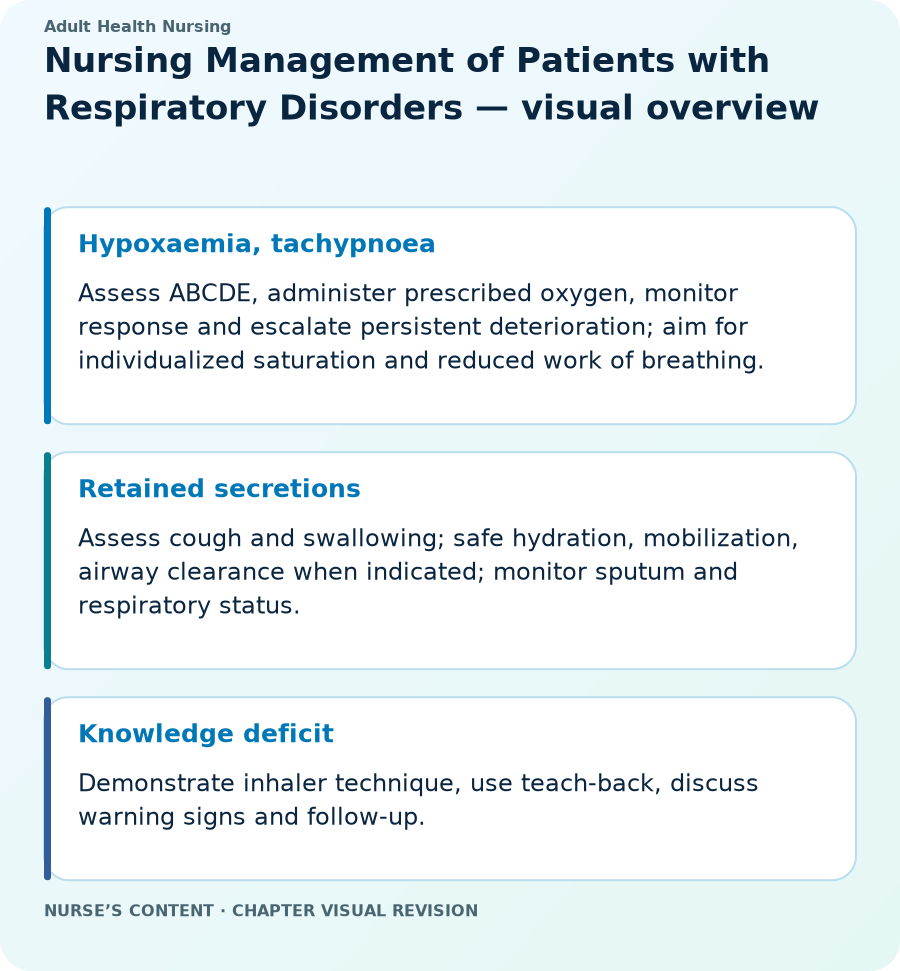
| Hypoxaemia, tachypnoea | Assess ABCDE, administer prescribed oxygen, monitor response and escalate persistent deterioration; aim for individualized saturation and reduced work of breathing. |
| Retained secretions | Assess cough and swallowing; safe hydration, mobilization, airway clearance when indicated; monitor sputum and respiratory status. |
| Knowledge deficit | Demonstrate inhaler technique, use teach-back, discuss warning signs and follow-up. |
5. Important Examination Questions
Long Answer Questions
- 1. Explain causes, clinical features, investigations and nursing management of asthma, COPD and pneumonia.
Short Answer Questions
- 1. Differentiate pleural effusion and pneumothorax
- 2. describe TB precautions
- 3. explain type 1 versus type 2 respiratory failure.
Very Short Answer Questions (with answers)
- 1. What test assesses variable airflow obstruction? — Spirometry.
- 2. Is a normal SpO2 sufficient to exclude hypercapnia? — No.
6. Quick Revision
- • Asthma requires anti-inflammatory management.
- • Tension pneumothorax is time critical.
- • TB requires airborne precautions and programme-based treatment.
7. Conclusion
Asthma requires anti-inflammatory management. Tension pneumothorax is time critical. TB requires airborne precautions and programme-based treatment.
Chapter reference images