Adult Health Nursing
Nursing Management of Patients with Pain and Inflammation
Types of pain, pain assessment, inflammation, fever, pharmacological and non-pharmacological pain management and nursing interventions.
Open quizzes and study tools Download PDF
CHAPTER 03 / ADULT HEALTH NURSING 03. Nursing Management of Patients with Pain and Inflammation
1. Definition and classification
Pain is an unpleasant sensory and emotional experience associated with actual or potential tissue injury, or resembling that experience. Self-report is the preferred measure when possible. Acute pain is often related to recent trauma or surgery; chronic pain persists or recurs beyond three months. Nociceptive pain arises from tissue injury, neuropathic pain from somatosensory disease or injury, and nociplastic pain from altered nociception without sufficient evidence of either mechanism.
2. Pain physiology and assessment
Transduction of harmful stimuli → transmission through peripheral nerves and spinal pathways → modulation → perception. Assess PQRST: provoking/relieving factors, quality, region/radiation, severity, timing. Record functional effects, previous treatment, analgesia response and adverse effects. NRS (0–10), visual analogue, verbal descriptors and validated behavioural scales are selected according to ability to communicate. Normal vital signs do not rule out pain.
3. Inflammation and fever
Inflammation is the tissue response to infection or injury, producing vasodilatation, increased capillary permeability and leukocyte recruitment. Cardinal signs: redness, heat, swelling, pain and loss of function. Acute inflammation is predominantly neutrophilic; chronic inflammation often involves macrophages and lymphocytes. Fever is raised hypothalamic temperature set point; hyperthermia is uncontrolled heat accumulation. Measure temperature and assess infection, medicines, exposure and other symptoms. Fever plus hypotension, confusion or respiratory distress needs urgent assessment for sepsis or another cause.
4. Management
| Intervention | Purpose and precautions |
|---|---|
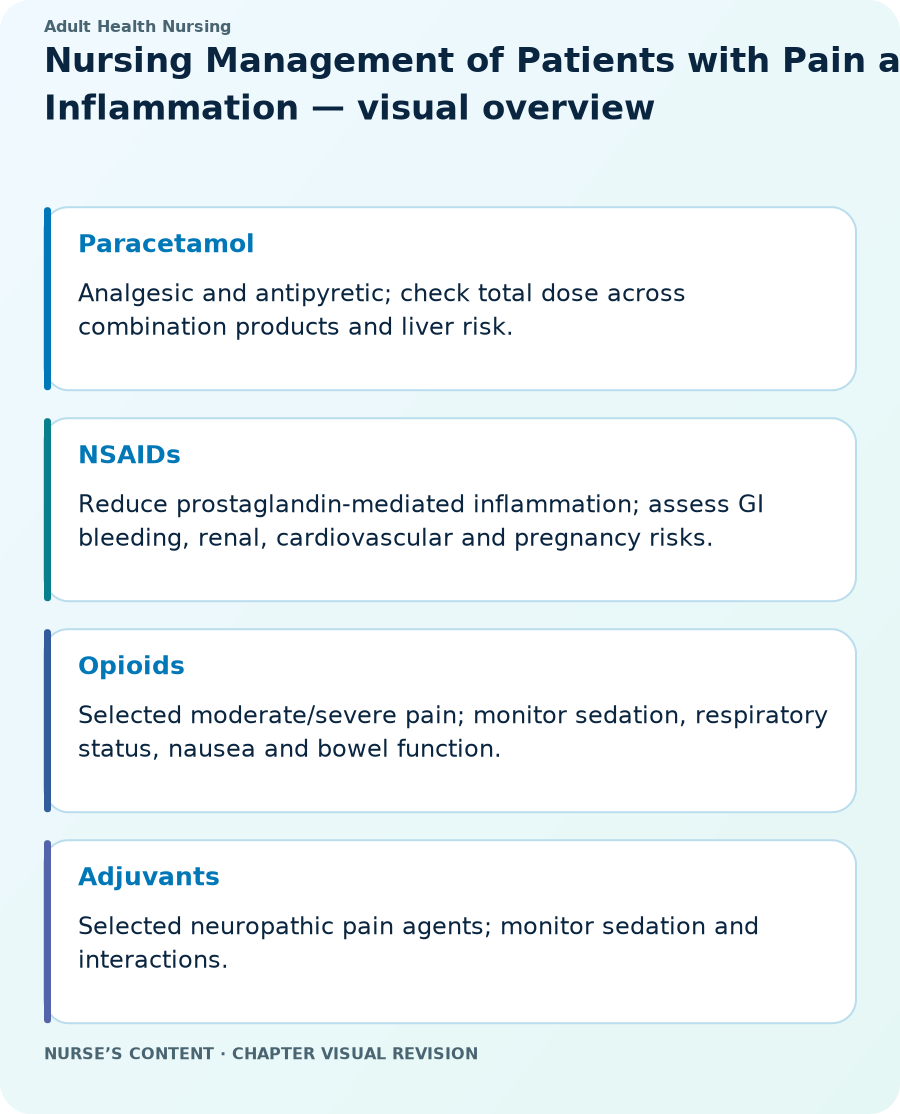
| Paracetamol | Analgesic and antipyretic; check total dose across combination products and liver risk. |
| NSAIDs | Reduce prostaglandin-mediated inflammation; assess GI bleeding, renal, cardiovascular and pregnancy risks. |
| Opioids | Selected moderate/severe pain; monitor sedation, respiratory status, nausea and bowel function. |
| Adjuvants | Selected neuropathic pain agents; monitor sedation and interactions. |
| Non-drug measures | Positioning, relaxation, splinting, distraction, graded activity and appropriate heat/cold. Avoid thermal injury in sensory or circulation impairment. |
5. Nursing interventions and evaluation
Assess cause and urgency before analgesia; new severe chest, abdominal or neurological pain needs immediate escalation. Provide ordered multimodal treatment, assess respiratory safety, support function, position comfortably and reassess within an interval suited to drug and route. For postoperative pain, support the incision during cough, coordinate analgesia before mobilization and document both pain score and ability to breathe and move. Unexplained escalating pain can signal infection, ischaemia or compartment syndrome.
6. Important Examination Questions
Long Answer Questions
- 1. Discuss pain physiology, assessment and nursing management.
Short Answer Questions
- 1. Explain PQRST
- 2. list cardinal signs of inflammation
- 3. differentiate fever and hyperthermia.
Very Short Answer Questions (with answers)
- 1. What is NRS? — Numerical rating scale.
- 2. What is neuropathic pain? — Pain due to a lesion or disease of the somatosensory system.
7. Quick Revision
- • Pain is subjective.
- • Reassess analgesia and function.
- • Fever is a sign, not a diagnosis.
8. Conclusion
Pain is subjective. Reassess analgesia and function. Fever is a sign, not a diagnosis.
Chapter reference images