Adult Health Nursing
Nursing Management of Patients with Fluid, Electrolyte and Acid–Base Imbalances
Fluid and electrolyte balance, dehydration, fluid overload, sodium, potassium, calcium and magnesium imbalances, acid–base disturbances and intravenous fluid therapy.
Open quizzes and study tools Download PDF
CHAPTER 02 / ADULT HEALTH NURSING 02. Nursing Management of Patients with Fluid, Electrolyte and Acid–Base Imbalances
1. Body fluid compartments and regulation
Total body water is commonly around 50–60% of adult body mass; approximately two-thirds is intracellular and one-third extracellular. Plasma and interstitial fluid form the main extracellular compartments. Osmosis moves water across semipermeable membranes, diffusion moves solutes down gradients, and active transport requires energy. The kidneys, thirst, antidiuretic hormone, renin–angiotensin–aldosterone system and natriuretic peptides regulate volume and osmolality.
2. Volume disturbances
Fluid volume deficit and dehydration
Definition and pathophysiology: Loss of extracellular volume from haemorrhage, diarrhoea, vomiting, burns or diuretics; dehydration specifically means water deficit.
Clinical features and investigations: Thirst, tachycardia, postural hypotension, oliguria, weight loss; assess perfusion, sodium, renal function and fluid history.
Management and nursing care: Address cause; oral rehydration when safe or prescribed IV crystalloid; assess response and avoid excessive fluids in cardiac or renal disease.
Fluid overload
Definition and pathophysiology: Excess extracellular fluid from renal impairment, heart failure or excessive IV fluids.
Clinical features and investigations: Oedema, weight gain, dyspnoea, crackles, raised jugular venous pressure; evaluate oxygenation and renal function.
Management and nursing care: Position for breathing, escalate pulmonary oedema, implement prescribed diuretics/fluid restriction and monitor daily weight and output.
3. Electrolytes: typical adult serum ranges
| Electrolyte | Reference range | Main role |
|---|---|---|
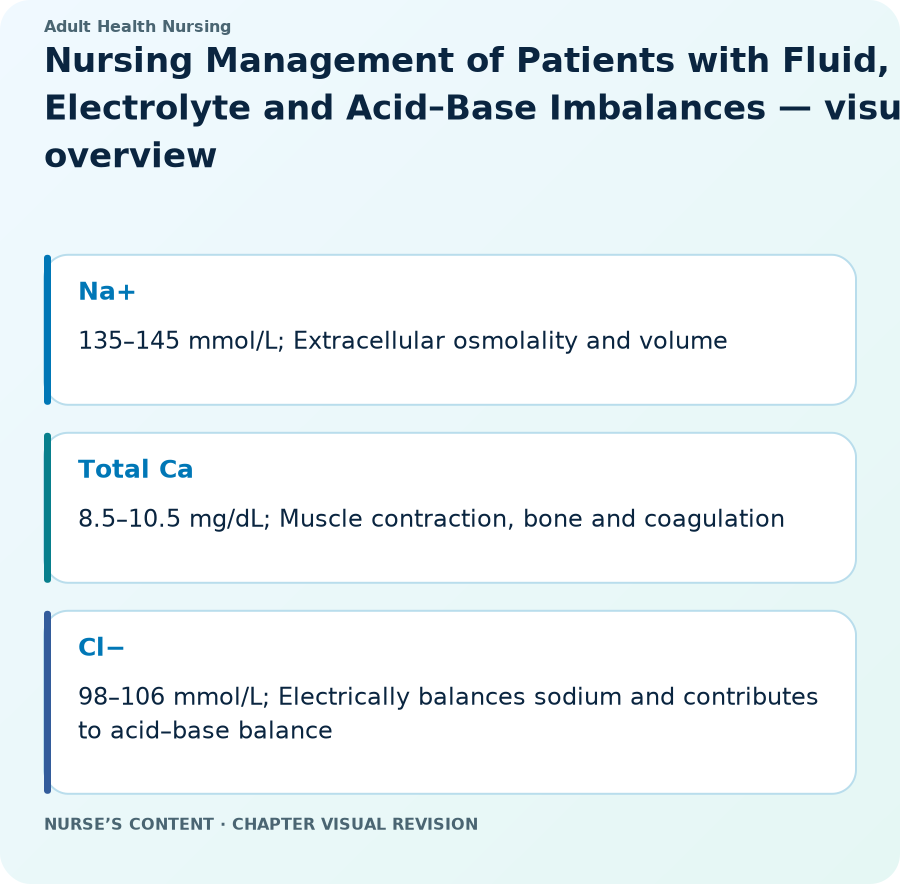
| Na+ | 135–145 mmol/L | Extracellular osmolality and volume |
| K+ | 3.5–5.0 mmol/L | Cardiac and neuromuscular excitability |
| Total Ca | 8.5–10.5 mg/dL | Muscle contraction, bone and coagulation |
| Mg | 1.7–2.2 mg/dL | Enzyme function and cardiac stability |
| Cl− | 98–106 mmol/L | Electrically balances sodium and contributes to acid–base balance |
Hyponatraemia and hypernatraemia
Definition and pathophysiology: Low sodium often reflects excess water relative to sodium; high sodium often reflects water deficit.
Clinical features and investigations: Headache, confusion and seizures in severe cases; assess glucose, osmolality, volume and urine studies.
Management and nursing care: Treat underlying cause and prescribed fluid strategy; rapid correction can cause brain injury. Monitor serial sodium and neurological status.
Hypokalaemia and hyperkalaemia
Definition and pathophysiology: Low K may follow GI losses or diuretics; high K may follow kidney failure, cell lysis or medications.
Clinical features and investigations: Weakness and arrhythmias; ECG changes may occur but a normal ECG does not exclude danger. Check sample haemolysis.
Management and nursing care: Urgent assessment for severe abnormalities; administer ordered replacement or hyperkalaemia treatment, cardiac monitoring and repeat levels. Never give potassium by IV push.
Calcium imbalance
Definition and pathophysiology: Low calcium may arise from hypoparathyroidism or vitamin D deficiency; high calcium from hyperparathyroidism or malignancy.
Clinical features and investigations: Hypocalcaemia: tingling, tetany, prolonged QT; hypercalcaemia: constipation, thirst, confusion. Interpret ionized calcium when indicated.
Management and nursing care: Monitor ECG and symptoms; provide prescribed replacement or treatment of hypercalcaemia and its cause.
Magnesium imbalance
Definition and pathophysiology: Deficiency from GI loss or drugs; excess with renal impairment or magnesium treatment.
Clinical features and investigations: Low: tremor, arrhythmia, refractory low K; high: weakness, diminished reflexes, respiratory depression.
Management and nursing care: Review renal function, ECG and reflexes; prescribed replacement or urgent treatment of toxicity.
4. Acid–base balance and ABG
Normal arterial pH 7.35–7.45, PaCO2 35–45 mmHg and HCO3− 22–26 mmol/L (laboratory ranges vary). Lungs regulate CO2; kidneys regulate bicarbonate and net acid excretion. Buffers act promptly.
| Disorder | Primary change | Typical cause |
|---|---|---|
| Respiratory acidosis | PaCO2 rises | Hypoventilation, opioid effect |
| Respiratory alkalosis | PaCO2 falls | Hyperventilation, hypoxaemia |
| Metabolic acidosis | HCO3− falls | DKA, diarrhoea, lactic acidosis |
| Metabolic alkalosis | HCO3− rises | Vomiting, diuretics |
Example: pH 7.28, PaCO2 55, HCO3− 25 suggests primary respiratory acidosis. Evaluate compensation and mixed disorders in clinical context. Anion gap = Na − (Cl + HCO3); for 140, 104, 16 the gap is 20 mmol/L; interpret with albumin and local range.
5. IV fluid therapy and safety
0.9% saline and balanced crystalloids expand extracellular fluid; 0.45% saline supplies more free water; 5% dextrose in water behaves as free water after glucose metabolism and is not a resuscitation fluid. Hypertonic saline requires close protocol-driven monitoring. Check indication, prescribed volume/rate, compatibility, vascular access and response. Identify infiltration, extravasation, phlebitis, infection and overload. Record intake/output, weight, vital signs, electrolytes and creatinine.
6. Important Examination Questions
Long Answer Questions
- 1. Discuss nursing management of fluid and electrolyte imbalance with clinical examples.
Short Answer Questions
- 1. Differentiate deficit and overload
- 2. explain four acid–base disorders
- 3. describe IV fluid safety.
Very Short Answer Questions (with answers)
- 1. Main intracellular cation? — Potassium.
- 2. Normal arterial pH? — 7.35–7.45.
7. Quick Revision
- • Assess volume status before choosing interventions.
- • Never administer IV potassium by direct push.
- • Correct sodium disorders under monitored protocols.
8. Conclusion
Assess volume status before choosing interventions. Never administer IV potassium by direct push. Correct sodium disorders under monitored protocols.
Chapter reference images